Part of: The 'Breach of Trust' surveillance hearing & the silhouette photo (May 20, 2025) · Assignment Desk Works, LLC v. Alexis Berg · Litigation Overview & Court-Filing Index
Was this the voyeurism Nancy Mace was talking about?
Nancy Mace posted that voyeurism is a real issue. The clearest test of what she means is her own May 20, 2025 House Oversight hearing, which she titled 'Breach of Trust: Surveillance in Private Spaces,' where she held up a poster-sized still she said showed her own body and called it nonconsensual hidden surveillance. Maceopedia asks the narrower public-record question her hearing never answered: was that a hidden camera in a private space, or footage from a room with open windows facing a public or shared space? The two are not the same factual claim, and voyeurism turns on the difference.
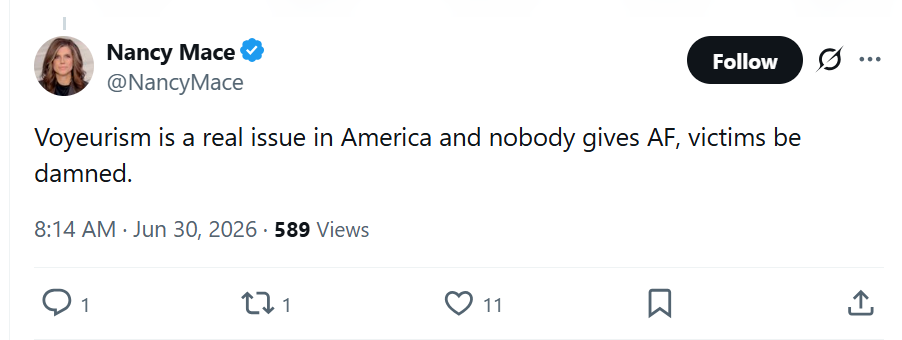
On June 30, 2026, Rep. Nancy Mace replied to an X thread about a Google Pixel phone "Audio Memory" feature and surveillance with a single line:
Voyeurism is a real issue in America and nobody gives AF, victims be damned.
Nancy Mace (@NancyMace) June 30, 2026
She is right that voyeurism is a real issue. That is exactly why one unresolved factual question in her own public record is newly relevant.
Mace made voyeurism part of her public argument
For more than a year, "voyeur" has been one of Mace's own words. On the House floor on February 10, 2025, she stood up a poster and directed the public to a congressional tip line:
"My office has a tip line that remains active for those who believe they may have been recorded, assaulted, or otherwise victimized by Patrick Bryant and any of his business partners. That number is (843) 212-7048."
At a House Oversight subcommittee hearing on May 20, 2025, she put a label on her ex-fiancé:
"This man is a rapist. He's a voyeur. He's a peeping tom. He deserves to be in jail."
And at a January 3, 2026 press conference promoting an "Aggravated Voyeurism Act," she argued the penalties were too low:
"Filming a rape, for example, under state law in South Carolina is basically the cost of a speeding ticket."
So when Mace posts that voyeurism is a real issue, she is not speaking in the abstract. She has built a public campaign on the claim that she and others were victims of it. That makes the next question fair, and narrow.
The hearing she titled "Surveillance in Private Spaces"
The single clearest test of what Mace means by voyeurism is a hearing she ran herself. On May 20, 2025, as chair of a House Oversight subcommittee, she convened a proceeding she titled "Breach of Trust: Surveillance in Private Spaces," and used it to display, on a poster at the dais, a black-and-white still she told the room showed her own body.
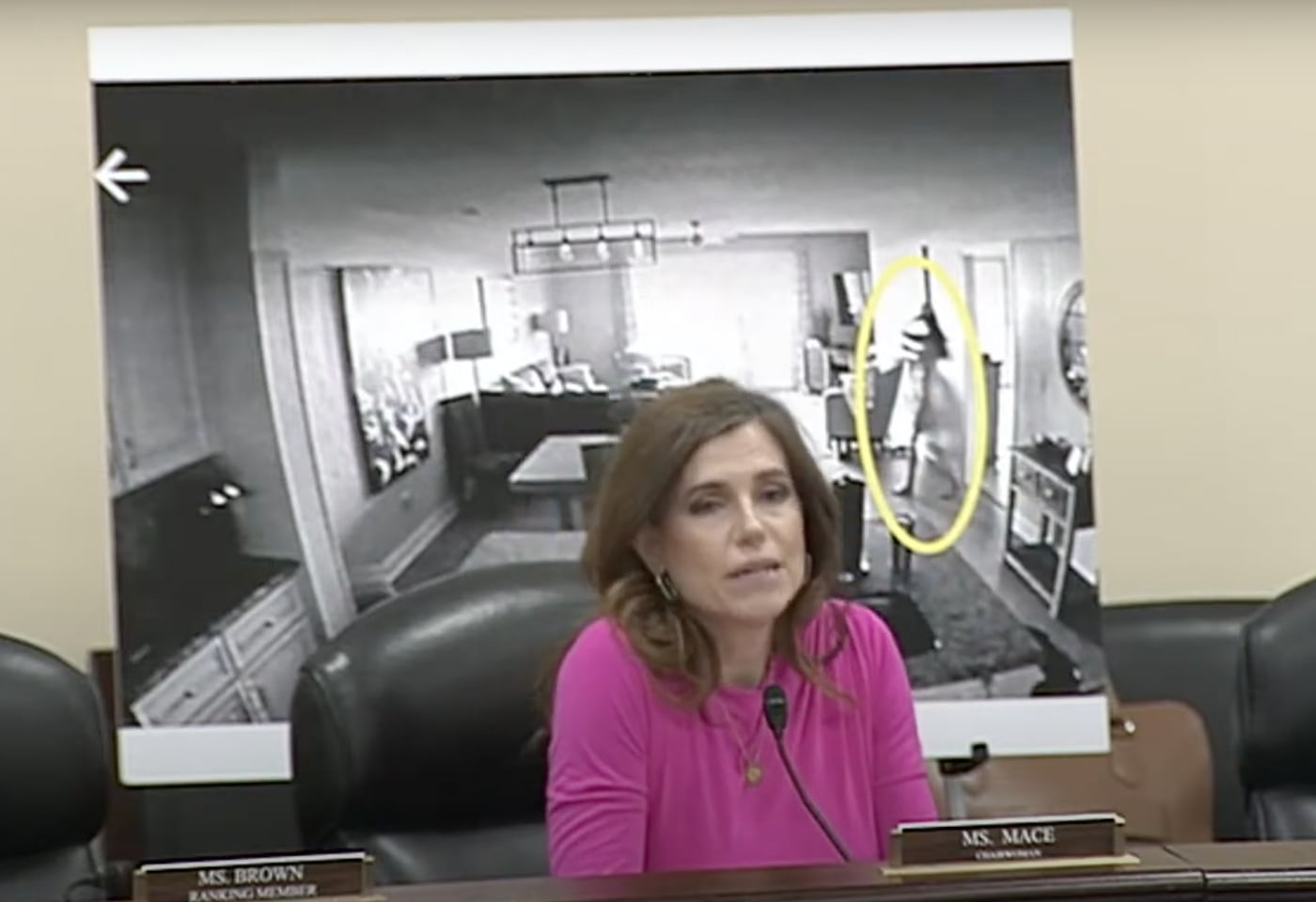
Mace at the hearing she chaired, beside the poster-sized still she displayed and said was her own "silhouette." The poster reads as an open, furnished common living area, with what appear to be a dining table, seating, and a doorway. Frame from the U.S. House Oversight Committee's official livestream. Watch the full hearing.
On the official congressional record, she narrated the image:
"I had an oversight about surveillance in private spaces, and that's my body. You can see the silhouette. It's, I mean, it's pretty tame. It's the silhouette. You can tell that it's me and my long hair and everything."
She told the subcommittee she had put other images on the same screen:
"I found evidence going back a decade of upskirt photos. And I showed some of those in this hearing."
And she described the footage as nonconsensual private-space surveillance, recorded:
"without their knowledge, without their permission, without their consent."
Two things about that hearing sit in tension with the word in its own title.
First, the title takes as given the very fact in dispute. The phrase "Surveillance in Private Spaces" reads as a presumption that the setting was a private space, with a reasonable expectation of privacy, captured by a concealed camera. That is the unresolved question, not a finding. The still Mace chose to put on the poster does not show a hidden nook. It reads as an open, furnished common living area, with what appear to be a dining table, seating, and a doorway. Whether that space was private and concealed, or open and visible to a public or shared area, is exactly what no court or investigator has decided.
Second, having titled the matter "Surveillance in Private Spaces" and called the images a nonconsensual privacy crime, Mace then put them on a poster and broadcast them, herself, to a global public audience on the committee's official livestream, where the video still sits today. She says the images should never have existed. She is also the one who chose to place them before that mass public audience. The full account of that moment is in the dispatch "That's my body. You can see the silhouette.".
Those are not gotchas. They are why the narrow question matters: before "voyeurism" is the right word, the public record has to establish that the place was private, that the recording was concealed, and that there was a reasonable expectation of privacy. Mace's hearing presupposed all three in how it was framed. It did not prove any of them.
The hidden-camera question
Voyeurism, as a legal matter, generally turns on privacy: concealment, secret recording, and a reasonable expectation of privacy in the place where it happened. A camera hidden to secretly record someone is the classic case.
That is a different factual claim from a camera placed in plain view in a room with open, visible windows facing a public or shared space. Both can produce a recording. Only one is what the word "voyeurism" usually means.
To the extent the images and video at the center of Mace's account involve her own body, the public record still has not resolved that basic distinction. Was the recording she describes made by a hidden camera, or was the camera in a room with open windows looking onto a public or shared area? On the public record, she has not clearly said.
On the other side of the ledger, the man she named has been explicit. The same day Mace testified, May 20, 2025, Patrick Bryant issued a public statement:
"I categorically deny the false and outrageous claims made by Nancy Mace. I have never raped anyone. I have never hidden cameras. I have never harmed any woman."
And in public trial testimony in Bowman v. Crosby on June 10, 2024, witness Melissa Britton described what she characterized as a mutual scene: "They both had their cameras out and they were pointing them." That is one fragment of a contested record, quoted and attributed to its speaker. It is not a finding about any specific footage, and Maceopedia draws no conclusion from it. But it bears on the open-versus-hidden distinction this dispatch is asking about.
Questions Mace has not clearly answered
- Was there a hidden camera?
- Where exactly was the camera positioned?
- Were the windows open or visible to a public or shared area?
- What in the public record distinguishes the recording as voyeurism rather than an open or exposed-view recording?
- Has any court, investigator, or filing actually made that factual finding?
The cases
This is not a side argument. Mace's voyeurism narrative is at the center of the litigation cluster: Patrick Bryant named her as a third-party defendant in Berg v. Bryant (2025-CP-10-03124), she removed that matter to federal court pro se, and a South Carolina State Law Enforcement Division (SLED) investigation is open. As of mid-2026, no court has made any finding on the merits of the underlying allegations.
Maceopedia is not resolving the underlying allegation here. The point is narrower: Mace has chosen to make voyeurism part of her public argument, so the public record should answer what she was actually describing.
The allegations referenced here are unproven, contested, and the subject of ongoing civil litigation and a SLED investigation. Mace denies Bryant's allegations and Bryant denies Mace's; Patrick Bryant has categorically denied her claims, no related criminal charges have been filed against him, and none of the underlying matters has been adjudicated. Nothing here is a finding of fact. See People in the Public Record.
Sources and related coverage
- Rep. Nancy Mace, X post, June 30, 2026
- Full hearing video, U.S. House Oversight Committee, "Breach of Trust: Surveillance in Private Spaces" (May 20, 2025)
- Maceopedia, "That's my body. You can see the silhouette." (the hearing, in full)
- Maceopedia, the hearing in the media catalog: "Breach of Trust: Surveillance in Private Spaces"
- Maceopedia, "Patrick Bryant: 'I categorically deny the false and outrageous claims made by Nancy Mace'"
- Maceopedia, "While the gag order holds, Mace proposes Aggravated Voyeurism Act"
- Maceopedia, "In an X thread, Mace says the amount should be higher"
- Maceopedia, On her first recorded call with Ali Berg
- Patrick Bryant in the Public Record
Read next
 June 28, 2026 · Dispatch
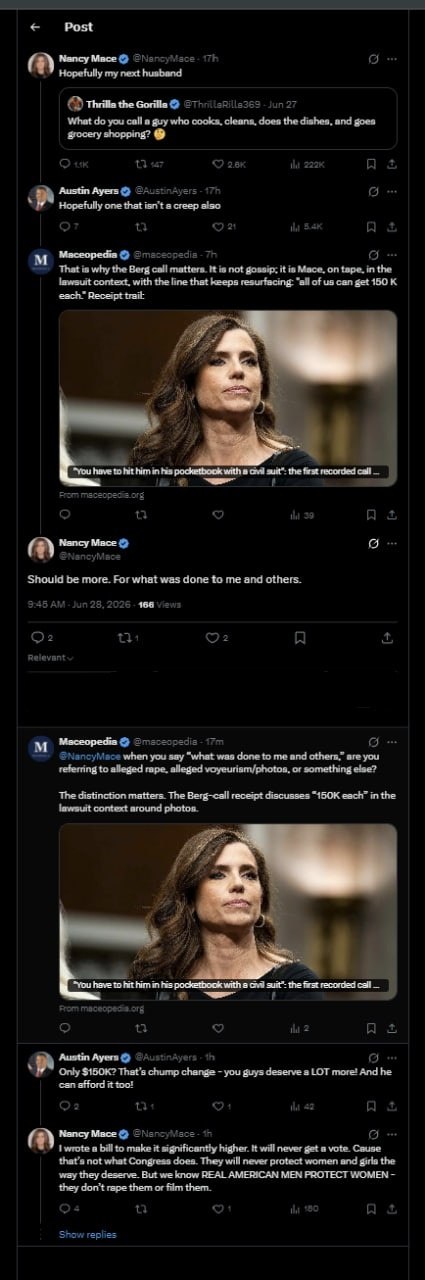
In an X thread, Mace says the amount should be higher. The public-record receipt says the earlier number was tied to photos.
After Maceopedia resurfaced the Berg-call line about '150K each,' Rep. Nancy Mace replied that the amount 'should be more' and connected the thread to 'what was done to me and others.' The public-record receipt matters because the recorded call discusses a civil lawsuit, photos, and money, not an adjudicated criminal finding.
 May 20, 2025 · Dispatch
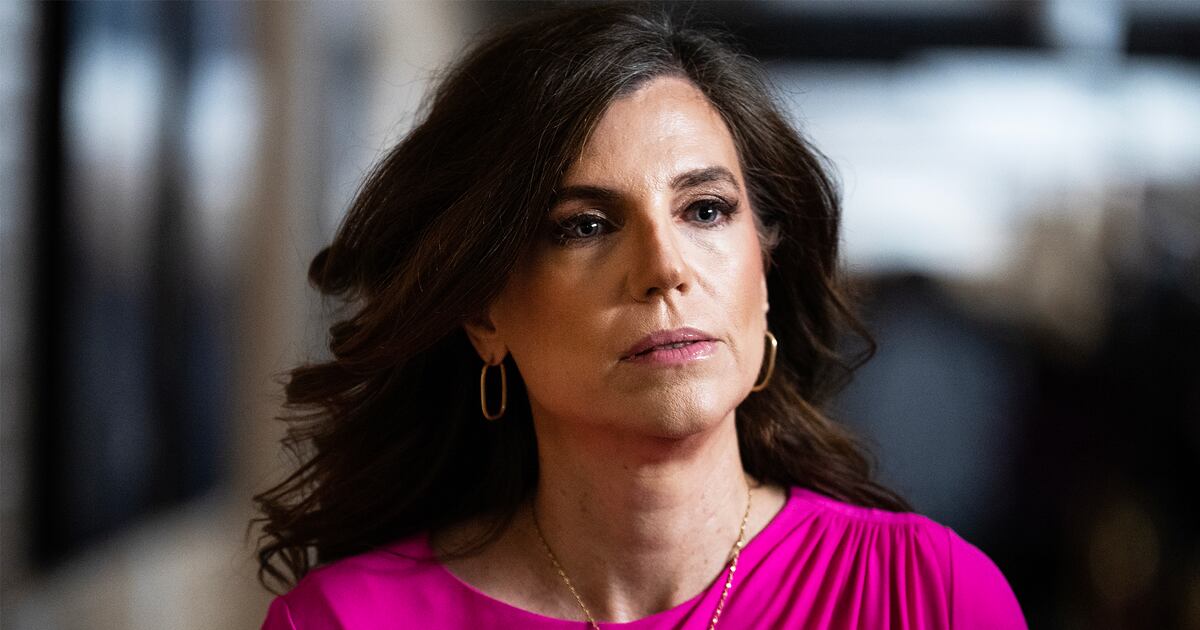
At her own surveillance hearing, Mace displays a 'naked silhouette' of herself: 'That's my body. You can see the silhouette.'
Chairing a House Oversight subcommittee hearing she titled 'Breach of Trust: Surveillance in Private Spaces,' Rep. Nancy Mace held up a poster-sized image she said depicted her own body, told the room it had been captured by hidden surveillance without her consent, and said no one had been arrested. She tied the image to her ex-fiancé, Patrick Bryant, who categorically denies her allegations; the matter is contested and in ongoing litigation.
 June 30, 2026 · Dispatch
You don't know anything about MKUltra, which is the purpose of this hearing.
At a June 30, 2026 House Oversight hearing convened specifically to examine the CIA's MKUltra program, Rep. Nancy Mace spent roughly the first two of her five allotted minutes questioning the hearing's non-MKUltra witness about Anthony Fauci, COVID-19 origins, and vaccine side effects. When the witness told her, eight separate times, that the subject was outside her expertise, Mace told her: 'You don't know anything about MKUltra, which is the purpose of this hearing.' Only then, with most of her time gone, did she turn to the witnesses who were actually there to discuss MKUltra.
 June 19, 2026 · Dispatch
Remember when Nancy Mace read a CNN guest's "kissy emoji" text into the congressional record?
A look back. On September 19, 2024, Rep. Nancy Mace used part of a House Oversight Committee hearing to enter into the official record a screenshot of a text she said Vanderbilt professor Michael Eric Dyson sent her after they clashed on CNN: "Shh don't tell anybody. We look good together," with a kissy emoji. Dyson denied hitting on her, said it was a joke, and called Mace "a bigot and racist." The clip is circulating again. In her own words and his, readers can judge.
 June 7, 2026 · Dispatch
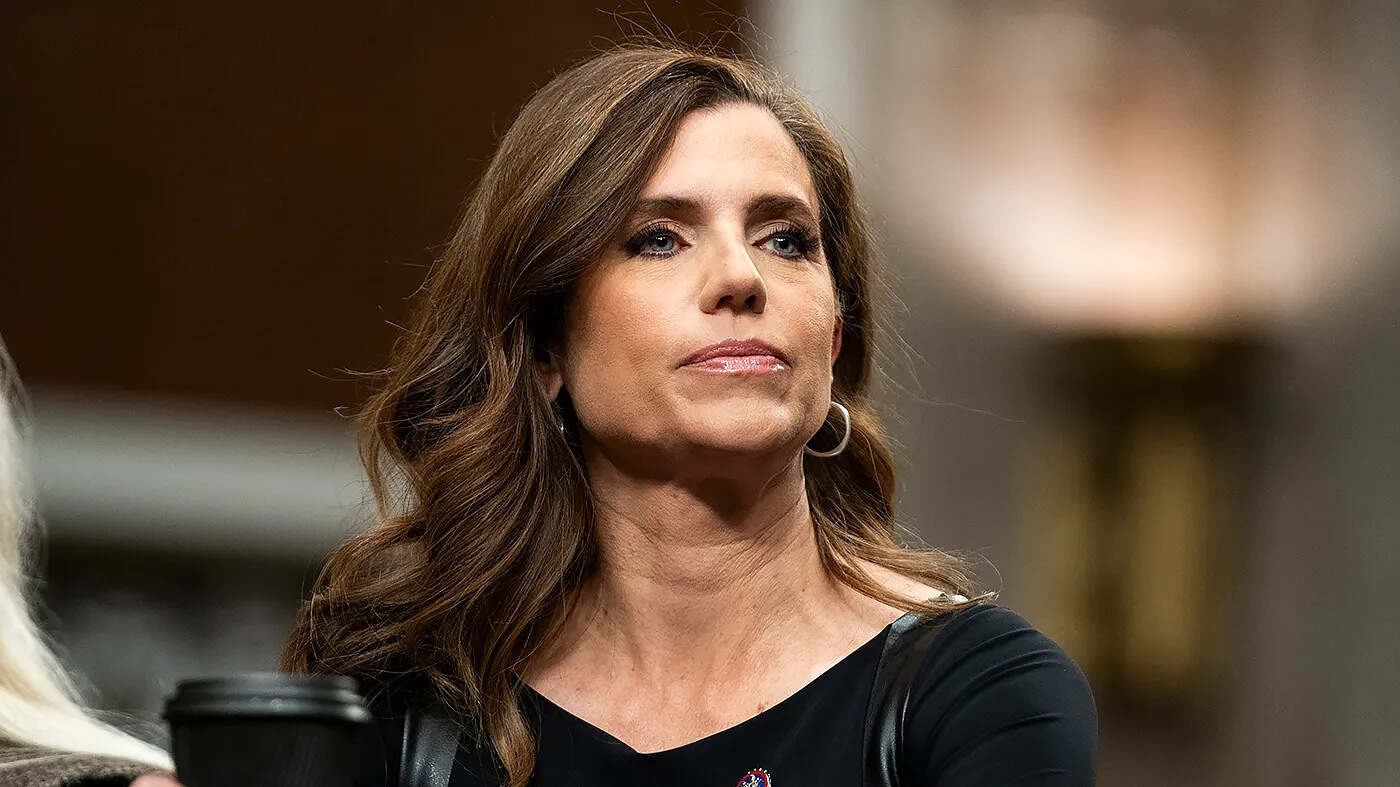
On her first recorded call with Ali Berg, Mace lays out a civil suit against Patrick Bryant: 'He can sell a building or two, settle, be done' and accusers 'can get 150 K each'
FITSNews published the full audio of Nancy Mace's first recorded phone call with Ali Berg. Across 44 minutes Mace asks the call stay 'private,' spends little time on the alleged assault or the man she names as the assailant, never offers a victim advocate or a referral to law enforcement, and instead pitches a civil lawsuit against her ex-fiancé Patrick Bryant, predicting he will 'sell a building or two, settle,' and that accusers could 'get 150 K each.'
- June 7, 2026 · Dispatch
"You have to hit him in his pocketbook with a civil suit": the first recorded call with Ali Berg, in her own words
A produced supercut of Rep. Nancy Mace's first recorded phone call with Ali Berg (April 6, 2024), published by FITSNews on June 7, 2026, after the recording was produced in ADW v. Berg. Across 44 minutes Mace pitched a civil lawsuit and a payout, never mentioned the police, and never offered Berg a victim advocate or counselor.