Part of: Mace Federal Removal (Berg v. Bryant → D.S.C.) · Berg v. Bryant (and Bryant's Third-Party Complaint against Mace) · Assignment Desk Works, LLC v. Alexis Berg · Musgrave v. Mace (2:25-cv-01823-RMG) · Nancy Mace's Gag Order Violations · 2026 Governor Campaign · Litigation Overview & Court-Filing Index
While the gag order holds, Mace proposes Aggravated Voyeurism Act and ties it to her 'personal experiences' as a victim
On January 3, 2026, with the Berg v. Bryant gag order in effect, Rep. Nancy Mace announced the Aggravated Voyeurism Act at the South Carolina statehouse and publicly tied it to her 'personal experiences' as a self-described victim of voyeurism. The announcement was not cited in the contempt motion filed January 12, 2026; it is presented here as a public statement made during the order's effective period. Mace disputes the validity and scope of the gag order.

On November 26, 2025, Judge Donald B. Hocker of the Charleston County Court of Common Pleas, Ninth Judicial Circuit, entered a sua sponte gag order in Berg v. Bryant, Case No. 2025-CP-10-03124. The order barred all parties and their agents and attorneys from "Making or publishing any comment about any aspect of this case … via oral, written, social media, text or any other forms of communication" and from commenting about "any party or attorney to this case or anyone connected to this case."
The order remained in effect as of January 3, 2026.
The January 3 announcement
On January 3, 2026, Mace appeared at the South Carolina statehouse to announce the Aggravated Voyeurism Act, a state-level proposal that would substantially stiffen penalties for recording sexual-assault victims without consent. Her press release, issued through her official website, framed the legislation in terms of her own experiences as a victim.
According to ABC News 4 / WCIV coverage of the event, Mace stated:
"Imagine surviving a sexual assault, only to learn someone filmed it. Under current law, the person who created a permanent record of your assault could walk away with a fine less than a speeding ticket. South Carolina law is sometimes absurd."
And:
"Recording this kind of crime isn't a footnote. It's an awful and invasive crime that does serious long-term damage to its victims. A recording can be distributed, held over a victim's head for years, used for extortion, or live on the internet forever. South Carolina law should treat it like the serious violation of someone's life, that it is."
The proposal, as reported by ABC News 4, would increase first-offense fines from $500 to $5,000, mandate jail time, and establish aggravated voyeurism as a felony carrying five to ten years imprisonment when victims are minors, incapacitated, or experiencing another crime at the time of the recording, or when the offender holds a position of authority. It would also require restitution for therapy and damages, with sentences running consecutively rather than concurrently.
Context: overlapping subject matter
The underlying litigation in Berg v. Bryant centers in part on allegations, disputed by Mace, involving recordings, privacy violations, and related claims that Mace has publicly characterized in terms of her own victimization. At the same time as announcing the Aggravated Voyeurism Act, Mace publicly described herself as a victim of the type of conduct the bill targets.
The gag order's prohibition on commenting "about any aspect of this case … or anyone connected to this case" encompasses parties and persons involved in the Berg v. Bryant matter. Whether and to what degree the January 3 announcement touched on matters within the order's scope is a contested legal question. This dispatch does not assert that the announcement violated the gag order. It is presented as a public statement made during the order's effective period, bearing factual overlap with the subject matter of the underlying case.
The January 3 announcement was not cited or attached as an exhibit in the contempt motion filed January 12, 2026, and was not part of the court's consideration in that proceeding.
Mace's position
Mace has disputed the validity and enforceability of the gag order. In a January 21, 2026 letter to Judge Hocker, filed on the state docket and attached to her federal removal filings, she wrote that the order is "overly broad, unconstitutional, and unenforceable, particularly as applied to a sitting member of the U.S. Congress and leading candidate for Governor of South Carolina." She simultaneously moved the contempt proceeding to the U.S. District Court for the District of South Carolina and declared: "I will not be SILENCED." The full letter is reproduced in the dispatch "Kangaroo Court … I will not be SILENCED".
The underlying dispute is the subject of ongoing civil litigation in Berg v. Bryant (Case No. 2025-CP-10-03124) and related actions, and a separate South Carolina State Law Enforcement Division (SLED) investigation. All allegations in the case remain unproven and contested. Mace denies Bryant's claims and contests the validity of the gag order; Bryant and Bowman deny Mace's allegations; no underlying matter has been adjudicated. The gag order's constitutionality is itself disputed and has not been ruled upon. Nothing here is a finding of fact. For background on the parties see People in the Public Record.
Sources & related coverage:
- Mace press release: Nancy Mace Proposes Voyeurism Law to SC, nancymace.org, January 3, 2026.
- ABC News 4 / WCIV: Nancy Mace's proposed Aggravated Voyeurism Act targets harsher penalties for offenders, published January 4, 2026.
- WTMA: Mace proposes Aggravated Voyeurism Act, targets harsher penalties for offenders, January 4, 2026.
- The Post and Courier: Nancy Mace pushes hearing video, privacy bills in SC, background on Mace's broader voyeurism-legislation push.
- The gag order: Gag Order, Nov. 26, 2025 (PDF), Judge Donald B. Hocker, Berg v. Bryant, No. 2025-CP-10-03124.
- Case hub: Berg v. Bryant, court filings
- Topic overview: The Gag Order · The Litigation
- Mace's response: "Kangaroo Court … I will not be SILENCED" (Jan. 21, 2026)
- SC Judicial Branch Public Index, Case No. 2025-CP-10-03124 (Charleston County).
Read next
 June 9, 2026 · Dispatch
Under a gag order barring 'any comment about any aspect of this case,' Mace uses her televised concession speech to talk about 'predators that got away in my case'
On the night of June 9, 2026, after conceding the South Carolina Republican gubernatorial primary, Nancy Mace told her Charleston election-night crowd, and a live television audience, that she had talked to Attorney General Alan Wilson 'about my case' and would help his administration ensure that 'predators that got away in my case … we finally put criminals behind bars.' Mace is a third-party defendant in Berg v. Bryant, where a November 26, 2025 gag order bars every party from 'making or publishing any comment about any aspect of this case' or about any party or person connected to it, and a January 12, 2026 civil-contempt motion over her earlier public statements remains pending. Both orders are reproduced in full below. Mace contends the gag order is unconstitutional; all underlying allegations are unproven and contested, and no court has ruled on the June 9 remarks.
 July 20, 2026 · Dispatch
"The one I'm already in": Mace's Senate withdrawal was a statement about the case, made under a gag order that has never been lifted
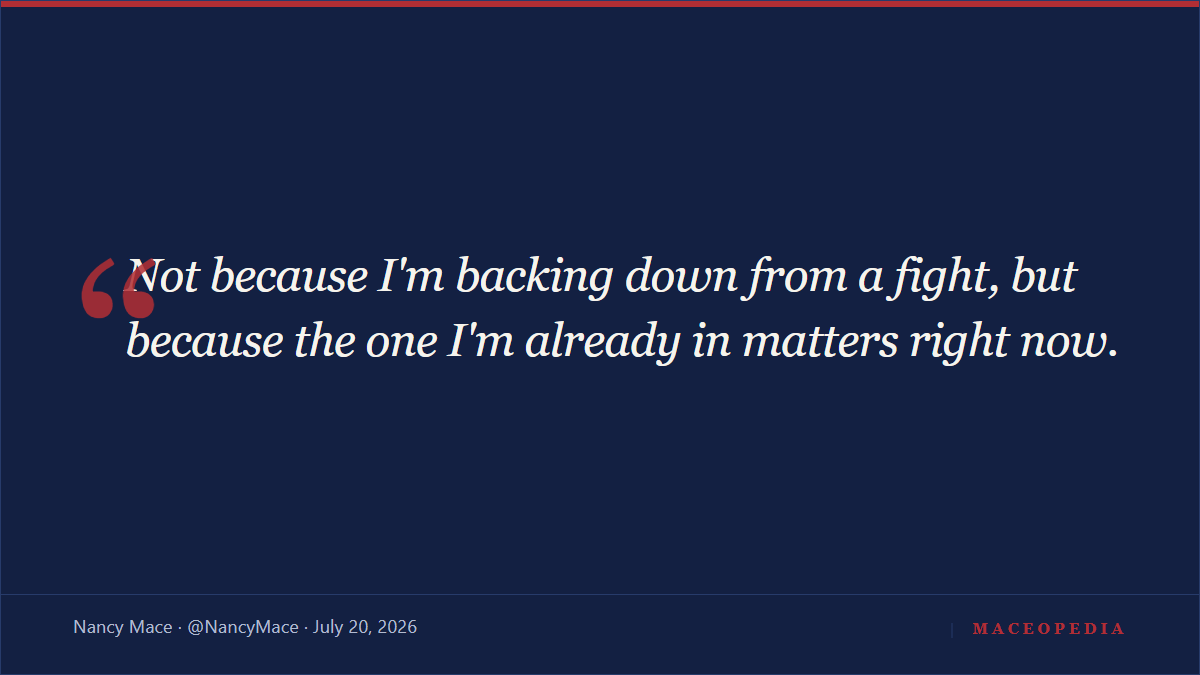
Rep. Nancy Mace's July 20, 2026 announcement that she will not run for the Senate was, in both the video and the written statement, an announcement about litigation. She said she was leaving the race 'not because I'm backing down from a fight, but because the one I'm already in matters right now,' told supporters she has 'unfinished business,' and dated that business to the day she 'stood on that House floor.' That was February 10, 2025, when she named four men and told them they had 'bought yourself a one-way ticket to hell.' Three of those men are parties to Berg v. Bryant, where a gag order barring comment on the case was extended indefinitely in December 2025 and, on the documentary record, has never been vacated, dissolved, or found expired. It has also never been enforced. Mace contends it is unconstitutional.
 January 21, 2026 · Dispatch
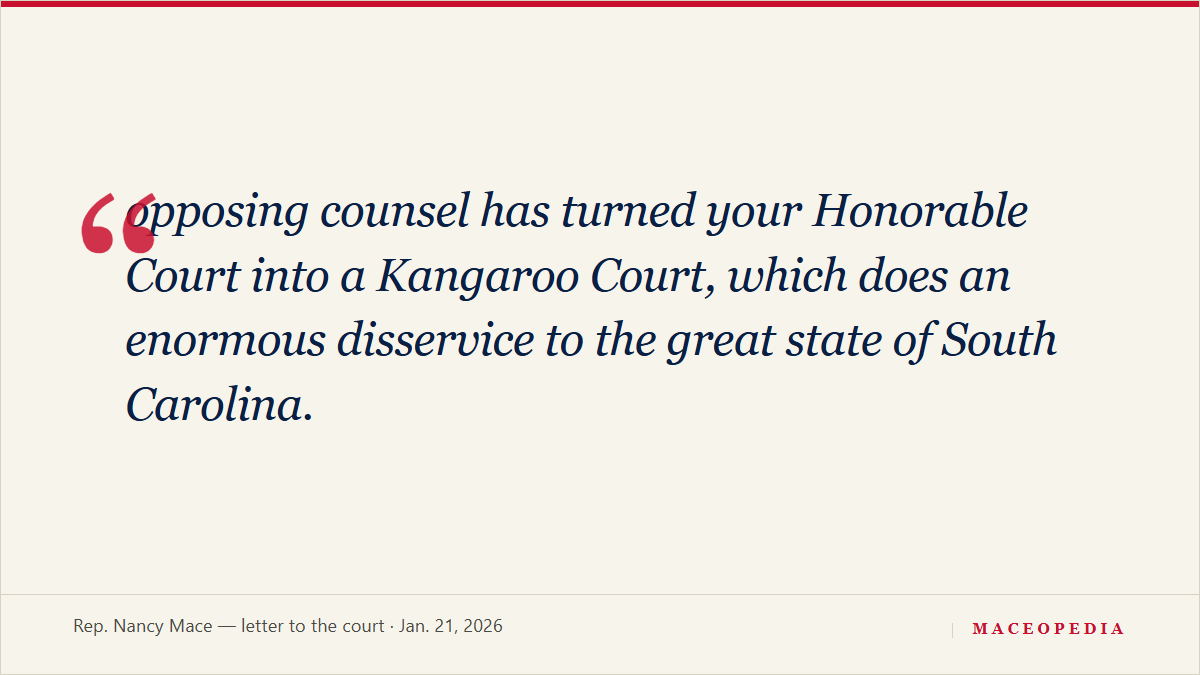
In a letter to the judge overseeing her gag order, Mace calls the court a 'Kangaroo Court' and moves the contempt matter to federal court: 'I will not be SILENCED.'
On January 21, 2026, Rep. Nancy Mace wrote directly to Judge Donald B. Hocker, the Charleston County circuit judge presiding over Berg v. Bryant, the case in which she is a third-party defendant under a gag order, calling the court a 'Kangaroo Court,' declaring the gag order unconstitutional, and announcing she was removing the contempt proceeding against her to federal court. Mace wrote the letter pro se, after she says she had discharged her counsel; it was stamped FILED on the state docket January 22, 2026. The full five-page filing is reproduced below. The allegations underlying the litigation are disputed and contested; Mace denies Bryant's claims, and Bryant denies Mace's.
 January 11, 2026 · Dispatch
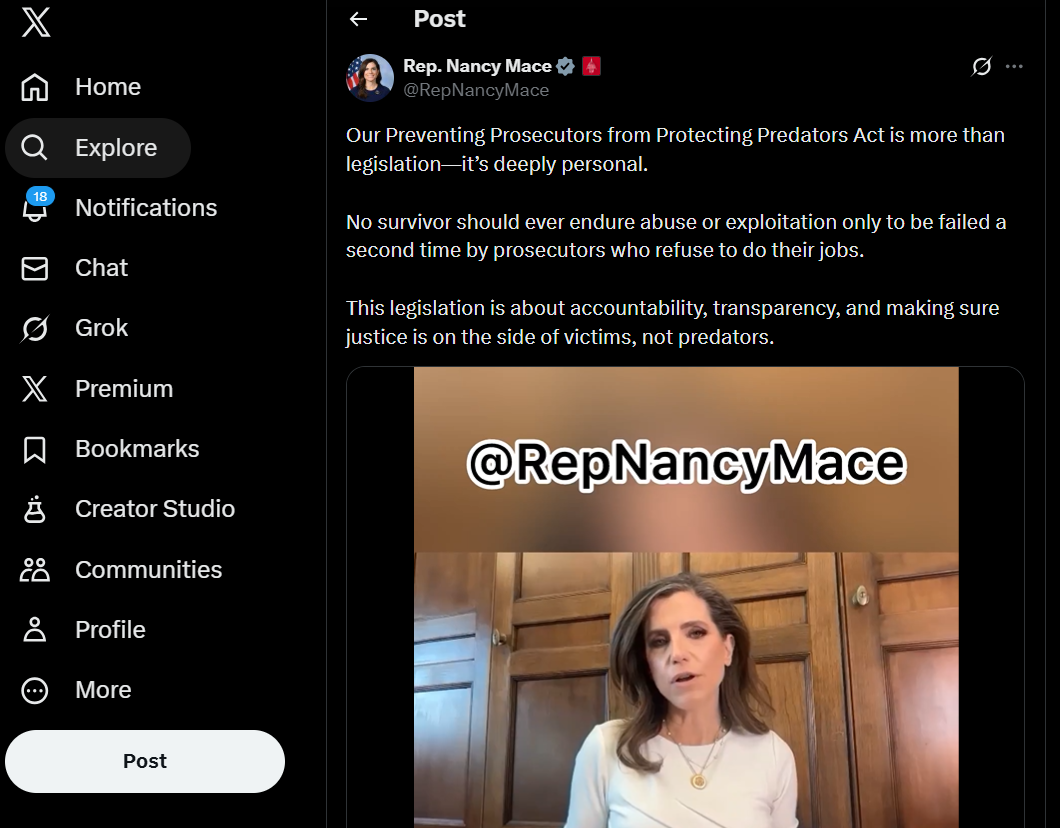
While the gag order holds, Mace promotes her 'Predators Act' as 'deeply personal'
On January 11, 2026, with the Berg v. Bryant gag order in effect and days before the court's supplemental order, Mace promoted her 'Preventing Prosecutors from Protecting Predators Act' from her verified @RepNancyMace account, calling it 'deeply personal' and tying it to 'trauma' she says she experienced 'two years ago.' Opposing counsel flagged the post as a continued public statement about matters connected to the case.
 September 4, 2026 · Dispatch
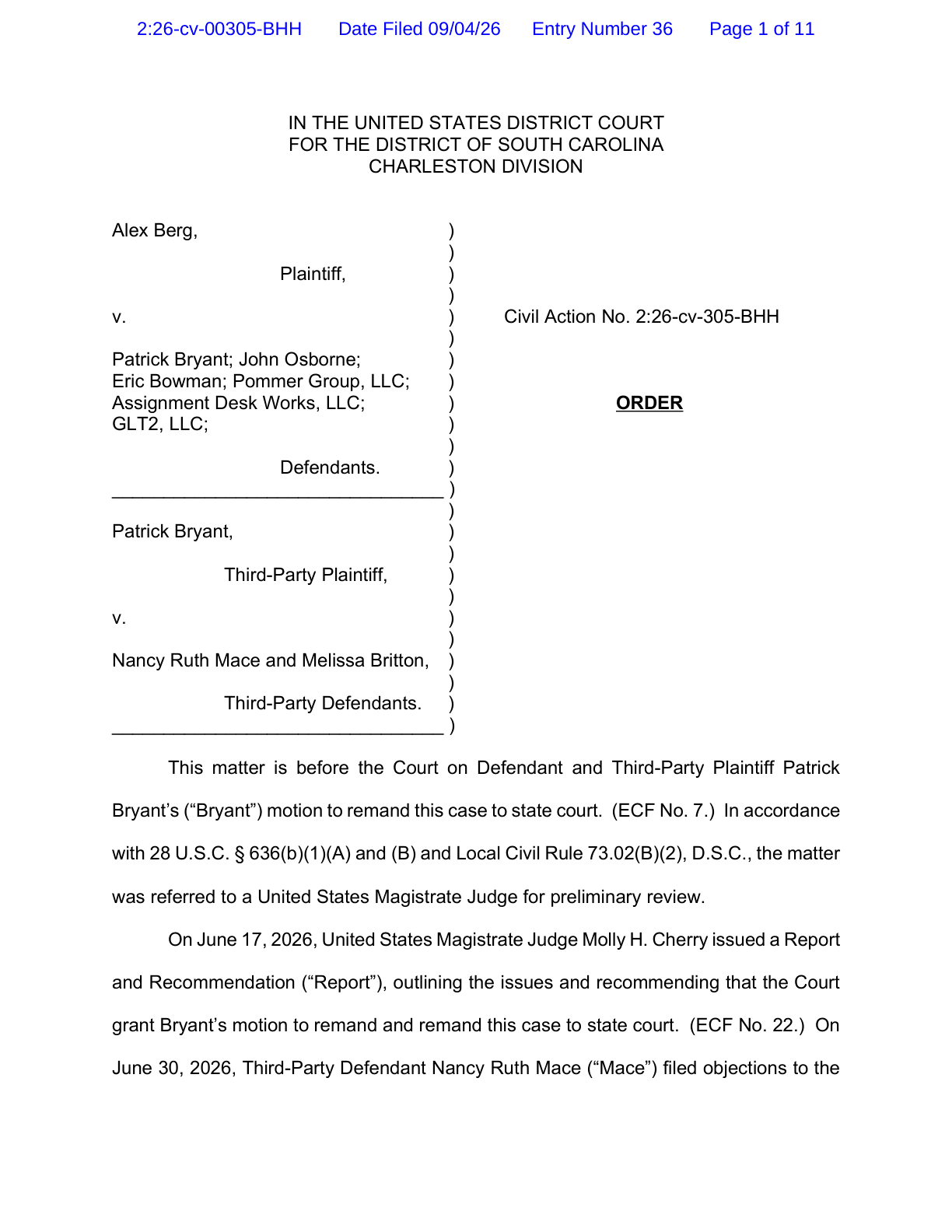
Nancy Mace loses in federal court: Bryant's suit accusing her of defamation and a blackmail conspiracy moves forward
Nancy Mace has lost in federal court. On September 4, 2026, U.S. District Judge Bruce H. Hendricks rejected her pro se bid to move the case out of state court, ruling her removal untimely 'by several measures,' and remanded Berg v. Bryant to the Charleston County Court of Common Pleas. That sends Patrick Bryant's third-party case against Mace forward in state court, a case that accuses her of defamation and of a civil conspiracy to hack his phone and blackmail him into signing over property. The Court affirmed the magistrate judge's recommendation with modifications, overruled Mace's objections, denied her motion for oral argument, and terminated her duplicate federal case as moot. The ruling is procedural: it does not reach the merits, and Mace's immunity defenses travel with the case. The order (ECF No. 36) is reproduced below. The allegations are disputed and unproven; Mace denies Bryant's claims, and Bryant denies Mace's.
 December 31, 2025 · Dispatch
A pinned post viewed 20,000+ times: Mace calls South Carolina a 'pedophile paradise' while the gag order is in effect
On December 31, 2025, from her verified @RepNancyMace account, Mace published and pinned a post attacking the South Carolina Attorney General, calling the state a 'pedophile paradise' at a time when a gag order in Berg v. Bryant was in effect. The post reportedly re-shared content from her December 27, 2025 video. A contempt motion filed January 12, 2026 attaches it as Exhibit 9 and notes the post had been viewed more than 20,000 times. Mace disputes the validity of the gag order and its application to her.