Part of: Abortion & Reproductive Rights
In Her Own Words: The High-School Rumors in Mace's Memoir, and the Rape She Revealed Years Later
Maceopedia ·

Nancy Mace has told the story of her teenage years twice, in two very different registers, and both versions are her own.
The first she published in 2001, in her memoir In the Company of Men: A Woman at The Citadel (Simon & Schuster, with co-author Mary Jane Ross). Written when she was in her early twenties, it describes a high school swallowed by false rumors and cruelty, a collapse she attributes to gossip, grief, and an undiagnosed learning disability. It does not mention a rape.
The second she began telling publicly in 2019, from the floor of the South Carolina House and then, repeatedly, on national television: that she was raped at 16 by a friend and classmate, that she kept it secret for decades, and that only her mother and her best friend knew at the time.
This dispatch lays out both accounts, side by side, drawn entirely from Mace's own published words and her own public statements. It names no one. It asserts no fact beyond what Mace herself has stated.
What the memoir says
In the opening chapter of In the Company of Men, Mace describes a miserable adolescence as an Army kid who moved constantly and never fit in. By her sophomore year of high school, she writes, her parents sent her to live with her older sister, Beth Ann, in Florida:
"By my sophomore year, I was so miserable that my parents sent me to Florida, to stay with my older sister, Beth Ann, for a while. For several months, I baby-sat my nieces and nephews and worked as a lifeguard at the local beach, entering several lifeguarding competitions as well. When summer ended, I returned to my parents' house and my old high school, hoping that this time things would go better there. Instead, everything just got worse."
According to the memoir, it was that months-long absence, and nothing else, that set off the rumor mill when she came home:
"Because I had been gone for several months, gossip began to circulate that I'd been pregnant and gone away to have the baby. The rumors grew and grew, and some of the guys at school started treating me like the town slut. I began getting nasty prank calls at home, and when I walked down the hallways at school, some of the football players would purposely bump into me or press me up against the walls and make lewd comments."
Mace is emphatic in the book that the rumors were false. She describes them multiplying past the point of anyone caring whether they were true:
"Soon other rumors followed: I was a drug addict, I'd had an abortion for a second pregnancy, and on and on. It never seemed to stop. Worst of all, nobody even seemed to care if what they said was true."
The memoir then describes the bottom falling out. After a friend was killed by a drunk driver during her junior year, she writes, she fell into a depression severe enough to require medication:
"I sank into a depression so deep that I required antidepressants just to get through the days. I had hit rock bottom. I no longer cared whether I lived or died, and that terrified me."
In the book's telling, the way out was a diagnosis of attention deficit disorder, being pulled from school and home-schooled, community-college classes at Trident Tech, and, eventually, The Citadel. The memoir frames her recovery as a triumph of persistence over gossip, grief, and a learning disability.
What the memoir does not say
Nowhere in In the Company of Men does Mace mention a rape or a sexual assault. The book attributes the breakdown of her high-school years to the false pregnancy rumors, the death of her friend, and her undiagnosed ADD. Written in 2001, it is the account of that period she chose to make public at the time.
That silence is not a small detail. It is the entire reason her later disclosures were, for many readers, so startling: the woman who had already written a whole book about how hard those years were had left out the hardest part.
What Mace revealed years later
Mace first spoke publicly about being a rape survivor on April 24, 2019, during the South Carolina House debate over a "fetal heartbeat" abortion bill, while arguing for exceptions in cases of rape and incest. As the Associated Press reported, she told her colleagues:
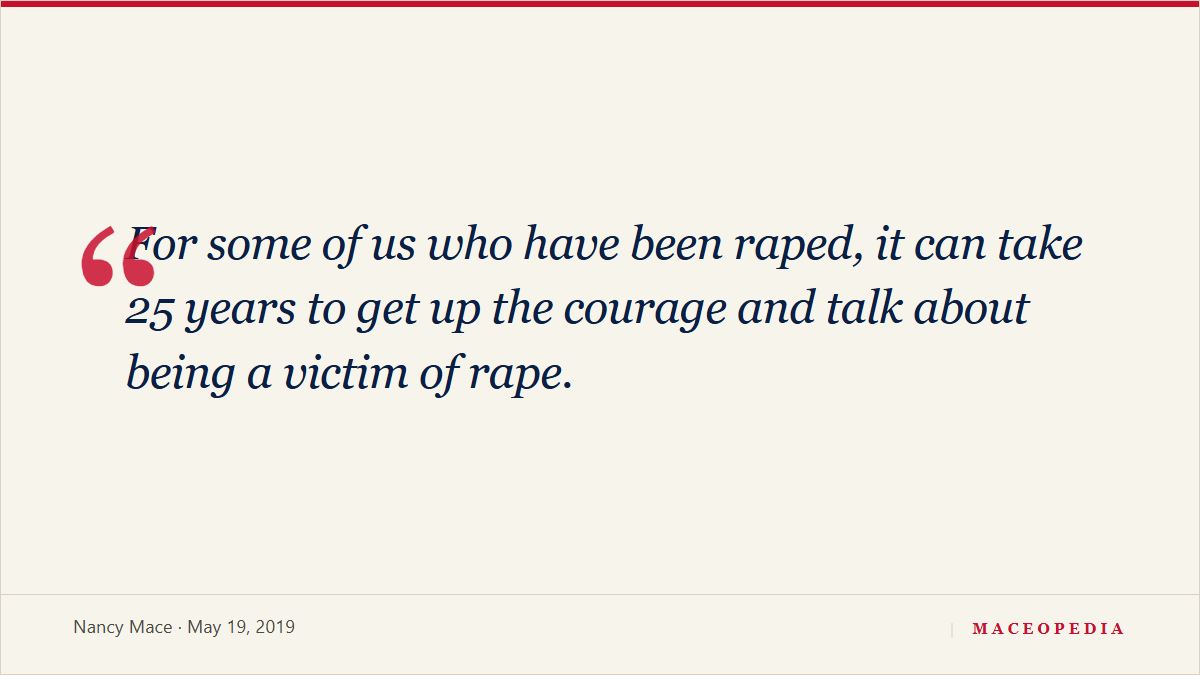
"For some of us who have been raped, it can take 25 years to get up the courage and talk about being a victim of rape. My mother and my best friend in high school were the only two people who knew."
In the days after, she gave The Post and Courier the fullest account of what had happened. The paper reported that Mace was 16 when she was raped by "a friend and classmate," that she told only her mother and her best friend, and that she never went to the police because she was "afraid and ashamed about what people would think." She dropped out of high school at 17. She would not speak of it publicly for another two decades. In her own words to the paper:
"It took me a long time to say that it wasn't my fault. That I didn't cause it. That it happened."
"I was not the strong, resilient little girl that my parents knew and loved. I was completely different."
"No woman chooses to or asks to be raped."
The Post and Courier also reported that Mace said she had been sexually assaulted a second time, at 14.
Mace has connected the assault directly to the collapse of her schooling that the memoir had described in other terms. As she later told Politico's Michael Kruse:
"When I was raped, I quit. I quit school."
"When you're a rape survivor, it's not like you get over it in a week or a year, it's lifelong trauma that you have to deal with."
Since 2019, Mace has repeated the disclosure many times, usually while staking out a policy position. On CBS's Face the Nation on May 8, 2022, weeks before Roe v. Wade fell, she said:
"I am pro-life, but I do support exceptions for rape. I'm a rape victim myself."
On ABC's This Week on March 10, 2024, pressed by George Stephanopoulos about endorsing Donald Trump after he was found civilly liable for sexual abuse, she said:
"I'm not going to sit here on your show and be asked a question meant to shame me about another potential rape victim. I'm not going to do that. I live with shame."
And on November 19, 2024, defending a House resolution restricting transgender members' restroom access, she invoked the same history:
"I'm a victim of abuse myself. I'm a rape survivor. I have PTSD from the abuse I've suffered at the hands of a man."
How the two accounts sit together
Both stories are anchored to the same stretch of Mace's life: the high-school years in the late 1990s that ended with her leaving school, entering Trident Tech, and remaking herself at The Citadel. The memoir explains that departure as the product of false rumors, a friend's death, and ADD. Her later public statements add a cause the book never named: a rape at 16 that, she says, is why she "quit school."
Mace has never publicly said that the pregnancy rumors described in her memoir were connected to the assault, and this dispatch does not suggest they were. The rumors, by her own consistent account, were false, and she has denied them for a quarter-century. The assault is a separate fact that she disclosed on her own terms, years later. What the record shows is simply this: two of Mace's own tellings of the same period, one written before she was ready to name what had happened, and one delivered after.
A note on sourcing and scope
Everything above is quoted verbatim from Mace's own memoir or from her own public statements as reported by the linked outlets. The person she has described as her attacker is not named by Mace in any of these accounts and is not named here. The "pregnancy" rumors are reproduced only as the false rumors Mace herself has always said they were. This entry concerns the teenage assault Mace has discussed publicly since 2019; it takes no position on, and does not address, any other allegation.
If you or someone you know needs help, the National Sexual Assault Hotline is available 24/7 at 1-800-656-4673 (RAINN).
Read next
- August 30, 2026 · Dispatch
The Record: What Nancy Mace Has Said About Being Sexually Assaulted, Whom She Told, and What Reached Authorities
 March 10, 2024 · Dispatch
Mace to Stephanopoulos: 'I live with shame'
On March 10, 2024, Mace pushed back at George Stephanopoulos on ABC's This Week after he pressed her on endorsing Trump given her public history as a rape survivor.
 April 24, 2019 · Dispatch
Mace's first public disclosure: 'It can take 25 years to get up the courage'
On April 24, 2019, during the South Carolina abortion-bill debate, Mace made her first public disclosure of being a rape survivor, describing how long she had kept the experience private.
 October 17, 2026 · Dispatch
Everything Nancy Mace Has Said About Ilhan Omar
Rep. Nancy Mace has posted about Rep. Ilhan Omar more than 200 times. This documentary puts what she has said in order, in her own voice and her own posts, with Omar's answers: her 2021 defense of Omar, the 2025 one-way ticket posts, the video she recorded at Omar's office door, the censure resolution the House tabled 214 to 213, the subpoena motion the Oversight Committee tabled, and what she said on her own show the night federal agents searched Omar's home. Omar married Ahmed Nur Said Elmi in 2009; no public record shows he is her brother, and Omar denies it. Omar has not been charged with a crime.
 October 17, 2026 · Dispatch
Everything Nancy Mace Has Said About Muslims
Rep. Nancy Mace has spoken about Muslims and Islam on television, on X and on her own show since 2021. This documentary puts it in order, in her own voice: her 2021 words that there was no room in either party for Islamophobia, the 2025 bills, the Ramadan interview on Newsmax, the summer 2026 posts, the CNN interview with Omar Jimenez on Aug. 9, 2026, her show, the debate with Mehdi Hasan on Piers Morgan Uncensored, and her Sept. 21 comments. She says she means radical Islam and elected officials, and that she does not hate all Muslims. Her defenses appear in full, beside the fact checks.
 October 15, 2026 · Dispatch
How the Epstein Files Ended Her Political Career
Rep. Nancy Mace says the Epstein files cost her a political career. She said it on NewsNation on July 13, 2026, in an interview with Tara Palmeri published August 30, and on Jubilee on September 6. This documentary sets that account beside the record: the 2025 discharge petition she signed, her walkout from the September 2, 2025 meeting with survivors and her post about it, the president's posts, the 427 to 1 vote, her praise of the president in 2026, the May 29 endorsement of a rival, her fifth place finish in the June 9 primary, and what she said after. The president's endorsement post names neither Mace nor the Epstein files. The link between the two is her account.