Part of: Mace Federal Removal (Berg v. Bryant → D.S.C.) · Berg v. Bryant (and Bryant's Third-Party Complaint against Mace) · Musgrave v. Mace (2:25-cv-01823-RMG) · Litigation Overview & Court-Filing Index
Can Nancy Mace Make a Living Off Her New Podcast?
A current staffer says Nancy Mace is auditioning for a media career to 'pay the bills' after she leaves Congress in January 2027. So Maceopedia ran the numbers on the video she posted August 11, and on the operation around it. The video even opens like a YouTuber's channel: a 'GET MACED' logo bumper, a beach-and-poolside swimsuit montage, and a spoken 'hit the subscribe button' pitch, all before a word of politics. The same clip drew about 153,000 views on X and about 15,000 on YouTube, a ten-to-one gap that shows how much of her reach is rented from the platform and the office rather than owned. Former staffers have also alleged, in reporting Mace denies, that some of her online support was manufactured through staff-run burner accounts. Her personal channel has 22,300 subscribers; her official House channel's recent videos draw 130 to 1,400 views apiece. Measured against the political podcasters who actually earn a living, the picture is the streaming economy's brutal power law: a handful of stars capture nearly everything, and everyone else earns close to nothing. At her demonstrated scale, the direct economics of 'this type of podcast' land around a low-six-figure business at best, roughly her current $174,000 congressional salary or less, and that is before the reach she is renting expires with the seat. On top of the math sits a legal problem: the defamation defense keeping her afloat right now depends entirely on her holding federal office.
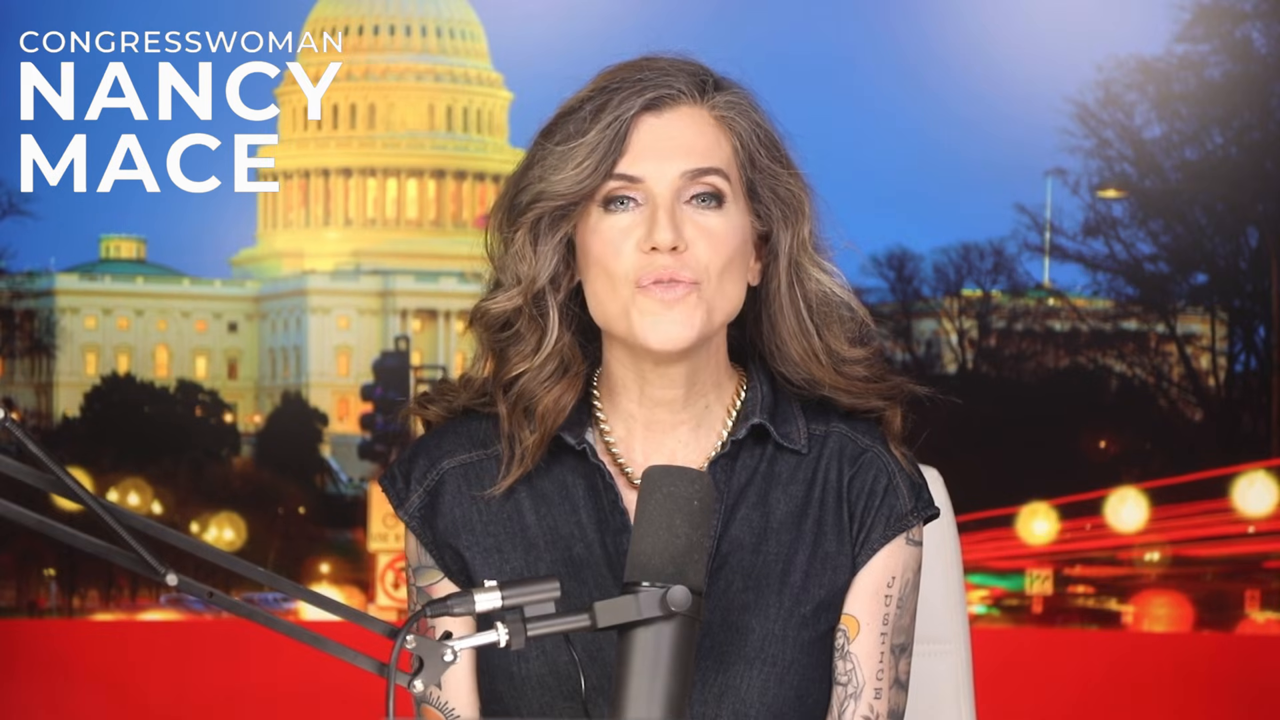
A current member of Nancy Mace's staff told Maceopedia last week that the run of studio videos she has been posting is a deliberate audition for a media career after she leaves Congress in January 2027. In the staffer's words: "She thinks that's how she could pay the bills."
So we did what the plan invites. We ran the numbers.
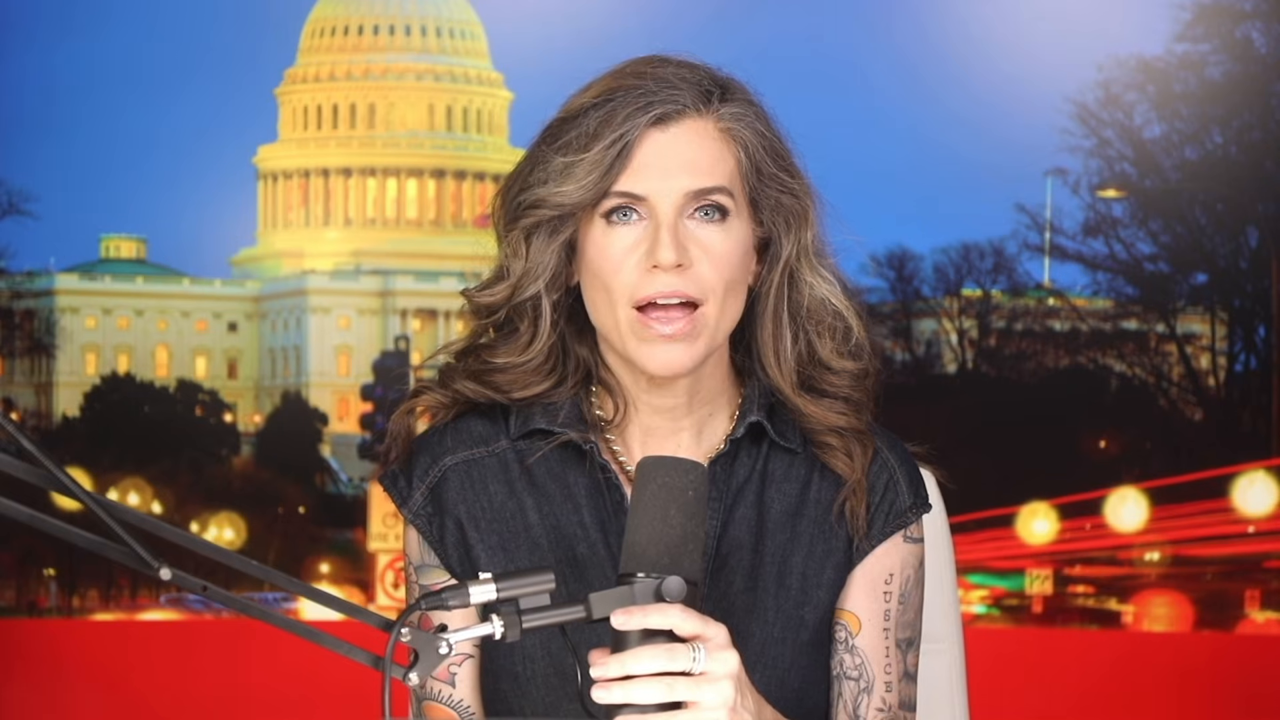
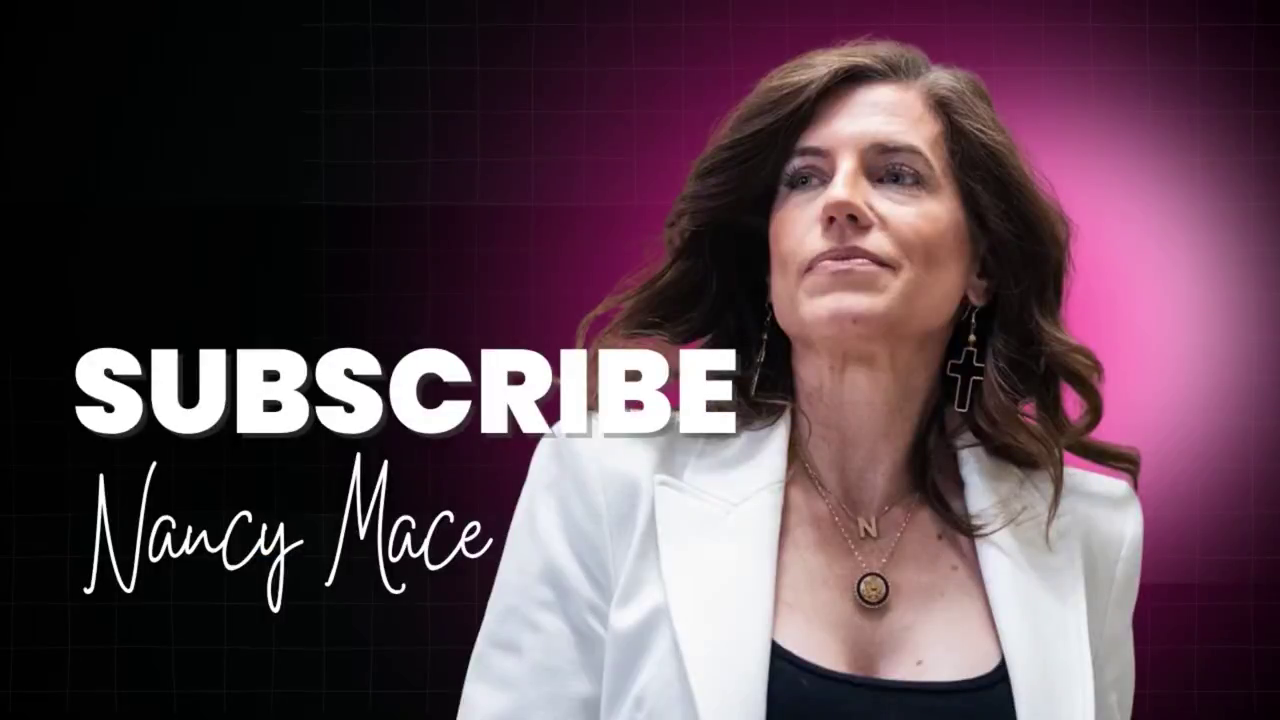
Mace (R-SC-01) finished fifth in the June 2026 Republican primary for South Carolina governor, did not run for re-election to her House seat, and leaves office in January 2027. On the way out she has stood up a branded, near-daily video operation: a boom microphone, a produced backdrop, captions and B-roll, a "CONGRESSWOMAN NANCY MACE" lower-third, and, on some of them, a full-screen "SUBSCRIBE: Nancy Mace" end card. It is, in form, a podcast. The question the staffer's account raises is whether it can actually do what she reportedly hopes it will do: replace a paycheck.
The honest answer, measured against her own numbers and the people who actually make a living at this, is that it cannot, at least not the way it looks now. And there is a second problem waiting for her on the other side of the seat that has nothing to do with views.
The same video, two platforms
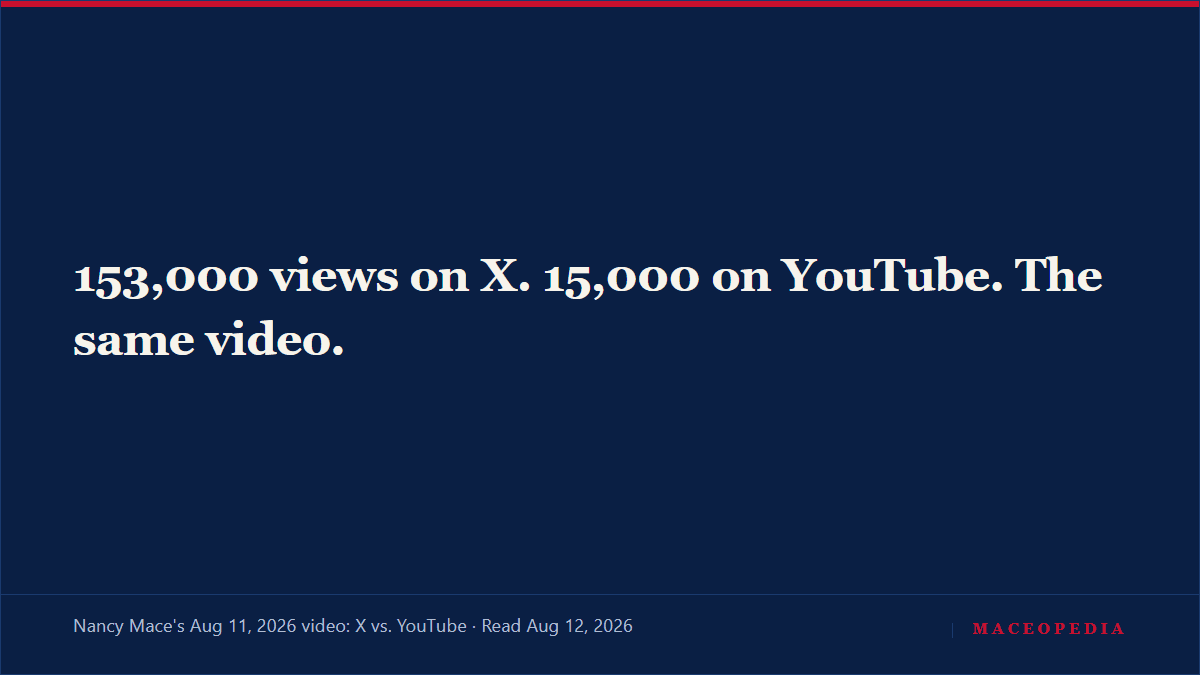
On August 11, 2026, Mace posted a four-minute studio monologue about Rep. Pramila Jayapal, tying remarks Mace had made about Islam to what she called the left's silence on abuses under Iran's regime. It is the video that prompted this piece. Here is what it did on each platform, read directly from the posts as of August 12, 2026:
| Platform | Views | Engagement |
|---|---|---|
| X (@NancyMace) | ~153,000 | ~19,400 likes, ~5,000 reposts, ~870 replies |
| YouTube (@NancyRMace, same clip) | ~15,000 | uploaded the same day |
The identical video drew roughly ten times the reach on X that it drew on YouTube. That gap is the tell. Her reach is not something she owns; it is lent to her by X's algorithm, which amplifies an inflammatory post from a sitting member of Congress, and by newsrooms that treat what a sitting congresswoman says as news. Take away the seat and you take away the amplifier.
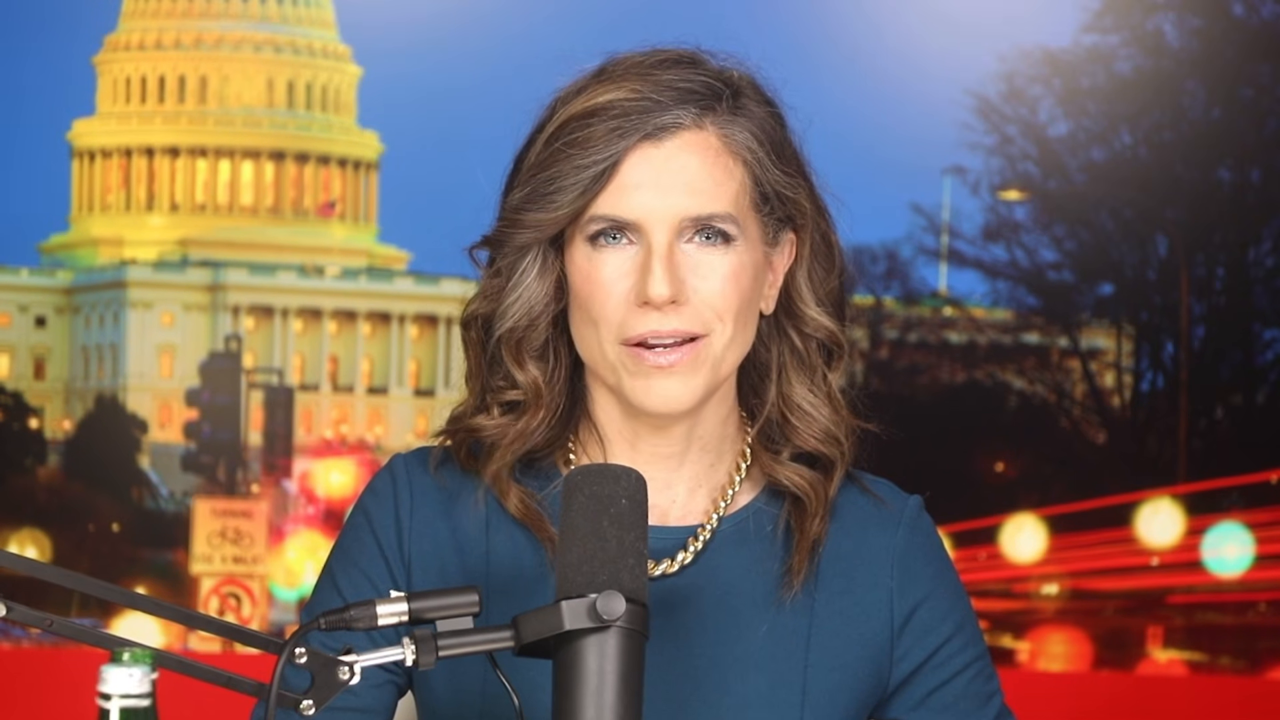 A frame from the August 11, 2026 video itself: the studio set, the boom microphone, the produced Capitol backdrop. Source: Nancy Mace on X and her own @NancyRMace YouTube channel.
Mace's August 11, 2026 video as posted to her own @NancyRMace YouTube channel, embedded so readers can watch it in full and judge it for themselves. Maceopedia is cataloging that she posted it, not endorsing or repeating its claims about Rep. Jayapal, who is the elected U.S. Representative for Washington's 7th district.
A second question about the numbers
Rented reach is the first problem. Manufactured reach is the second, and it is already part of the public record on Mace's operation. In May 2025, WIRED's Jake Lahut reported that several former Mace staffers alleged she had directed them to create and run anonymous "burner" accounts to boost her image and push back on critics online, in one staffer's telling, replying to comments with things that were not true. The account was picked up widely and fact-checked by Snopes. Mace flatly denied it, telling Fox News Digital that a story built on "anonymous former staffers" is "journalist-speak for 'We didn't have anything real, so we called the bitter exes.'" The allegation is contested and unproven; we lay out the full record, including the separate and unverified claim about the "reply guy" account @jarvis_best, in a companion dispatch.
None of that proves any particular like or view on the August 11 video is fake, and we do not claim it does. What it does is set the backdrop for reading engagement from this operation. A media business is bought and sold on owned, organic audience: the people who would follow the host anywhere. What sits underneath Mace's studio videos is, by her own former staff's account, at least in part an operation accused of manufacturing the appearance of support, layered on top of an algorithm that rewards a sitting member's most inflammatory posts and newsrooms that cover what she says because of the office she holds. Strip out the office, the algorithm's thumb, and whatever share of the engagement is staff-built, and the question is not how big the audience is. It is how much of it is really hers to take with her.
The first thirty seconds tell you everything
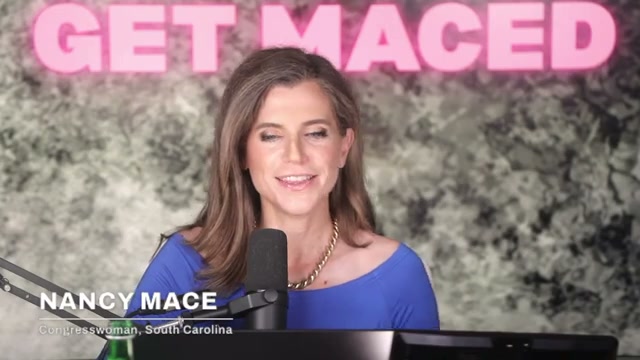
You do not have to take a staffer's word that this is an audition. Watch the open of the August 11 video. For the first half-minute, before Mace says a single word about Pramila Jayapal or Iran or Congress, the clip runs a title sequence built exactly like a YouTuber's channel: a glossy pink GET MACED logo bumper (it recurs seven-plus times in that opening stretch), cut against a personal-brand montage that includes beach and poolside swimsuit footage, one shot of her walking out of the surf in a bikini with a surfboard, her extensively tattooed arms on display throughout.
 The recurring "GET MACED" channel bumper that opens the August 11 video. Source: Mace's own @NancyRMace YouTube channel.
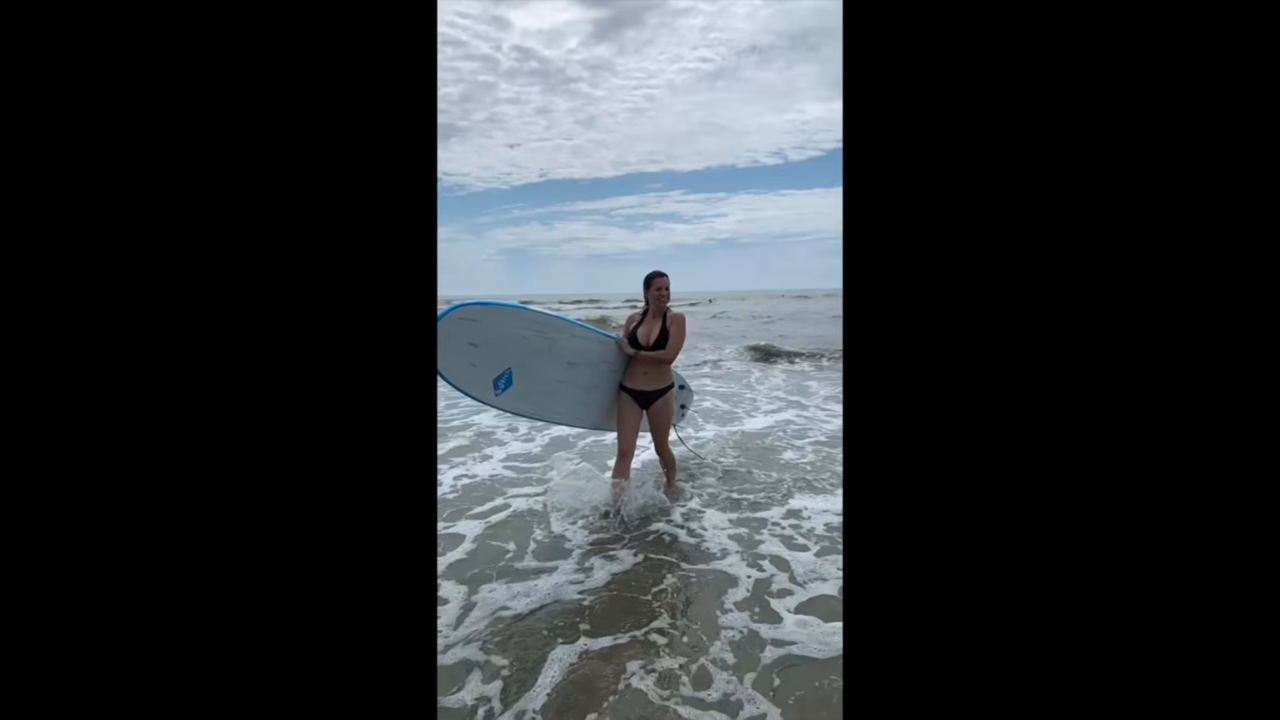 The intro montage cuts in personal glamour and swimsuit footage, here, walking out of the ocean with a surfboard, before any commentary begins. Source: Mace's own August 11, 2026 video.
Then, still before the political content, she looks into the camera and makes the ask directly: "Can you do me one favor right now? Hit the subscribe button and the little notification bell while you're at it." Only after that does the "Congresswoman Nancy Mace" segment begin. Members of Congress do not open a message to constituents with a swimsuit sizzle reel and a subscribe-and-notification-bell pitch. Content creators open videos exactly that way. It is the audition thesis rendered on screen, in her own edit, in the first thirty seconds.
The operation: a channel, not a podcast
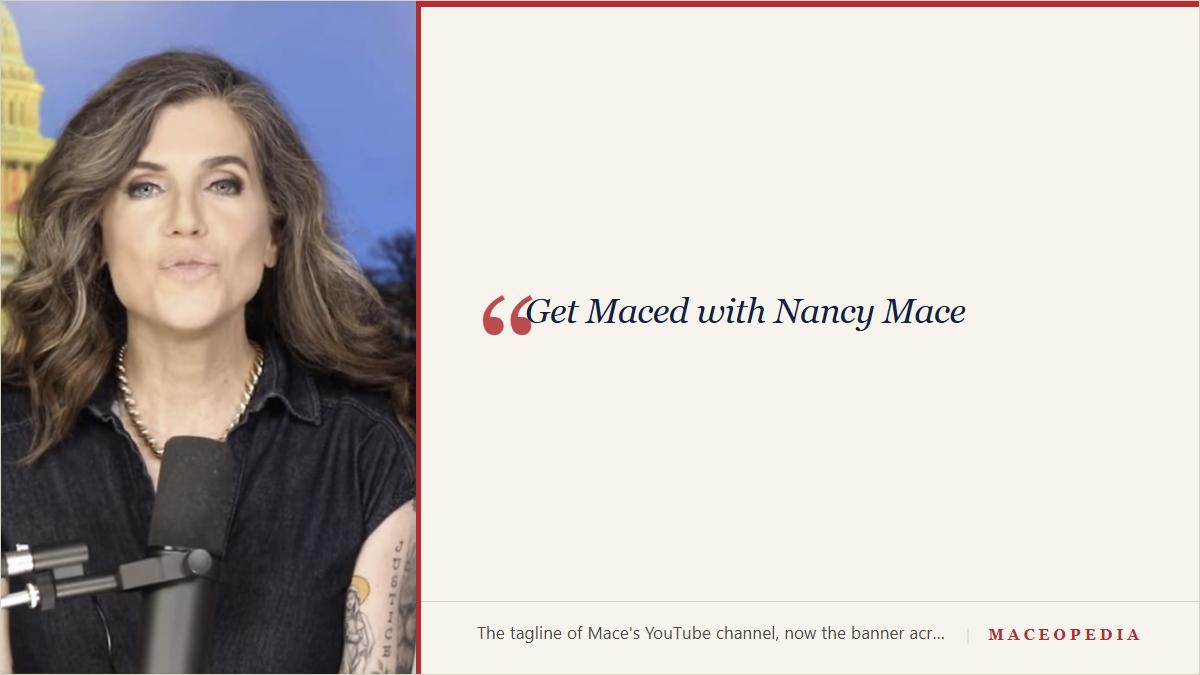
For all the podcast staging, there is no Nancy Mace show on Spotify or Apple Podcasts. What exists is a video channel. She posts the monologues to her personal account, @NancyMace, and to a personal YouTube channel, @NancyRMace, whose tagline is "Get Maced with Nancy Mace." The set is consistent enough to be a brand.
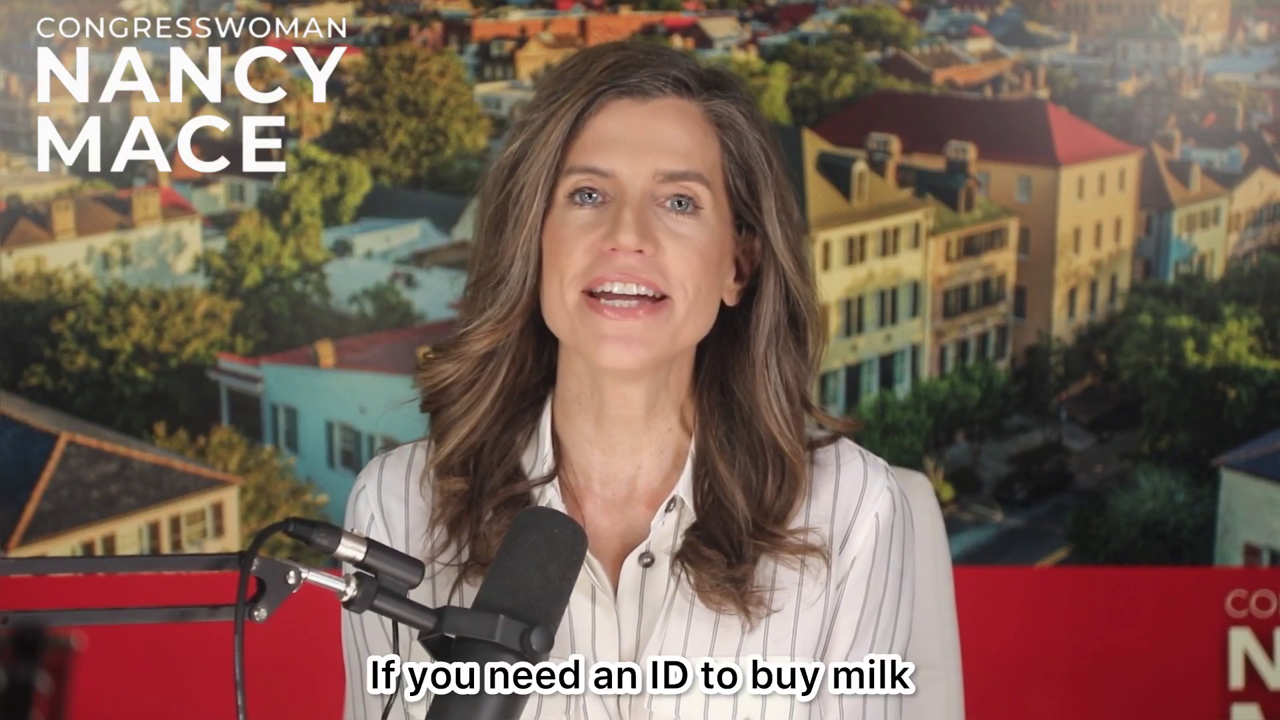 From an August 3, 2026 studio video. Source: @NancyMace on X.
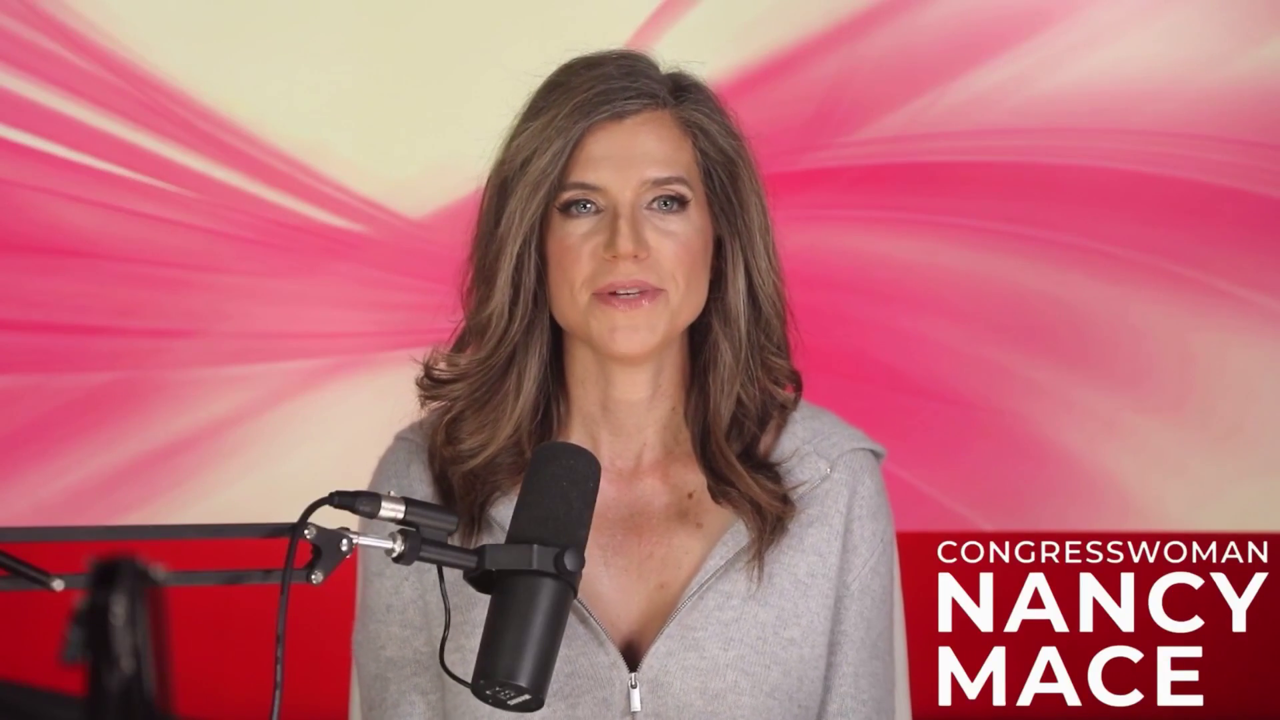 From an August 4, 2026 studio video. Source: @NancyMace on X.
The @NancyRMace channel has posted since June 2019, carries 508 videos, and has drawn about 3.46 million views total over seven years. Its recent cadence is near-daily. Individual videos range widely: a late-July "men in the WNBA" clip cleared roughly 140,000 views, while several others in the same stretch landed between 1,000 and 50,000, with a working median around 23,000. That is the honest shape of the operation: occasional viral spikes riding on a floor of tens of thousands.
Here is the number that shows how much of that is the office and not the brand. Her official House channel, @RepNancyMace, has more subscribers (about 44,000) but strips out the campaign-persona content, and its recent videos draw 130 to 1,400 views apiece. That is the closest thing to a preview of "Nancy Mace, private citizen commentator." When the content is just the job, without the fight-picking and the algorithm's thumb on the scale, the audience is a rounding error.
The Spotify problem
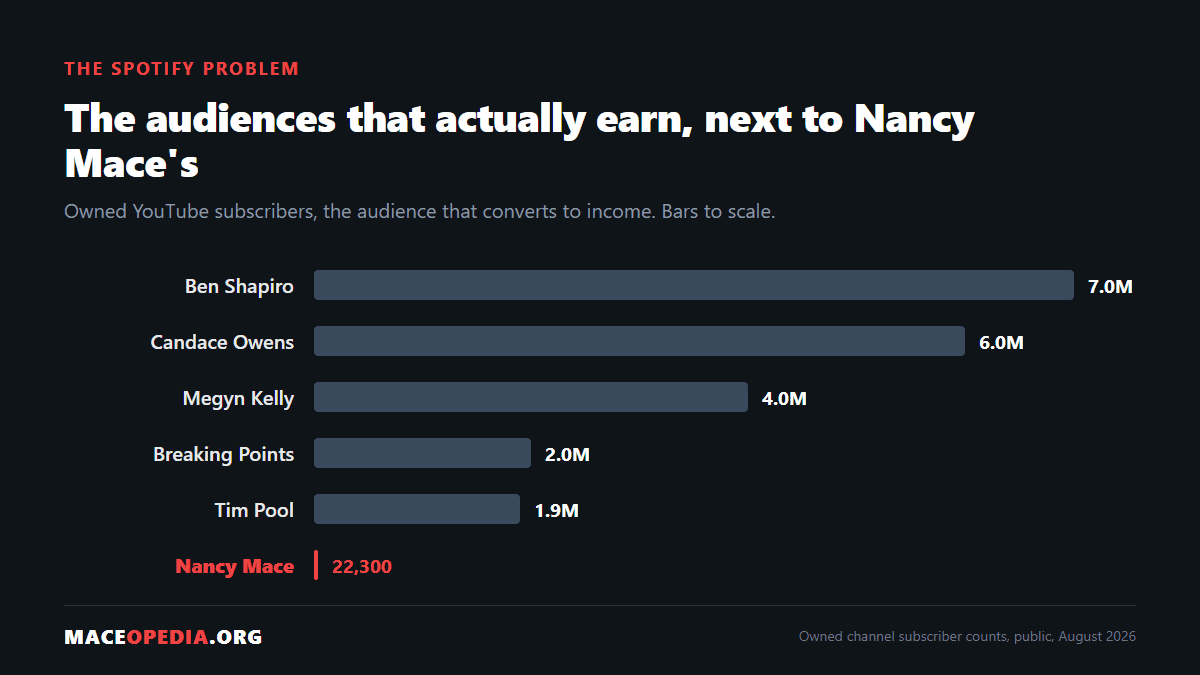
You asked the right frame for this: it is Spotify math. On the streaming platforms, a tiny number of superstar artists capture almost all the money while the overwhelming majority of musicians make close to nothing. Political podcasting works the same way. It is a power law, not a ladder. The industry's own benchmark is that roughly 71% of independent creators earn under $30,000 a year. The people who get rich are operating one or two orders of magnitude above where Mace sits.
Compare the owned audiences, the subscriber base that actually converts to money, not the borrowed viral views:
| Show / person | Owned YouTube audience | Reported or estimated earnings |
|---|---|---|
| Ben Shapiro | ~7,000,000 subs | ~$10-20M/yr (estimated) |
| Candace Owens | ~6,000,000 subs, ~3.5M downloads per episode | ~$13-24M/yr (estimated, all sources) |
| Megyn Kelly | ~4,000,000 subs | ~$10-20M/yr (estimated) |
| Breaking Points | ~2,000,000 subs | 40,000+ paid subscribers |
| Tim Pool / Timcast | ~1,900,000 subs | ~$700K/yr AdSense on one channel (estimated) |
| Tulsi Gabbard | not disclosed | $409,000 from her own show entities; ~$1.2M total media income (disclosed) |
| Marjorie Taylor Greene (no show; book + Cameo) | n/a | $178,230 in book royalties in a single year (disclosed) |
| Nancy Mace | ~22,300 subs, ~23,000 views per video | currently monetizes almost none of it as a business |
In the Spotify analogy, Mace is not the headliner. She is one of the hundreds of thousands of artists whose quarterly streaming check is smaller than a dinner out. Her single best viral swing this month, the 153,000-view X post, is a slow day for the people at the top of that table. The gap between her and the earners is not effort or volume, she posts constantly, it is owned audience, and she has very little of it.
What "this type of podcast" actually pays
Now put real multipliers on her real numbers. The pieces of a political-media income and what they pay, from industry data and disclosed figures:
- YouTube ads: roughly $3 to $13 per 1,000 views for news and politics, and this niche is chronically demonetized or advertiser-excluded, so the low end is the safe assumption. Mace's censored on-screen wording ("rped," "mrdered") is itself a sign she is fighting the monetization filters. At her current cadence and reach, call it 7 to 10 million YouTube views a year. That is about $25,000 to $70,000 a year in ad revenue, and that is with the sitting-congresswoman amplification still running.
- X payouts: real but small and volatile at her scale, plausibly another $10,000 to $40,000 a year, dependent on engagement from other paying users.
- Direct subscriptions (Patreon/Substack/memberships): she has none today. This is the single biggest swing factor, and it is the one thing viral views do not automatically produce. A blended paying subscriber is worth about $5 to $15 a month; converting even a few thousand would matter, but conversion runs at a low single-digit percentage of a regular audience, not of a one-time viral crowd.
- Sponsorships: mid-tier host-read deals run $500 to $2,500 an episode, but they require an advertiser-safe show, which "the communist way," Islam-and-rape monologues, and named-target segments are the opposite of.
Stack it up and the show's own direct economics, at her demonstrated scale, are a low-six-figure business at the very best. That is the number to hold against the one she is losing.
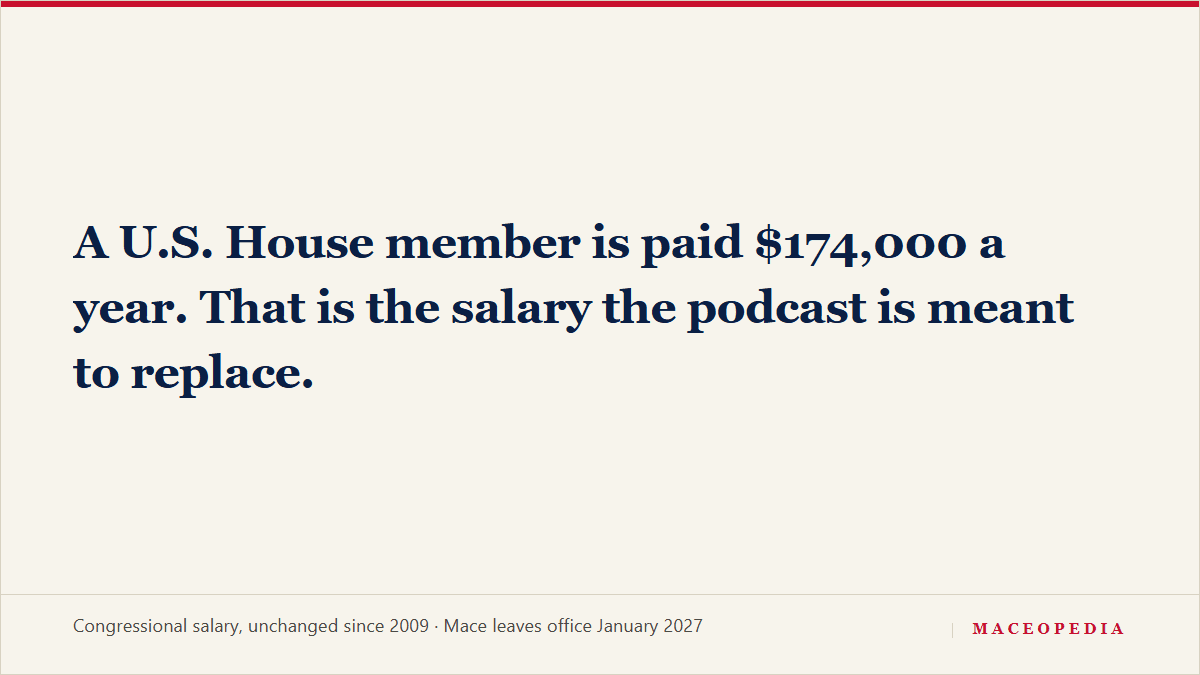
A rank-and-file member of the U.S. House is paid $174,000 a year, a figure unchanged since 2009. That is Mace's current salary, and it disappears in January 2027. So the brutal comparison is this: the podcast, monetized directly and generously, roughly matches or falls short of the paycheck it is supposed to replace, and it does so only while she still holds the office that inflates her reach. Strip the seat away, watch the numbers drift toward the 130-to-1,400 range of her official channel, and the "career" is a side income, not a salary.
Where the real post-office money in political media actually lives is not ad revenue at all. It is the things a platform makes you bookable for: a cable-news contributor contract (Tulsi Gabbard's disclosed Fox deal was $199,500), a book advance and royalties (Marjorie Taylor Greene cleared $178,230 on one book in a single year), the speaking circuit ($10,000 to $30,000 a keynote), Cameo (Sarah Palin reportedly made $211,529 from it in 2021 alone). The video operation is not the store. It is the shop window, an audition tape meant to land one of those deals. Which brings up the problem the views can't fix.
The lawsuit in the way
Mace's whole media persona is built on making sharp, named accusations. That is also the conduct at the center of active litigation against her, and the defense keeping her out of trouble is one she is about to lose.
The origin is public record. On February 10, 2025, from the floor of the U.S. House during debate on her Stop VOYEURS Act, Mace named four men, including her ex-fiancé Patrick Bryant, and described them as involved in or aware of sexual assault and the exploitation of women and girls. She repeated versions of the accusations in social-media posts viewed by millions. All of the men have denied the accusations. Nothing in them has been proven.
Those statements are now the subject of a defamation claim. In Berg v. Bryant (Charleston County Court of Common Pleas, No. 2025-CP-10-03124), a case in which Alexis Berg sued Bryant, Bryant filed a Third-Party Complaint on November 6, 2025 bringing Mace into the case as a Third-Party Defendant. That complaint, Bryant against Mace, alleges defamation, intentional infliction of emotional distress, conversion, invasion of privacy, and civil conspiracy. Critically, it frames her conduct as "solely personal acts, for her own personal gain, without any relationship to her position as a United States Congresswoman."
Mace's answer to that is her entire defense: that she was acting within the scope of her federal office. She has invoked the Federal Tort Claims Act, the Westfall Act, and the Speech or Debate Clause, and she removed the case to federal court under the statute that lets federal officers move suits into a federal forum (No. 2:26-cv-00305-BHH-MHC). In June 2026, U.S. Magistrate Judge Molly Cherry recommended sending the case back to state court as an untimely removal; Mace, by then proceeding pro se after her law firm withdrew, filed objections.
Here is why this matters to the podcast. Her legal shield is her job. The immunity she is leaning on exists only because, and only for as long as, she is a member of Congress acting in an official capacity. The day she becomes a private-citizen podcaster, that argument is gone. Every new monologue that names a person and makes a factual claim about them is spoken with no Westfall Act, no Speech or Debate Clause, no House general counsel, and no path to a federal officer's forum. It is exactly the "solely personal act, for her own personal gain" that the complaint against her already alleges, except now it would be indisputably true that she is a private actor doing it for her own commercial benefit.
That is also why the "land a network deal" exit is narrower than it looks. Her natural home would be Fox, and Fox is the single most defamation-shy operation in the business after writing a $787.5 million settlement check to Dominion Voting Systems. Cable networks indemnify their on-air talent; taking on a host who is a current defamation defendant, whose show would manufacture fresh legal exposure weekly, is precisely the risk their lawyers exist to refuse. A fringe, high-risk platform might still take her, some corners of that ecosystem treat being sued as a credential, but those seats pay a fraction of a real contract and come with none of the legal cover she would suddenly, urgently need.
The verdict
Is a podcast a job for Nancy Mace, or not worth the time?
As a strategic asset, it is worth the time. It is cheap to produce, it keeps her name alive between offices, and it is the audition tape for the paid gigs where political-media money actually is. As the job itself, at the scale she has actually demonstrated, it is a low-six-figure operation that roughly matches or trails the $174,000 salary it is meant to replace, and it leans entirely on reach she is renting from a seat she is vacating. When the seat goes, the reach drifts toward her official channel's 130-to-1,400-view reality, and the same content that draws the views becomes an uninsured legal liability the moment the immunity defense dies with the office.
The rude awakening is not just that the podcast probably will not pay. It is that "this type of podcast," the named-target, accusation-driven kind that gets the clicks, turns from an asset into a liability generator on the exact day she needs it to become a paycheck.
Sources & related coverage
- Rep. Nancy Mace / @NancyMace on X, August 11, 2026 (the video, ~153K views), and the same clip on her @NancyRMace YouTube channel (~15K views). View counts read directly from the posts as of August 12, 2026.
- Maceopedia, The Congresswoman Has a Podcast Studio: Nancy Mace Is Auditioning for Life After Office (the current-staffer account) and Subscribe to Nancy Mace: Who Pays (the funding question).
- Congressional salary: rank-and-file Members of Congress are paid $174,000 per year, unchanged since 2009. See the Congressional Research Service, Salaries of Members of Congress: Recent Actions and Historical Tables.
- Podcast and YouTube economics (CPM/RPM ranges, creator-income distribution) and comparable-earner figures (Owens, Kelly, Shapiro, Gabbard, Greene, Palin) are drawn from public industry reporting and, where noted, from disclosed financial filings; estimates are labeled as estimates.
- The burner-account allegations: WIRED, Jake Lahut, Nancy Mace's Former Staff Claim She Had Them Create Burner Accounts to Promote Her (May 28, 2025); Snopes fact-check (May 31, 2025); Mace's denial via Fox News Digital (May 30, 2025). Maceopedia's fuller treatment: Who Is Jarvis? Nancy Mace's Favorite Reply Guy, and the Burner-Account Question.
- The defamation claim against Mace: Bryant's Third-Party Complaint in Berg v. Bryant, Charleston County Court of Common Pleas No. 2025-CP-10-03124, removed to the U.S. District Court for the District of South Carolina as No. 2:26-cv-00305-BHH-MHC; U.S. Magistrate Judge Molly Cherry's June 17, 2026 Report and Recommendation to remand. See the Maceopedia case hubs for Berg v. Bryant and the Mace federal removal.
- Maceopedia's evergreen hub for this story: Get Maced: Nancy Mace's Podcast Operation
This dispatch quotes a current Mace staffer (an account Maceopedia cannot independently confirm, attributed to its source) and reports view counts read from Mace's own public posts, industry economic data, disclosed earnings of other public figures, and public court filings, each linked. The burner-account claims it references are the accounts of former staffers as reported by WIRED; Mace denies them and they are unproven. The February 2025 accusations Mace made against Patrick Bryant and three other men are her statements; all four men deny them and none have been proven, and Bryant's third-party complaint alleges they are false and defamatory, which Mace denies while asserting truth and official-immunity defenses. Nothing here adjudicates those accusations or the pending litigation; the legal analysis concerns only the public, undisputed structure of Mace's official-capacity defense. Revenue figures for Mace are estimates derived from her publicly visible reach, not statements of her actual income, which is not disclosed. Maceopedia offers no clinical or personal characterization of Mace.
Read next
 August 28, 2026 · Dispatch
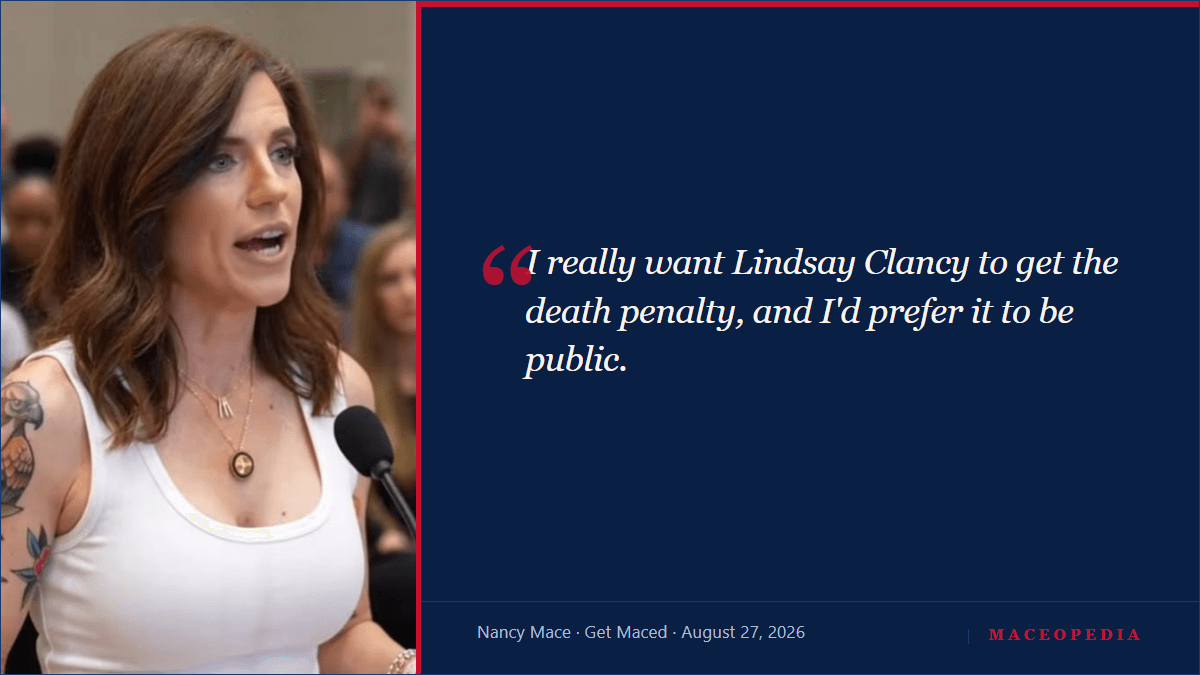
'I Really Want Her to Get the Death Penalty, and I'd Prefer It to Be Public': On Thursday Night's 'Get Maced,' Nancy Mace Turned the Lindsay Clancy Trial Into an On-Air Call for a Televised Execution, With the Jury Still Out
On her Thursday, August 27, 2026 'Get Maced' live stream, Nancy Mace devoted a segment she titled 'the face of evil' to the murder trial of Lindsay Clancy, the Massachusetts mother whose jury had just begun deliberating. Mace told her viewers, 'I really want Lindsay Clancy to get the death penalty, and I'd prefer it to be public,' having acknowledged in the same breath that Massachusetts has no death penalty, where the maximum sentence is life without parole and no verdict had been reached. She also disclosed her own postpartum experience to draw a line against Clancy ('the only difference is I didn't murder my children'), mocked the defense attorney's closing ('I don't know any darn good moms who murder all three of their children'), and built the rest of the hour around a thesis about the gap between who people claim to be and who they are: Hillary Clinton in the Hamptons, Michigan Senate nominee Abdul El-Sayed and his physician title, and a closing tribute to Dolly Parton. This is Maceopedia's review of the broadcast, every quote verbatim from her own stream.
 August 26, 2026 · Dispatch
Amateur Hour: Nancy Mace's First 'Get Maced' Live Stream Was Muted at the Open, Out of Focus in the Middle, and Watched Live by Fewer Than 1,000 People
On the night of the August 25, 2026 South Carolina runoff for the late Lindsey Graham's Senate seat, Nancy Mace went live on her personal @NancyRMace YouTube channel for the first time ever: a 45-minute, one-camera runoff-watch show she opened by admitting the microphone had been muted the whole time she'd been talking, narrated her own camera going out of focus, and paused near the 40-minute mark to go get a glass of water. Fewer than 1,000 people watched it live. The content whiplashed too: she spent the front half prosecuting the appointment of Graham's sister Darlene ('It's not an heirloom... it could be Donald Duck, it could be Mickey Mouse') and the back half, once Darlene won and Mace's own pick Ralph Norman lost, congratulating 'Senator Graham' and pledging to help her. Her staff prompted her on air to remind viewers to subscribe. This is Maceopedia's television-critic review of the broadcast, with the full edit of the night's quotes and snafus.
 August 25, 2026 · Dispatch
Nancy Mace Puts 'Get Maced' on a Clock: A Fixed Nightly Show, 8PM Monday Through Thursday
For most of 2026, Nancy Mace's 'Get Maced' videos dropped whenever the news did: near-daily, but on no fixed day and at no fixed hour, a loose feed of studio monologues tied to whatever fight she was picking that afternoon. As of August 25, 2026, that is over. Her personal YouTube channel, @NancyRMace, now carries a schedule banner reading 'GET MACED, 8PM, MONDAY - THURSDAY,' and the channel's own description bills the operation as 'the nightly show Washington wishes you'd skip,' with 'New episodes Monday through Thursday night at 8PM ET,' promising 'a cold open, the day's biggest stories, and a close cable news won't give you... Done in 30 minutes or less.' The channel is now verified and has roughly 45,700 subscribers, up from about 22,300 two weeks ago. The move converts a scattershot upload habit into appointment television, a named time slot four nights a week, and it is the most formal commitment yet to the media brand a current staffer told Maceopedia she is building to 'pay the bills' after she leaves Congress in January 2027.
 August 16, 2026 · Dispatch
Nancy Mace Rebrands Her Main X Account Into a 'Get Maced' Billboard
Nancy Mace has remade the top of her main X account, @NancyMace, into a promotion for her show. Her new banner is the glossy pink 'GET MACED' logo, set against a sparkle background and a studio glamour photo of her in a black tank with her tattoo sleeve on display, and her new profile photo is a polished beauty-shot headshot rather than her congressional portrait. The version stamps on the images place the changes on August 14 and 15, 2026. The branding is identical to the pink logo bumper that opens her August 11 studio video and to the tagline of her personal YouTube channel, @NancyRMace: 'Get Maced with Nancy Mace.' It is the clearest sign yet that the account she uses for her congressional fights is now doubling as the marketing channel for the media brand a current staffer told Maceopedia she is building to 'pay the bills' after she leaves office in January 2027. There is still no Nancy Mace podcast on Spotify or Apple; the operation is a video channel, and its front door is now her main political profile.
 August 5, 2026 · Dispatch
Subscribe to Nancy Mace: The Studio Videos Now End Like a YouTuber's, and the Public Record Won't Say Who Pays
On August 5, 2026, Rep. Nancy Mace posted another produced studio monologue to her personal @NancyMace account, a nearly four-minute reaction to Abdul El-Sayed's win in Michigan's Democratic Senate primary. The video ends the way a content creator's does: a branded card that reads SUBSCRIBE, Nancy Mace, over a glamour portrait. That end card is the clearest sign yet of what a current staffer already told Maceopedia the videos are, an audition for life after office. It also raises two fair questions a reader asked us: who produces this operation, and is any of it touching taxpayer money? We went to the public record for both. The short answers: no filing names a producer, and House rules bar official funds from exactly this kind of personal-brand content, which is why it lives on her personal feed and not her official one.
- August 5, 2026 · Dispatch
The Congresswoman Has a Podcast Studio: Nancy Mace Is Auditioning for Life After Office, On Camera
A current member of Nancy Mace's staff tells Maceopedia the congresswoman is auditioning for a career in political media for after she leaves office, and that the escalating content is the strategy. Mace lost her primary for governor, is not running for re-election, and leaves Congress in January 2027. In her final months she has stood up a branded, studio-produced video operation on her personal account, a podcast set with a boom microphone and produced backdrops, posting to-camera monologues that rack up tens of thousands of views. This dispatch reports the staffer's account and lays the videos, in her own words and with view counts, alongside it.