Part of: Mace Federal Removal (Berg v. Bryant → D.S.C.) · House Ethics Committee Investigation of Rep. Nancy Mace (OCC Review 25-5681) · Berg v. Bryant (and Bryant's Third-Party Complaint against Mace) · Mace v. Bowman · Assignment Desk Works, LLC v. Alexis Berg · Musgrave v. Mace (2:25-cv-01823-RMG) · Mace v. Bryant · Nancy Mace's Gag Order Violations · Litigation Overview & Court-Filing Index
Nancy Mace loses in federal court: Bryant's suit accusing her of defamation and a blackmail conspiracy moves forward
Nancy Mace has lost in federal court. On September 4, 2026, U.S. District Judge Bruce H. Hendricks rejected her pro se bid to move the case out of state court, ruling her removal untimely 'by several measures,' and remanded Berg v. Bryant to the Charleston County Court of Common Pleas. That sends Patrick Bryant's third-party case against Mace forward in state court, a case that accuses her of defamation and of a civil conspiracy to hack his phone and blackmail him into signing over property. The Court affirmed the magistrate judge's recommendation with modifications, overruled Mace's objections, denied her motion for oral argument, and terminated her duplicate federal case as moot. The ruling is procedural: it does not reach the merits, and Mace's immunity defenses travel with the case. The order (ECF No. 36) is reproduced below. The allegations are disputed and unproven; Mace denies Bryant's claims, and Bryant denies Mace's.
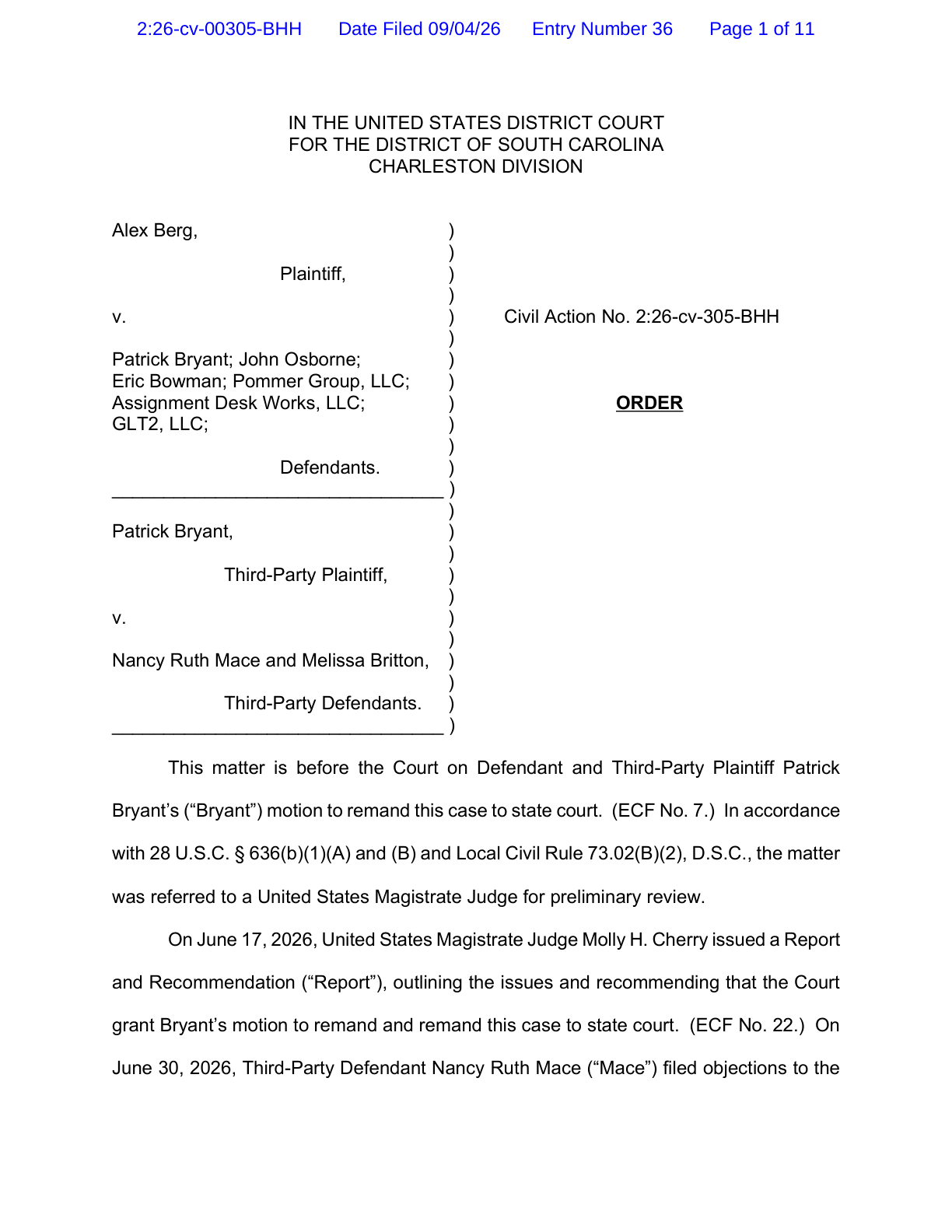
On September 4, 2026, United States District Judge Bruce H. Hendricks of the U.S. District Court for the District of South Carolina, Charleston Division, entered an order granting Patrick Bryant's motion to remand and sending the case back to state court, the Charleston County Court of Common Pleas for the Ninth Judicial Circuit. Rep. Nancy Mace, appearing pro se, without a lawyer, had removed the matter to federal court in January under the federal-officer removal statute. The Court held that her removal was untimely and returned the entire dispute to the state court she tried to leave.
In the same order the Court affirmed the magistrate judge's earlier recommendation "with modifications," overruled Mace's objections, denied her motion for oral argument as unnecessary, and terminated as moot the duplicate federal case number she had opened. The eleven-page order (Entry Number 36) is reproduced below and is available here as a PDF.
The practical effect is that Patrick Bryant's third-party lawsuit against Mace now moves forward in state court. That suit, his third-party complaint in Berg v. Bryant, accuses Mace of defamation and of a civil conspiracy to hack and steal Bryant's cellphone and then blackmail him into transferring ownership of property to her, along with claims of intentional infliction of emotional distress, conversion, and invasion of privacy. Those are Bryant's allegations; Mace denies them, and no court has adjudicated any of them. What the September 4 order settles is only where the case will be decided, not whether the claims are true.
The order, as filed
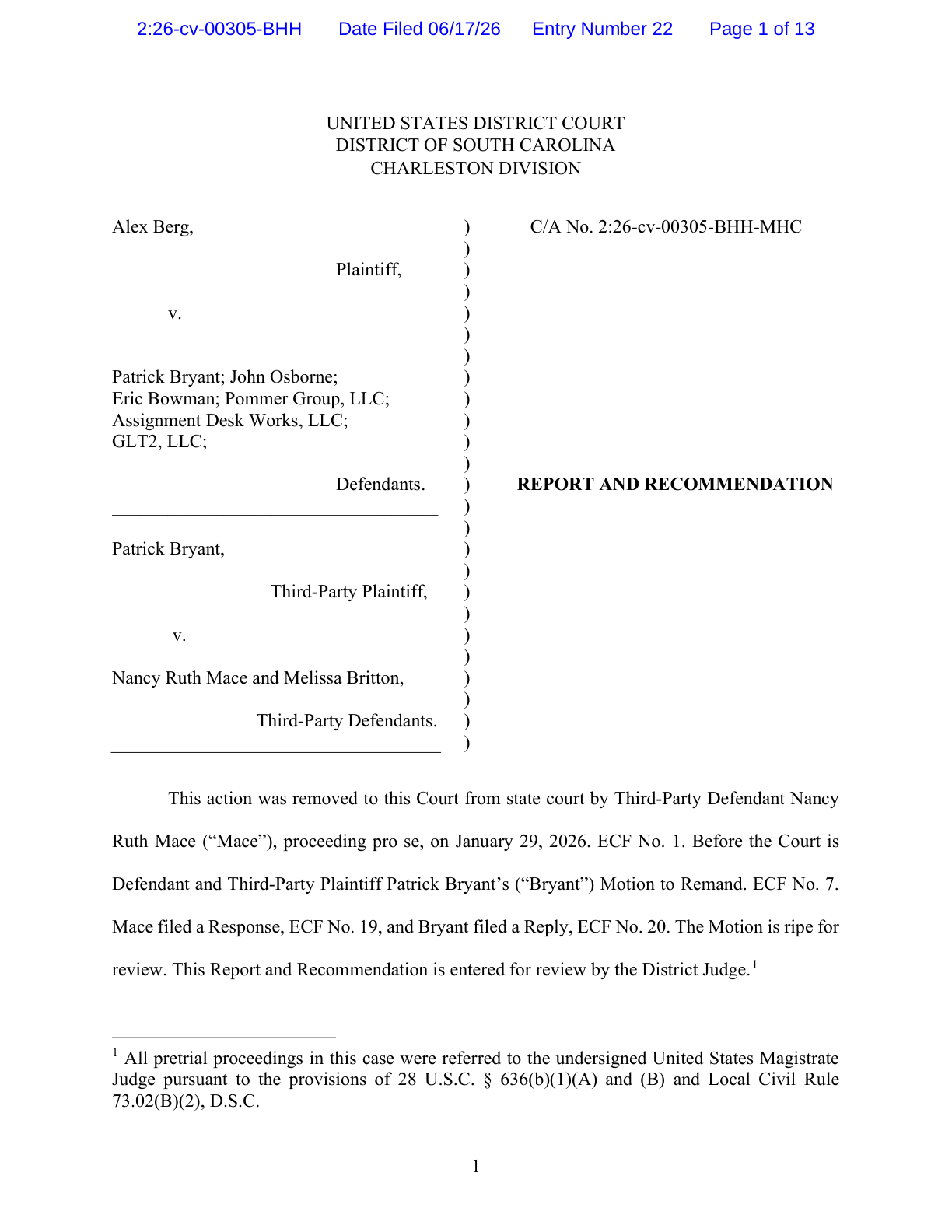
Page 1, the caption. Plaintiff Alex Berg v. Patrick Bryant and others; third-party plaintiff Patrick Bryant v. third-party defendants Nancy Ruth Mace and Melissa Britton. Civil Action No. 2:26-cv-305-BHH. The order addresses "Defendant and Third-Party Plaintiff Patrick Bryant's ... motion to remand this case to state court."
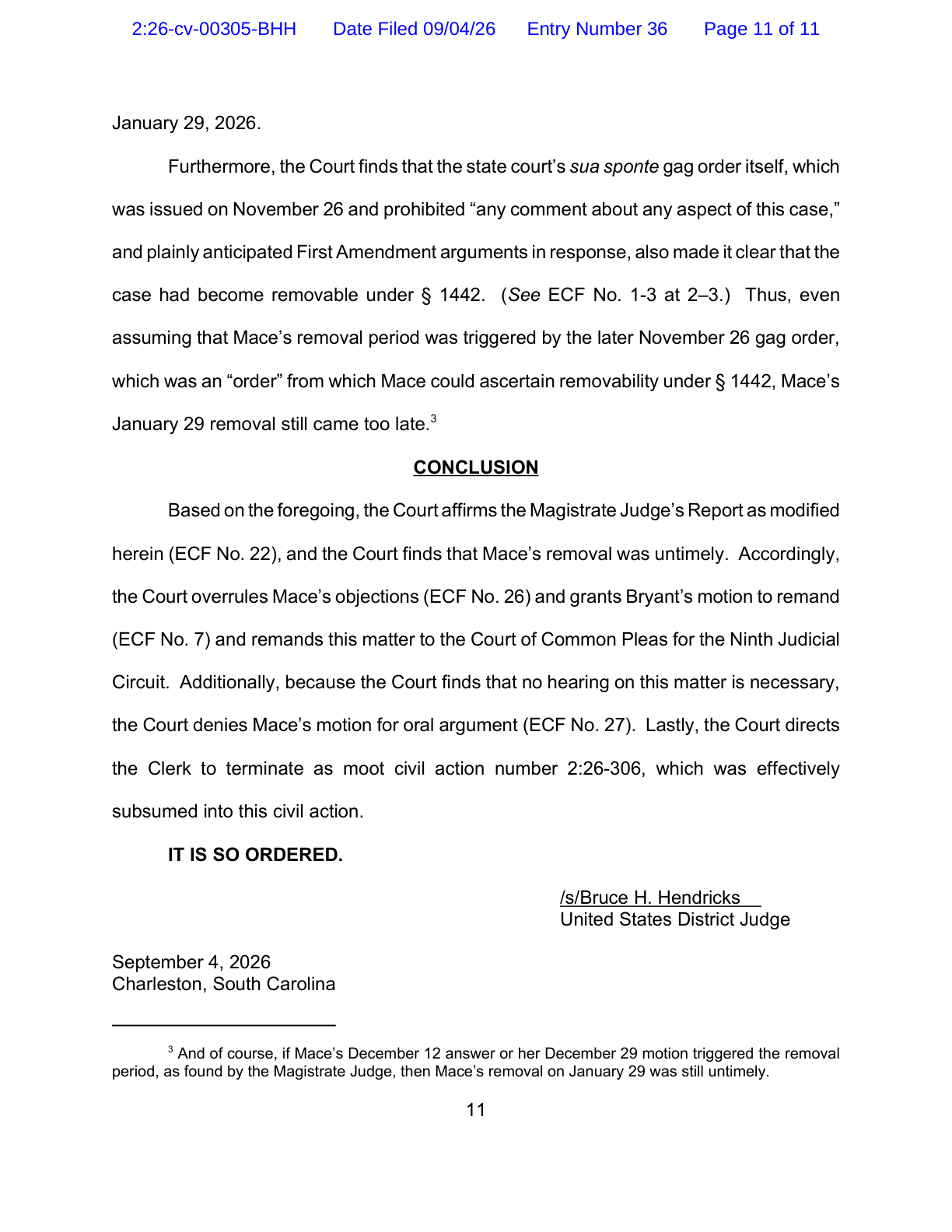 Page 11, the conclusion: the Court "grants Bryant's motion to remand ... and remands this matter to the Court of Common Pleas for the Ninth Judicial Circuit," denies Mace's motion for oral argument, and directs the Clerk to terminate the duplicate case as moot. Signed by U.S. District Judge Bruce H. Hendricks, September 4, 2026.
What the Court decided
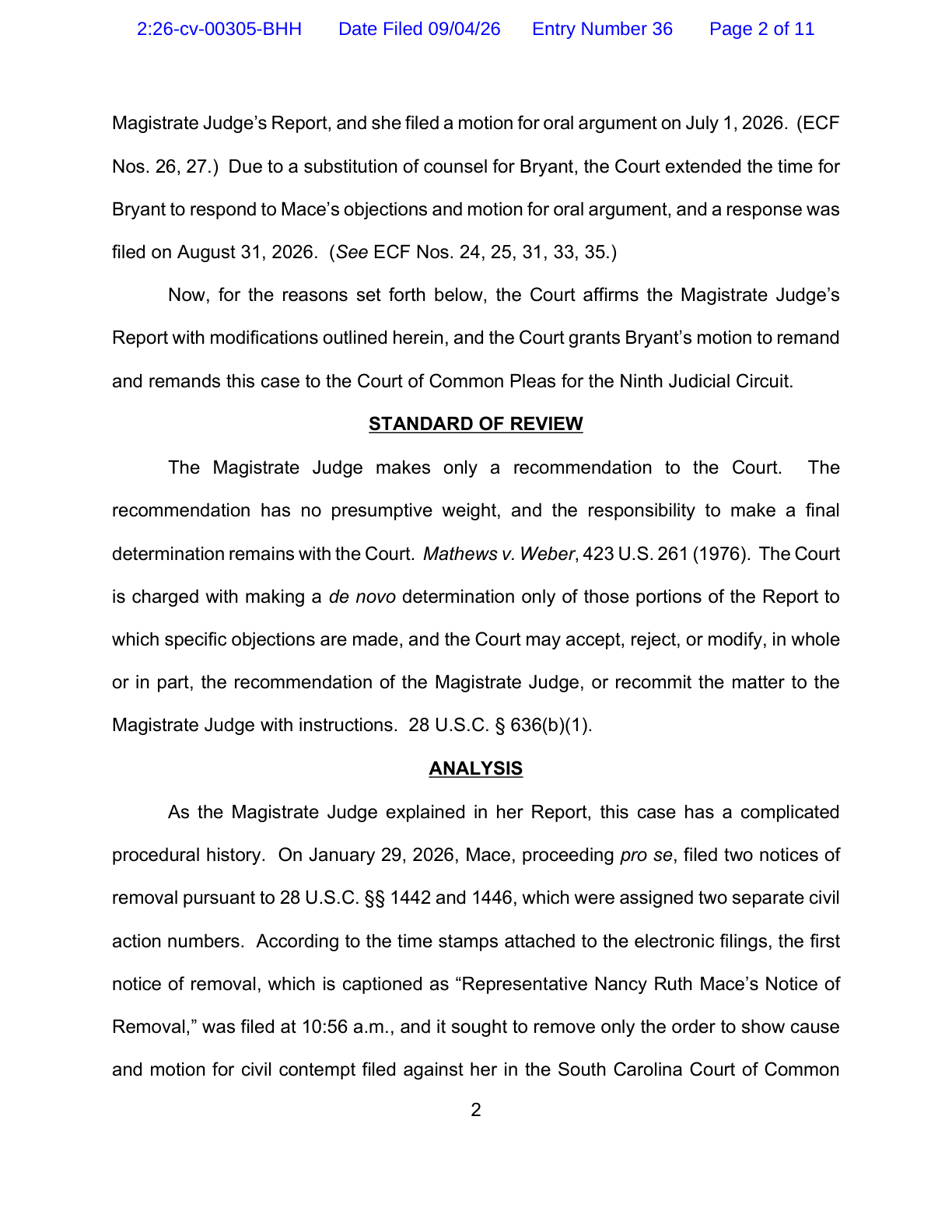
The only question the order reaches is a procedural one: was Mace's removal on time? She had thirty days to move a removable case to federal court under 28 U.S.C. § 1446. The magistrate judge, in a June 17, 2026 Report and Recommendation, had found that Mace was on notice the case was removable by December 12, 2025 (when she asserted federal defenses in her Answer), so her January 29, 2026 removal came too late. Judge Hendricks agreed with that conclusion, writing after a de novo review that the Court "fully agrees with the Magistrate Judge that Mace's removal was untimely by several measures."
The Court then went further than the magistrate, siding with Bryant that the recommendation had actually given Mace "too much leeway." The Court found that Bryant's November 17, 2025 motion for a temporary restraining order, which sought to bar Mace from using her "Congressional social media account, campaign account, press conference, interview, podcast, or communications with reporters," and which referenced her Congressional speeches and accused her of "hiding behind Congressional immunity," was the paper "from which it may first be ascertained that the case is one which is or has become removable." By that measure, the Court held, Mace "was required to remove this action on or before December 17, 2025, but did not do so until January 29, 2026."
As an independent alternative, the Court held that the state court's November 26, 2025 gag order, which barred "any comment about any aspect of this case," was itself an "order" that made removability clear, so that even a clock started on that date left the January 29 removal too late. The order stacks these grounds deliberately: whether the clock is measured from November 17, November 26, December 12, or December 29, the Court found the January 29 removal untimely on every one.
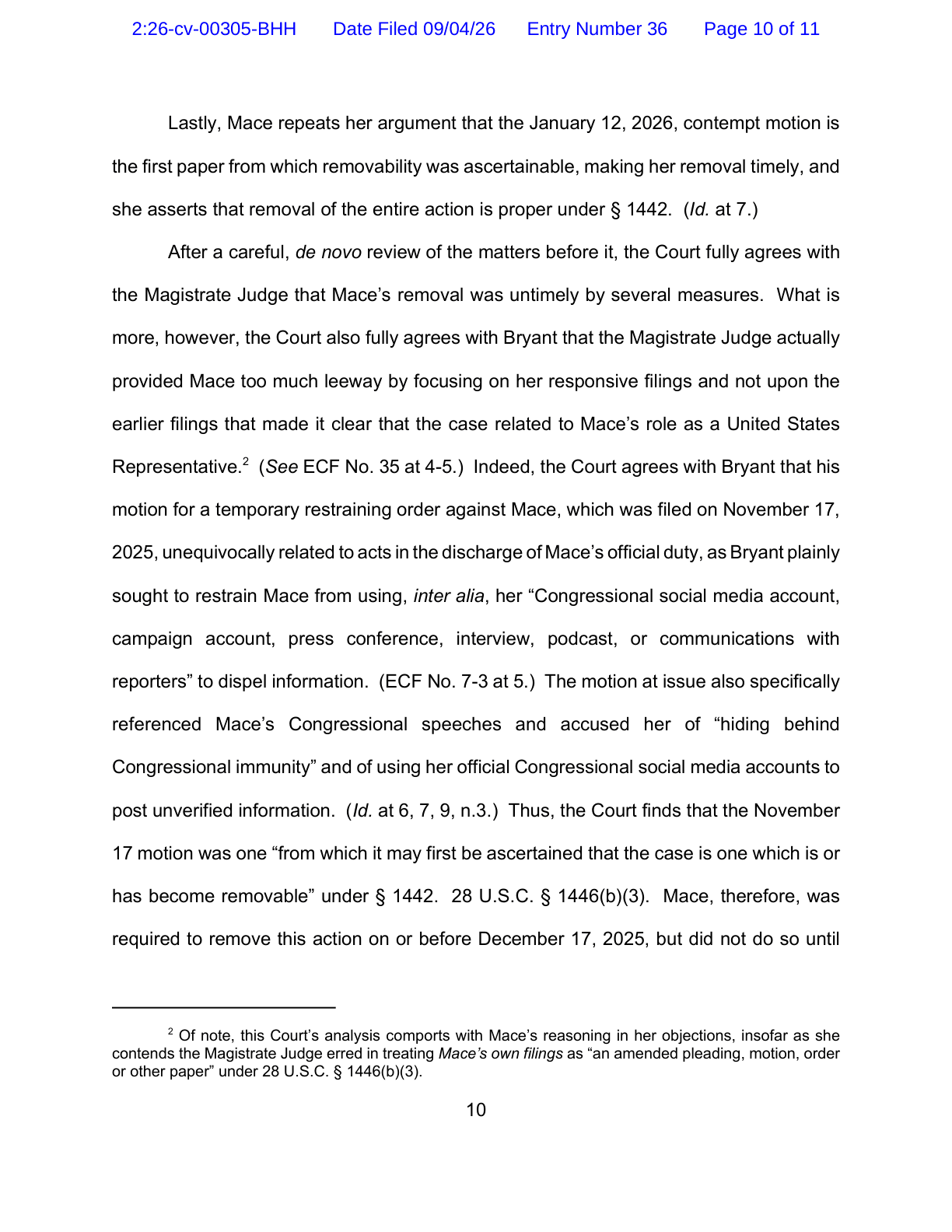 Page 10, the modification: the Court agrees with Bryant that the November 17 TRO motion "unequivocally related to acts in the discharge of Mace's official duty," setting a removal deadline of December 17, 2025.
What the ruling does not decide
The order is procedural. It does not rule on the merits of the defenses Mace has raised, her assertions of protection under the Westfall Act, the Federal Tort Claims Act, and the Speech or Debate Clause. Those defenses are not resolved by this order; they return with the case to state court, where they can still be litigated. As a matter of appeal, remand orders are ordinarily unreviewable, but 28 U.S.C. § 1447(d) contains an express exception for cases removed under the federal-officer statute (§ 1442), which means an order like this one may be appealed to the U.S. Court of Appeals for the Fourth Circuit.
What happens now
The case goes back to the Charleston County Court of Common Pleas (No. 2025-CP-10-03124), the same forum, before the same state judge, where Bryant's third-party complaint against Mace, the gag order, and the pending civil-contempt proceeding all sit. The state-court gag order remains a state-court order. The Court also directed the Clerk to close the second federal case number (2:26-cv-306) that Mace's filings had generated, folding everything into the single action it remanded.
The underlying dispute is the subject of ongoing civil litigation in Berg v. Bryant (No. 2025-CP-10-03124) and related actions, and of a separate South Carolina State Law Enforcement Division (SLED) inquiry; all allegations remain unproven and contested, and this order is not a finding on any of them. Mace denies Bryant's allegations; Bryant and the other named parties deny Mace's allegations; no underlying matter has been adjudicated. This dispatch reports a public court order and quotes it verbatim; nothing here is a finding of fact by this site. For background on the parties see People in the Public Record.
Sources & related coverage:
- The order itself: Order granting remand (PDF, 11 pages), signed by U.S. District Judge Bruce H. Hendricks, September 4, 2026 (Entry Number 36), Berg v. Bryant, Civil Action No. 2:26-cv-305-BHH, U.S. District Court for the District of South Carolina.
- Case background and the full federal docket: Mace Federal Removal (Berg v. Bryant → D.S.C.).
- The underlying state case: Berg v. Bryant (2025-CP-10-03124).
- The magistrate's earlier recommendation: A federal magistrate recommends sending the case Mace removed to federal court back to state court.
- The federal docket, Case No. 2:26-cv-00305-BHH-MHC, is public on CourtListener and PACER (pacer.uscourts.gov). The state action, No. 2025-CP-10-03124, is searchable on the South Carolina Judicial Branch Public Index. All filings cited are public court records.
Read next
 June 17, 2026 · Dispatch
A federal magistrate recommends sending the case Mace removed to federal court back to state court, finding her pro se removal 'untimely': 'it is RECOMMENDED that Bryant's Motion to Remand be GRANTED and that the case be REMANDED to state court.'
On June 17, 2026, U.S. Magistrate Judge Molly H. Cherry issued a Report and Recommendation in the case Rep. Nancy Mace removed to federal court (Berg v. Bryant, docketed federally as No. 2:26-cv-00305-BHH-MHC), recommending that the case be remanded to state court. The recommendation is procedural, not a ruling on the truth of anyone's allegations: the magistrate found that Mace, who removed the case and briefed the remand motion pro se, was on notice the case was removable by December 12, 2025, so her January 29, 2026 removal of the entire case was untimely. A Report and Recommendation is not a final order; the parties have 14 days to object, and U.S. District Judge Bruce Howe Hendricks will make the final decision. The underlying allegations are disputed and contested; Mace denies Bryant's claims, and Bryant denies Mace's.
 January 21, 2026 · Dispatch
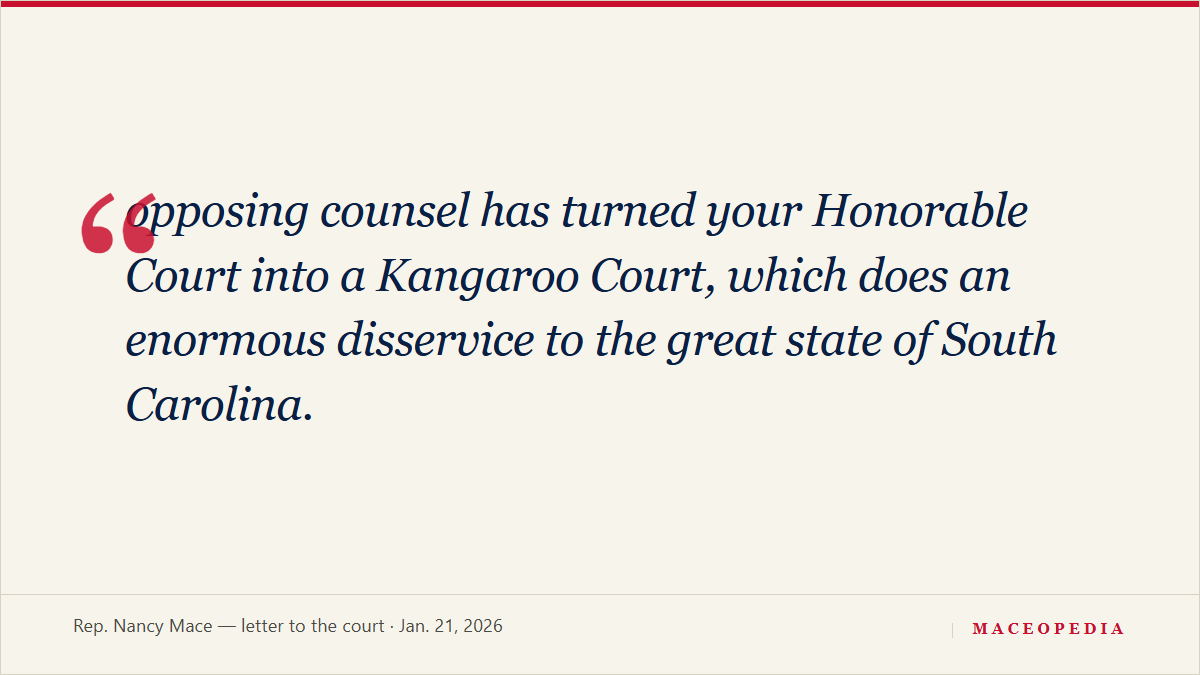
In a letter to the judge overseeing her gag order, Mace calls the court a 'Kangaroo Court' and moves the contempt matter to federal court: 'I will not be SILENCED.'
On January 21, 2026, Rep. Nancy Mace wrote directly to Judge Donald B. Hocker, the Charleston County circuit judge presiding over Berg v. Bryant, the case in which she is a third-party defendant under a gag order, calling the court a 'Kangaroo Court,' declaring the gag order unconstitutional, and announcing she was removing the contempt proceeding against her to federal court. Mace wrote the letter pro se, after she says she had discharged her counsel; it was stamped FILED on the state docket January 22, 2026. The full five-page filing is reproduced below. The allegations underlying the litigation are disputed and contested; Mace denies Bryant's claims, and Bryant denies Mace's.
 June 16, 2026 · Dispatch
Court appoints former Judge Kristi Harrington as third-party neutral to sort the 11,000+ disputed files in Mace's Google Drive
On June 16, 2026, Judge Donald B. Hocker appointed Kristi Harrington, a Charleston attorney and former South Carolina Circuit Court judge, to serve as a 'third-party neutral' in Assignment Desk Works, LLC v. Alexis Berg (Charleston County Court of Common Pleas, No. 2025-CP-10-2671), one of the cluster of cases tied to Rep. Nancy Mace and her former fiance, Patrick Bryant. Harrington's task is to review the more than 11,000 electronic files in what the court calls 'Mace's Google Drive,' files that both Mace and Bryant claim to own, and decide which, if any, must be turned over in discovery. The court split her fees between the two camps, warned the volume could make the process 'very cost-prohibitive,' and entered the order over Mace's objection. The order makes no finding on privilege, admissibility, ownership, or wrongdoing; the underlying allegations remain contested and unproven.
 July 20, 2026 · Dispatch
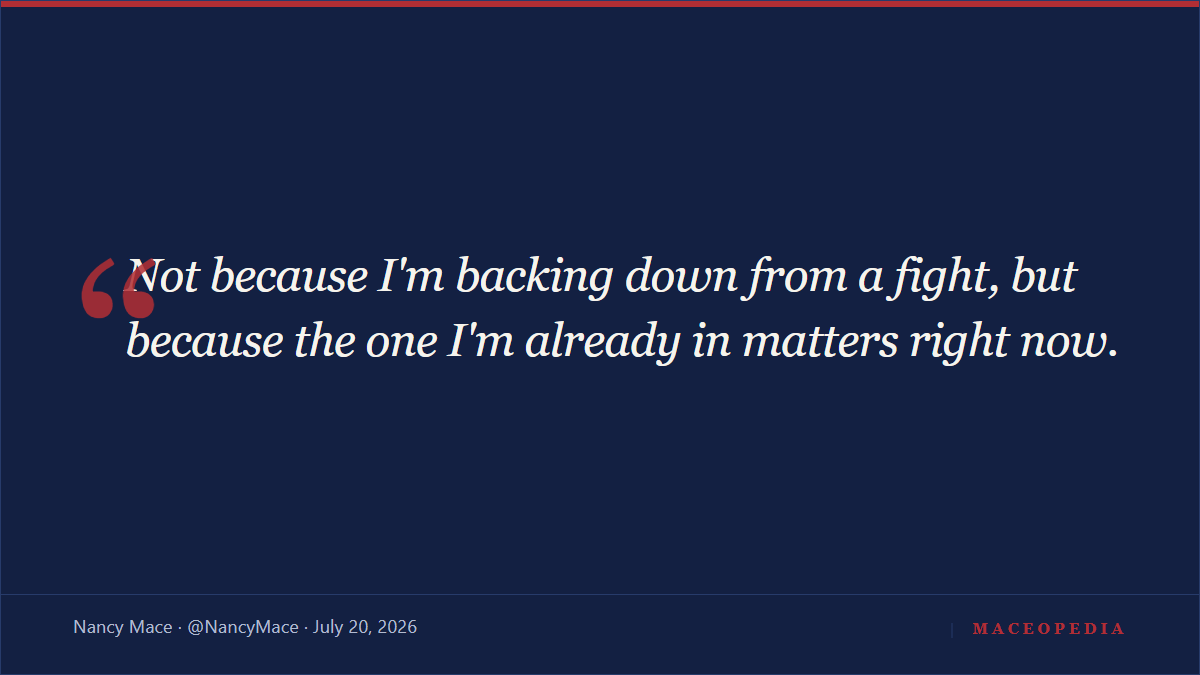
"The one I'm already in": Mace's Senate withdrawal was a statement about the case, made under a gag order that has never been lifted
Rep. Nancy Mace's July 20, 2026 announcement that she will not run for the Senate was, in both the video and the written statement, an announcement about litigation. She said she was leaving the race 'not because I'm backing down from a fight, but because the one I'm already in matters right now,' told supporters she has 'unfinished business,' and dated that business to the day she 'stood on that House floor.' That was February 10, 2025, when she named four men and told them they had 'bought yourself a one-way ticket to hell.' Three of those men are parties to Berg v. Bryant, where a gag order barring comment on the case was extended indefinitely in December 2025 and, on the documentary record, has never been vacated, dissolved, or found expired. It has also never been enforced. Mace contends it is unconstitutional.
 June 9, 2026 · Dispatch
Under a gag order barring 'any comment about any aspect of this case,' Mace uses her televised concession speech to talk about 'predators that got away in my case'
On the night of June 9, 2026, after conceding the South Carolina Republican gubernatorial primary, Nancy Mace told her Charleston election-night crowd, and a live television audience, that she had talked to Attorney General Alan Wilson 'about my case' and would help his administration ensure that 'predators that got away in my case … we finally put criminals behind bars.' Mace is a third-party defendant in Berg v. Bryant, where a November 26, 2025 gag order bars every party from 'making or publishing any comment about any aspect of this case' or about any party or person connected to it, and a January 12, 2026 civil-contempt motion over her earlier public statements remains pending. Both orders are reproduced in full below. Mace contends the gag order is unconstitutional; all underlying allegations are unproven and contested, and no court has ruled on the June 9 remarks.
 June 8, 2026 · Dispatch
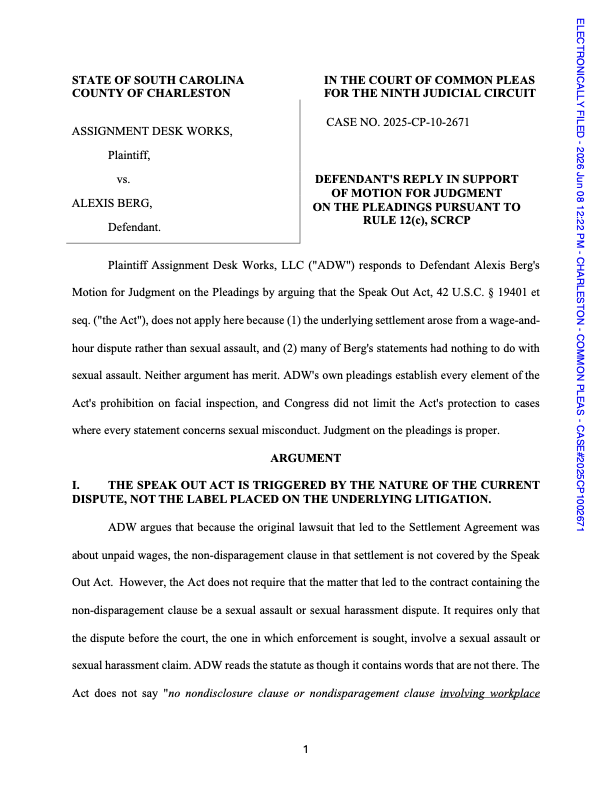
Gretchen Carlson, who helped write the Speak Out Act, files a sworn declaration backing Alexis Berg
On June 8, 2026, Alexis Berg's counsel filed a reply brief in Assignment Desk Works, LLC v. Alexis Berg (No. 2025-CP-10-2671) arguing that the federal Speak Out Act makes the non-disparagement clause ADW is suing on judicially unenforceable, because the dispute before the court involves sexual-assault allegations. Attached was a sworn declaration from Gretchen Carlson, the former Fox News anchor whose 2016 case helped inspire the Act, who states she has met with Berg and that 'this is exactly the situation we fought to address,' and offers to testify. ADW argues the Act does not apply. The motion is undecided; the underlying allegations are contested and denied.