'There's no other route': Mace's own cited Supreme Court ruling on birthright citizenship lays out a third option she didn't mention
Three days after the Supreme Court struck down Trump's birthright-citizenship executive order in Trump v. Barbara, Mace told followers a constitutional amendment is 'the only way' to fix the issue and that 'there's no other route.' The ruling she was citing includes a third path she left out: Justice Kavanaugh's separate opinion arguing Congress could rewrite the existing citizenship statute without touching the Constitution at all, though the majority and legal commentators dispute whether that route would actually survive review.

On July 3, 2026, Mace posted a vertical video on X titled "Fixing Birthright Citizenship: 2 Amendments," captioned:
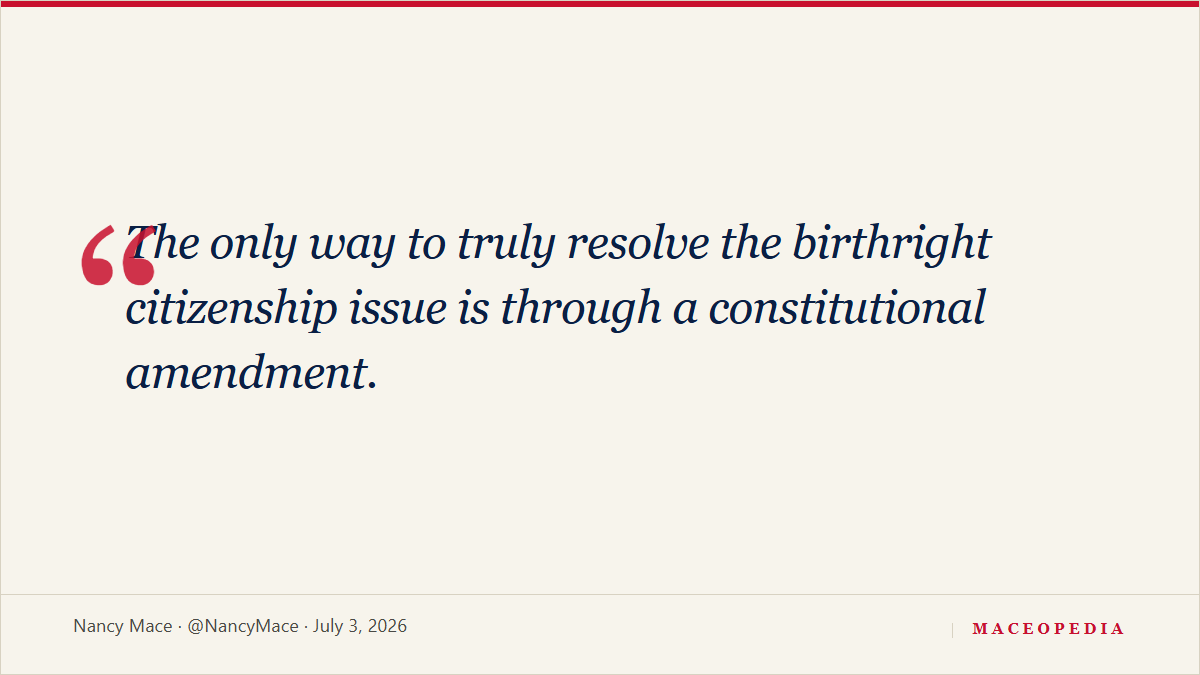
"The only way to truly resolve the birthright citizenship issue is through a constitutional amendment. Senator Rand Paul and I have both filed them."
The only way to truly resolve the birthright citizenship issue is through a constitutional amendment. Senator Rand Paul and I have both filed them.
Nancy Mace (@NancyMace) July 3, 2026
In the 63-second clip, Mace said:
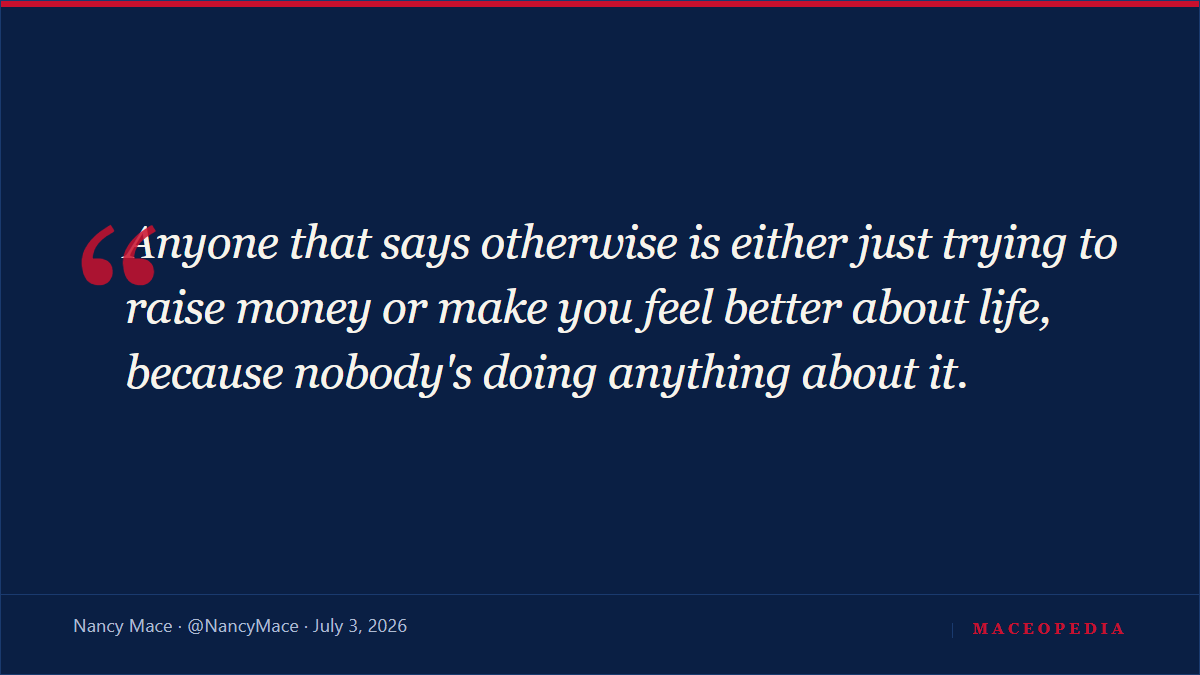
"There are two constitutional amendments. Back in April, Senator Rand Paul filed one. And then last month, early June, June 2nd, I filed one. Now both Rand Paul's and my constitutional amendment to fix the birthright citizenship issue in the Constitution, those are really the only two options in the meantime until SCOTUS rules a different way, which they're not going to. Because this was the majority opinion that came out this week. That's the only way out of this mess. And anyone that says otherwise is either just trying to raise money or make you feel better about life because nobody's doing anything about it. ... I am already and have been extremely pro mass deportation. Get them out of our country, don't let them in. And this is a massive problem for us and the only way to fix it is through a constitutional limit. In the meantime, that's it, there's no other route."
The ruling she's citing
The "majority opinion that came out this week" is Trump v. Barbara, No. 25-365, 609 U. S. ___ (2026), decided by the Supreme Court on June 30, 2026, three days before Mace's video. The case was a direct challenge to Executive Order 14160, which tried to deny automatic citizenship to children born in the U.S. to parents who are unlawfully or temporarily present.
Chief Justice Roberts wrote the opinion of the Court, joined by Justices Sotomayor, Kagan, Barrett, and Jackson, holding 5-4 that the Fourteenth Amendment's Citizenship Clause itself guarantees those children citizenship, following United States v. Wong Kim Ark, 169 U.S. 649 (1898). Justice Jackson filed a separate concurrence. Justice Kavanaugh concurred in the judgment (making the final vote to strike the order 6-3) but dissented from the majority's constitutional reasoning. Justice Thomas dissented, joined by Justice Gorsuch; Justice Alito and Justice Gorsuch each also filed separate dissents arguing the executive order was constitutional.
The option Mace left out
Mace frames the choice as binary: a constitutional amendment, or nothing, "until SCOTUS rules a different way, which they're not going to." But in the same ruling she cites, Justice Kavanaugh laid out a third path, one that runs through ordinary legislation rather than the Constitution at all. In an opinion "concurring in the judgment and dissenting in part," Kavanaugh wrote:
"But the Order does contravene a federal statute, 8 U. S. C. §1401(a). Congress could, consistent with the Fourteenth Amendment, amend §1401(a) or otherwise enact new legislation establishing exceptions to birthright citizenship for children born to foreign citizens unlawfully or temporarily in the country. But Congress has not yet done so."
He repeated the point at the close of his opinion:
"For those reasons, to reiterate, the Executive Order does not violate the Fourteenth Amendment. But the Order does contravene 8 U. S. C. §1401(a). Consistent with the Fourteenth Amendment, Congress could amend §1401(a) or otherwise enact new legislation establishing exceptions to birthright citizenship for children born to foreign citizens unlawfully or temporarily in the country. But Congress has not yet done so."
Kavanaugh's theory rests on a distinction between two things that currently happen to say the same thing: the Fourteenth Amendment itself, and the statute Congress passed to implement it, 8 U.S.C. §1401(a) (originally enacted in 1940 and 1952, tracing to the Immigration and Nationality Act). Kavanaugh read the Constitution's citizenship guarantee narrowly enough that he thought Congress could legislate new exceptions to the statute, without a constitutional amendment, and have that statute survive review. That is a real, published legal position from a sitting Justice, in the very case Mace cited three days later as proof there is no other route.
Not a settled path, including for the majority
The third option is disputed, including inside the same ruling. Roberts' majority opinion responds to Kavanaugh directly in a footnote, arguing his carve-out is self-contradictory:
"JUSTICE KAVANAUGH proposes a similar ad hoc exception to his own interpretation of the Citizenship Clause. Under his rule, the Clause generally does not promise citizenship to children whose parents are 'not U. S. citizens.' Yet it must grant citizenship under the 'facts and circumstances' presented in Wong Kim Ark, even though Wong's parents were not U. S. citizens. ... JUSTICE KAVANAUGH's exception is at war with his supposedly 'unifying' principle of the Clause."
The majority's own historical account cuts the same direction. Tracing the 1866 Civil Rights Act, the Court noted that Reconstruction-era critics argued Congress could not settle citizenship "by statute alone," which is precisely why the same Congress turned to a constitutional amendment instead, intending to place the "great question of citizenship" "beyond the legislative power" altogether.
Legal commentary since the ruling has largely sided with that skepticism. Writing in The New Republic, Matt Ford argued Kavanaugh's approach doesn't actually avoid a constitutional fight the way it claims to: "It is not possible to disentangle the statutory text from the constitutional text this time," and that treating citizenship as something Congress can narrow by ordinary statute "transforms the citizenship clause into an Article 1 legislative power" rather than a fixed right. SCOTUSblog's breakdown of the decision similarly frames Kavanaugh's position as the outlier: a "middle ground" that "sided with the challengers to Trump's order" on the outcome while rejecting the majority's constitutional basis for doing so.
None of that means Kavanaugh's statutory route is dead, only that it is contested, not settled, and not the unanimous or even majority view of the Court that decided Barbara. Mace's claim that a constitutional amendment is "the only way" and that "there's no other route" tracks the five-Justice constitutional majority. It leaves out that one member of the six-Justice judgment, in the ruling she is citing as proof, is on record proposing exactly the kind of legislative fix she says doesn't exist.
What Mace and Paul actually filed
Mace's own account of the amendments is accurate as far as it goes: Sen. Rand Paul filed a Senate joint resolution in April 2026, and Mace filed a House companion on June 2, 2026, each proposing to amend the Fourteenth Amendment to deny automatic citizenship to children of parents who are unlawfully present or in the country temporarily. Both are constitutional amendments, which require two-thirds of both chambers of Congress and ratification by three-fourths of the states, a far higher bar than the ordinary majority-vote statute Kavanaugh described.
This is not Mace's first citizenship-related constitutional amendment. On May 20, 2026, she introduced a separate joint resolution to bar naturalized citizens from serving in Congress, on the federal bench, or in Senate-confirmed positions, naming Reps. Ilhan Omar, Shri Thanedar, and Pramila Jayapal as her stated motivation. That amendment addressed who can hold office; the birthright citizenship amendment addresses who is a citizen at all. They are separate proposals on separate constitutional questions.
Sources and related coverage
- Nancy Mace (@NancyMace), X post and video, July 3, 2026
- Trump v. Barbara, No. 25-365, 609 U. S. ___ (2026), slip opinion (PDF)
- SCOTUSblog, case page: Trump v. Barbara
- SCOTUSblog, "Supreme Court strikes down Trump's order ending birthright citizenship"
- SCOTUSblog, "Breaking down the birthright citizenship decision" (Adam Feldman)
- The New Republic, "What Did Kavanaugh Write on Birthright Citizenship" (Matt Ford)
- Wikipedia, "Trump v. Barbara"
- Mace introduces constitutional amendment to bar naturalized citizens from Congress
Read next
 May 20, 2026 · Dispatch
Mace introduces constitutional amendment to bar naturalized citizens from Congress: 'Not Somalia. Not any other country.'
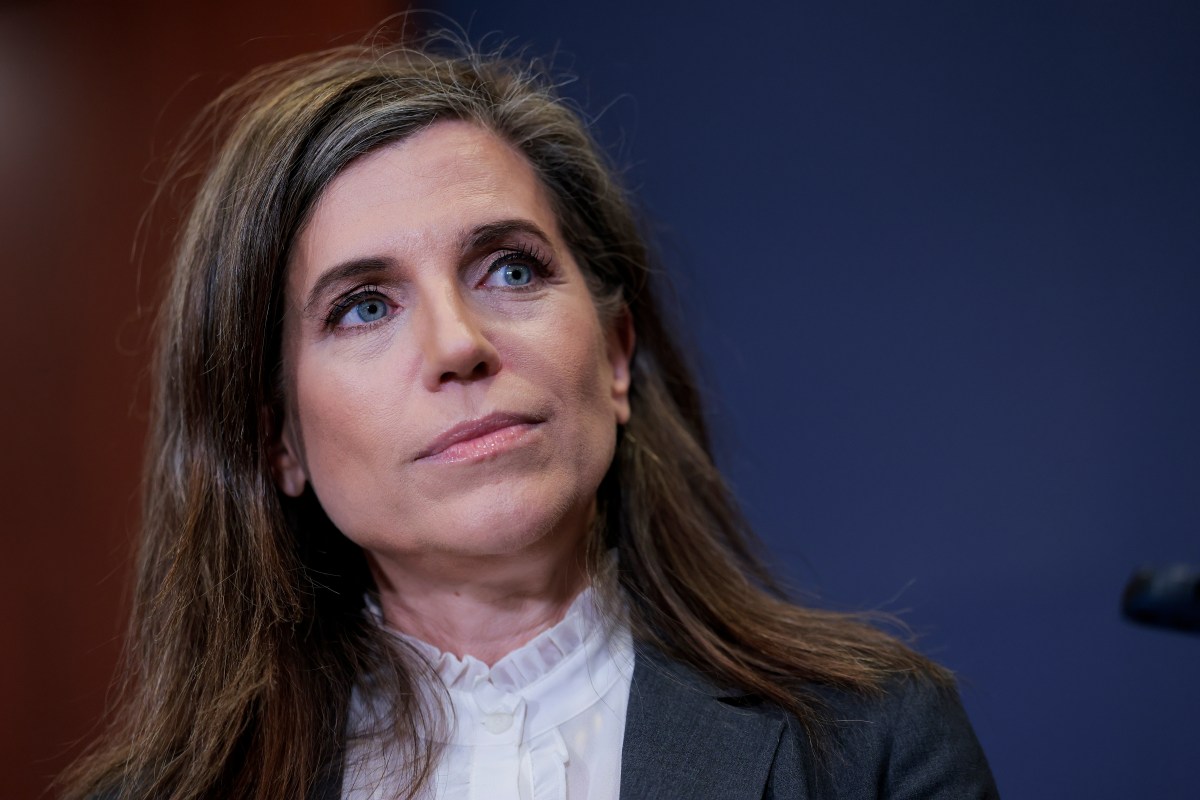
On May 20, 2026, Mace introduced a joint resolution to amend the Constitution to bar naturalized citizens from serving in Congress or on the federal bench, naming three Democratic members, all naturalized, as her motivation.
 September 4, 2026 · Dispatch
Mace targets Celeste Keaton with anti-LGBTQ slur on X
On July 31, 2026, from her personal X account, Rep. Nancy Mace posted a photo of a named individual, Celeste Keaton, and wrote 'She looks like a dyke,' using an anti-LGBTQ slur that runs against X's own hateful-conduct policy. Maceopedia documents the post as part of Mace's public language record. Maceopedia has not independently verified, and does not repeat as fact, the separate allegation Mace attached about the individual.
 September 4, 2026 · Dispatch
Nancy Mace, on Piers Morgan: 'I don't believe there's been genocide in Gaza'
On the September 1, 2026 Piers Morgan Uncensored panel, Rep. Nancy Mace was pressed repeatedly by a fellow panelist to call the war in Gaza a genocide and refused, saying, 'I don't believe there's been genocide in Gaza.' She defended Israel without qualification ('I think Israel is protecting Jews as they should. I support Israel'), rejected a two-state solution ('This has been Israel's land'), and, asked to condemn the killing of civilian children in Gaza, pivoted instead. A panelist confronted her over pro-Israel PAC money, calling her 'bought and paid for.'
 September 1, 2026 · Dispatch
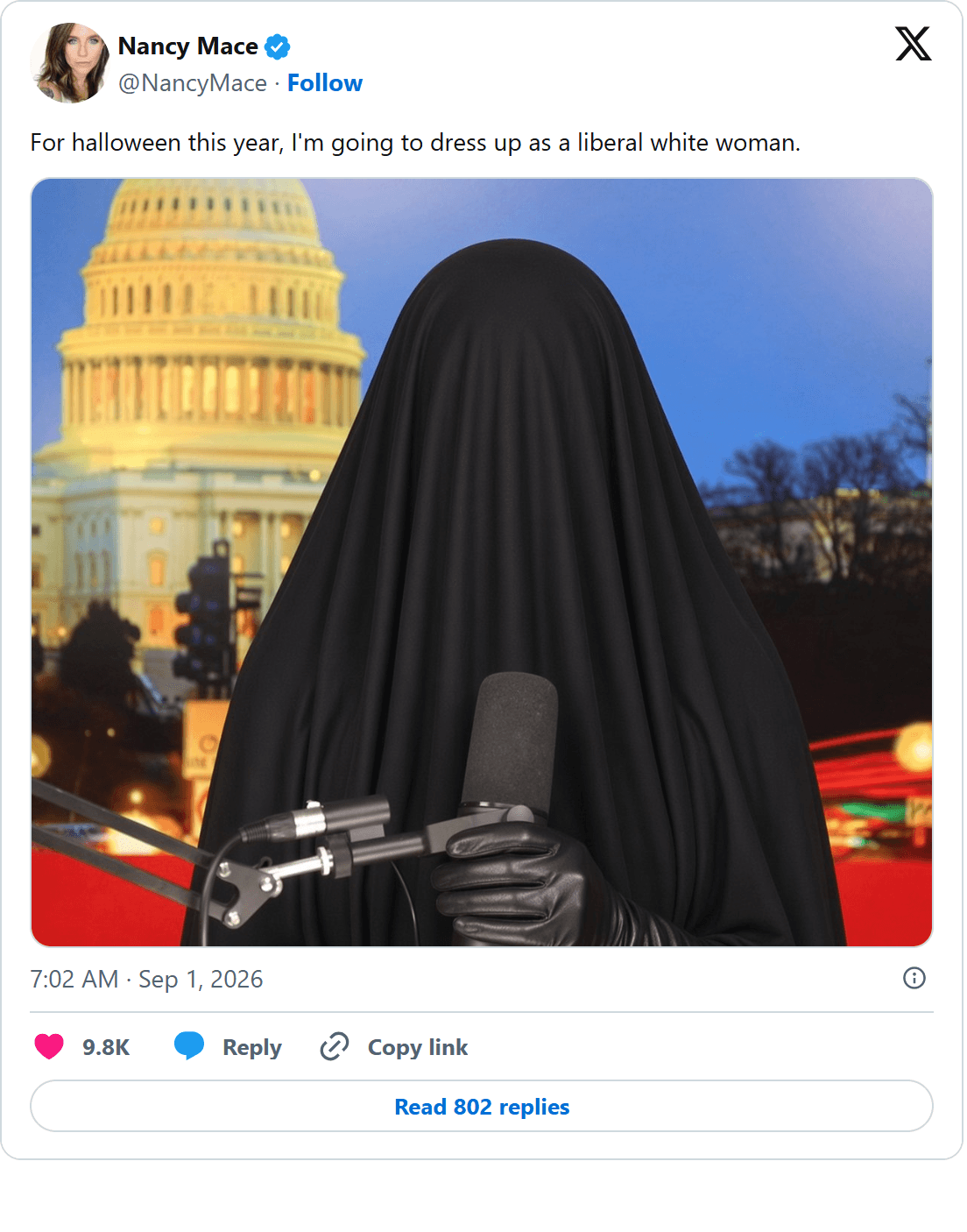
Mace's Halloween Post: 'I'm Going To Dress Up As A Liberal White Woman'
On the morning of September 1, 2026, Rep. Nancy Mace posted from her personal verified X account: 'For halloween this year, I'm going to dress up as a liberal white woman.' The line ran over a staged image of a figure draped head to toe in black, face fully covered, a gloved hand on a podcast microphone before the lit Capitol. It is not a one-off. It is the capstone of a documented month-long run of 'liberal white woman' material from Mace: a 'Get Maced' episode titled 'THE ENEMY WITHIN,' a Daily Wire op-ed under her byline calling liberal white women a 'national security threat,' and Facebook teasers. This dispatch shows the post and lays out the record; readers can judge it for themselves.
 August 30, 2026 · Dispatch
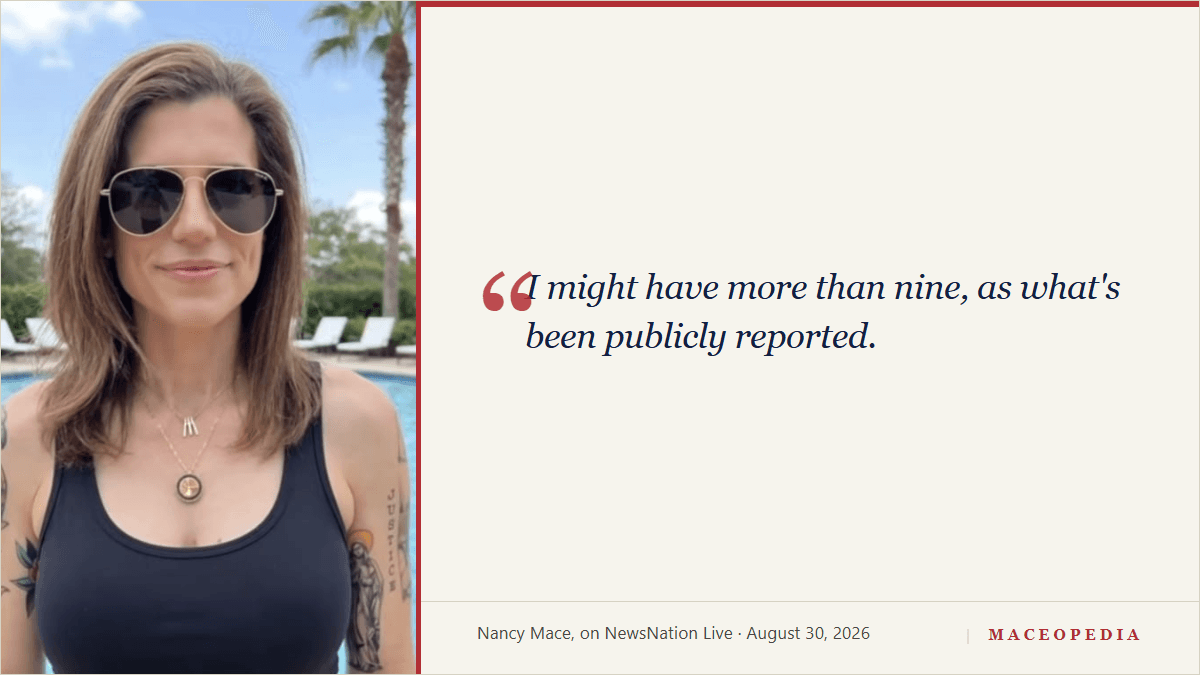
Mace, on NewsNation: her tattoos are 'free speech,' and 'I might have more than nine'
In an August 30, 2026 NewsNation Live interview, Rep. Nancy Mace framed her tattoos as an expression of free speech rather than a shot at President Trump, saying, 'I've always supported the president's policies. He's not always supported mine,' and tying the ink to 'the beauty of the First Amendment and free speech.' She also revised her own tattoo count upward on camera: 'I have a few tattoos. I might have more than nine, as what's been publicly reported.'
 August 30, 2026 · Dispatch
The Record: What Nancy Mace Has Said About Being Sexually Assaulted, Whom She Told, and What Reached Authorities