We Beat ISIS In Iraq And Came Home. Iran Is Next in LINE. Nancy Mace
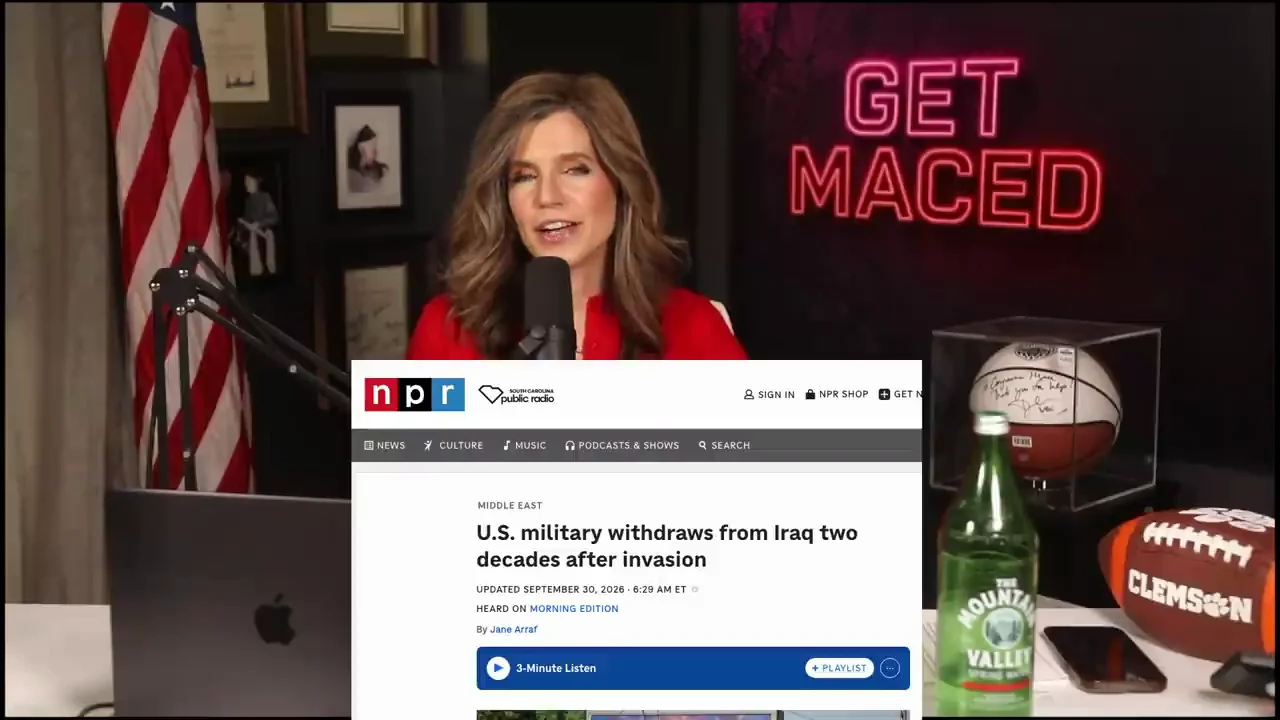
[00:03] All right. Good evening to this edition of Get Maced. I'm Congresswoman Nancy Mace. I do four nights a week, Monday through Thursday at 8 p.m. If you haven't subscribed, please subscribe now. Tonight's episode is going to be a little bit different than I know. I like to tell a few jokes, but this is no laughing matter. So I'm going to tell hardly any. I might tell one tonight, one little quip. But I want to talk about a story this week that the mainstream media really hasn't covered. And this is the withdrawal from Iraq. I think this is really important because the vast majority of us are not for forever wars. And when we when we withdraw from a country, our military does. I think that we should all know about it and know about it in detail. But the mainstream media doesn't want to want to do stories on this because they don't want to give Trump a win, whether you like Trump or not. Withdrawing. Withdrawing from a country in the Middle East is a win. It's nonpartisan. We've had presidents who are Republican and presidents who are Democrat put withdrawal plans together.
[01:07] And this is a success story for all of us, given what's going on with Iran right now. And all of us want that war to end.
[01:15] So we're going to go into we're going to do a deep dive on that tonight.
[01:50] Iraq's government is run by by Iraqis out of Baghdad. They have a prime minister. They have a government which is different. From Afghanistan, I I don't think of Afghanistan as a government run country because they've got the Taliban, a terrorist organization that we pay, by the way. Other actors in this story are the Kurds. The Kurds are allies of the United States. They have fought alongside American soldiers for decades. They have a Kurdish leader, also a prime minister. And then you have Iran's militias. There are two or three, three actually militias that run around in Iraq that are funded by Iran. And that's important. To know, ISIS is still in Iraq, funded by Iran. And so the go-between between Iran and the U.S. on the Iranian side is on the go-between between the U.S. and Iran on the U.S. side is cutter. So those are the main players tonight. And this week, American troops left Iraq.
[02:53] We had a few thousand there about two thousand a year since 2017. They left. left this week and they will not and they will not be back the orderly departure of coalition forces and equipment from herbal air base marks the successful conclusion of the military mission that defeated isis in iraq it is a successful conclusion is different than the conclusion in afghanistan it's certainly different than iran right now but where did it all start in august of 2014 you had the operation that was started by president obama operation inherent resolve started in iraq we started bombing and attacking isis forces under the obama administration and our first strikes protected the kurdish city of herbal from isis that was 12 years later herbal was the last base we left in iraq and this started under obama and of course all this conflict in the middle using the u.s and arizona went on disappear until late 2014 and this was the started under Bush.
[03:55] And we can have a whole long podcast about whether or not that was the right call. I disagree with Bush on going into the Middle East. But what also came home was our missile defense system that that did protect our Kurdish allies. And we'll get into that. And then this week, Iran got our answer to their plan to end the war. And that was
[04:22] zero. That was a no. So politicians love a deadline. And actually, for the first time in a long time, the US government met its deadline, and we we got out of there. So I'm going to go through all of it tonight in plain English for you. Okay, so how did we get here? Like I said, it started in 2014. With Operation Inherent Resolve, however, obviously, 9-11 happened September 11, 2001. We sent forward the final statement that we wanted to end the war. So forces overseas to different countries, Iraq, Afghanistan, and invaded Iraq in 2003 is when we invaded. At the peak in 2007, we had more than 160,000 US troops in Iraq. In 2011, we pulled out. ISIS took some ground and got stronger. And so then in 2014, after ISIS took over huge parts of Iraq, we went back in to beat them. And we won. Iraq has declared ISIS defeated in their country.
[05:24] We kept a small force about 2000 troops this year, and it's dwindled down. And now now we're completely now we're out.
[05:35] And by 2024, Washington and Baghdad agreed to wind down the presence of around 2500 troops from Iraq by September 30. This year, those troops are mostly located in the semi autonomous Kurdish region of northern Iraq. It includes a removal of US air defense systems. So the Biden administration and Iraq agreed in 2024 to end the mission by 2026. And President Trump kept that date. Thank you, President Trump for for doing what you said you were going to do. And then Pentagon spokesperson, Sean Parnell put out a statement. He's a chief spokesperson for the Pentagon. He said that US and coalition partners formally concluded operation in Europe, this concrete, consistent with September 2024, the US Iraq joint statement, and US national interest and all this started operation inherent resolve started in 2014. When President Obama first did strikes on ISIS fighters up in that region of the world.
[06:37] And Iraq was supposed to disarm Iran's militia as it hasn't totally happened yet they've set a deseline for 2827 to fully disarm Isis. ISIS fighters since a few of them still have their guns. And then this week, obviously, there are going to be some people celebrating. Iran's going to celebrate a victory. ISIS is going to celebrate a victory. That's what the terrorists do. They take a story that's bad for them and turn around and use propaganda on their people. So Iran's militias are celebrating tonight. They attacked our troops over 600 times since February. Think about that. And now we're leaving on our win, as we said we would. We're fulfilling our promise. And they want to take that as one. Of course, they do. That's called propaganda. But obviously, the U.S. won. And we made good on our promise to exit out. It's very rare that the U.S. government will give you the exit strategy and then fulfill that exit strategy and do it on time. It's every politician's favorite.
[07:38] It's every politician's dream to do it on time and put it in a press release. Let's talk about the Kurds for a little bit. The Kurds are our ally. American troops have been fighting alongside them for decades. The Kurds fought ISIS on the ground side by side with American troops, and we left the rest of Iraq first. We stayed back in Erbil, which is their capital. That was our last base. That's where it was. The Patriot missiles that shot down drones and rockets fired at them from the base, from Erbil. The Kurdish government is concerned because they say that over 1,000 drones and missiles were fired at them since February. And a chance to expose the Taliban's weakness. But with only five days left before U.S. forces pull out for good, the despair of... There is some despair there, and that's what's going to happen anytime the United States leaves a region. Prime Minister for the Kurds, Barzani, said this week, losing those defenses, our defense systems will definitely put them at risk. But the U.S.
[08:40] just can't be, we just can't be the world's police. We can't occupy every country all the time. We've got to take care of America first. We left Afghanistan in 2021. That was a disaster. We lost 13 American troops. This is not that. We left without any American troops harmed.
[08:58] Back in Afghanistan, the Taliban took over in days. We pay them, by the way, $80 million a week, which I support Congressman Tim Burch's bill not to do that anymore. We shouldn't be paying terrorists. We shouldn't be paying the Taliban. We don't know where that money is going. We've got a lot bigger problems on our hand. Sean and Legend brought to our attention that at least $40 million per week, per week, $40 million per week in taxpayer money is ending up in the hands of the Taliban, and then it's later being auctioned off. But both times in the Iraqi withdrawal, we're saying to the Iraqi government, they have an actual government. It's now in your hands. The same thing we do with Afghanistan.
[09:42] We told the Taliban it's in your hands, and we pay them, which we shouldn't be doing.
[09:48] The lesson here is that the U.S. government has kept its promise in Iraq. Iraq hasn't kept theirs. They had to push back the date to disarm ISIS. They've given themselves until 2027 to do that. I pray that they do that because I don't want us going back into Iraq. I do not want the United States to be back there.
[10:08] Now moving on to Iran, the Iran war. February 28th, the U.S., along with our ally Israel, began bombing Iran seven months ago.
[10:22] And on February 28th, the U.S., alongside our ally Israel, started bombing Iran. We can go into the facts of why that happened. Probably better to do it in a skiff, to be honest with you. I think what the administration was told, what other information was out there, I don't know that the information was quite that accurate. But that war started seven months ago. Now on February 28th, the U.S. started bombing Iran with our ally Israel, and that was seven months ago.
[10:54] And the administration wants to call this a strike. These are strikes. This is a war. When you strike over and over and over again, day in and day out, you are in a war. There's no other way to define it. Pre-Iran war, we had over 130 vessels, mostly oil tankers, going through the Strait of Hormuz. The Strait of Hormuz is primarily shut down today. Pre-Iran war, we had over 20 million barrels of oil a day coming through the Strait, so when you look at one-fifth of the world's oil going through the Strait of Hormuz, when you ask yourself, why is my gas so high? This obviously has had an effect on gas prices, and it's only going to get worse as long as this war continues. Now the Strait of Hormuz is a narrow sea lane that traverses overseas adjacent to Iran, and Oman is right across from Iran on the map. So it's a very,
[11:56] narrow strait that Iran is trying to control. You should care, because the reason your gas is so high is because of the Strait of Hormuz. Now our move is that our navy is blocking Iran's ports so they can't sell their oil. Now I will tell you, while that's happening, Oman has been trying, allegedly, to sell oil on the market that they have labeled as their own, but is Iran's. So how that's happening, I'm not sure, and I don't like it. You should know where the oil is coming from.
[12:23] Iran's offer, Iran made an offer.
[12:28] Here's the president.
[12:32] And the president, of course, turned that down. Iran's offer was that they reopen the sea lane, the Strait of Hormuz in a week, and we lift our blockade and give them back their frozen money. The U.S. has frozen. They have about $24 billion in financial assets that Iran wants back with no strings attached. That was an easy no by President Trump. They're not going to get free money to go build a nuclear bomb. I don't think so. The president said no, that he disagreed. And still, this week we sent an answer back. So Iran uses Oman and the U.S. uses Qatar to negotiate with the Iranians. There's a lot of go back and forth.
[13:24] And we took it to them this weekend. We took it to them this weekend. We took a response to them this week after we declined their offer. The fight really is about who goes first. And my whole thing is that you can't give Iran money or give them any sort of grace until you have strings attached, until you have a system that inserts on the ground at their nuclear sites to ensure they aren't and do not have the resources that they need to build a nuclear bomb. That's number one.
[13:58] So that's really having an inspector on the nuclear sites is first. And to get to that $24 billion that Iran wants, if and when they ever do get it, I think it should only go to medical. So our medical expenses and food, nothing else, which means it's going to have to be administered by a third party, i.e. a third country or someone who can make sure it's not going to fund terrorism or not going to prop up the IRGC and terrorism. Iran is very good at that. And we don't want them. We don't want them to have those resources to be able to do that. Now, something I wanted to explain is that we've had a couple of votes on the Iran war. We have voted on multiple war powers resolutions, but we haven't yet voted on an AUMF or an authorized use of military force.
[14:52] There are two votes in a war in Congress and only Congress under Article 1 of the Constitution gets to declare war.
[14:59] One is the war powers resolution, which basically says stop the war. And then an AUMF, an authorized use of military force, which means go, start the war. There are two uses. Congress has voted on the war powers resolution over and over again. We have yet to vote on an AUMF. And to get into the specifics of the AUMF, Congress has the power to declare war under Article 1. The president's responsibilities, what the commander-in-chief can do, which is be in charge of our military, that's under Article 2. And Article 1 and Article 2 in the Constitution have been fighting for hundreds of years since the Constitution was written. And so those two powers have been fighting each other for a very long time. Congress actually hasn't officially declared war since World War II. Since World War II, we've been using the AUMF to fight our battles, starting with Vietnam. So for the Vietnam vets that are watching tonight, welcome home. Why it exists?
[16:00] It exists because of Vietnam. Congress felt the president had dragged our country into a war they did not want to fight and never really, never voted for it. It passed the war powers resolution in 1973 to bring, you know, our troops home in Vietnam was passed over. It was passed over President Nixon's veto. That's a big deal. And it requires the president to tell Congress within 48
[16:30] days. President Trump did that at the beginning of the Iran war. The troops have to come out of the conflict within 60 days. They have an extra 30 days to withdraw. So a total of 90 days. And we have held presidents historically, we've held their feet to the fire on that. Any member can force a vote of a war powers resolution. We've had a couple of them. The last war powers resolution, seven Republican members voted for it, including two from Iowa. I was one of them. I want the war powers resolution to be a part of the war powers resolution. I hope you have a good day. Okay, a few examples of war powers resolutions that have passed. In 2019, Congress passed one to end U.S. support for the Saudi war in Yemen. Trump vetoed it. In 2020, Congress passed one on Iran after the Soleimani strike. Trump vetoed that too. And I love the Soleimani strike. I would have never voted for a war powers resolution. Trump has had a history of going in very surgically, taking somebody out and coming right out. Iran is different because we've been there now for seven months.
[17:31] We've been there for seven months. It is not a surgical, tactical thing. It is a war. Now, when it comes to AUMFs, AUMFs are laws that are passed by Congress, by both chambers, meaning the House of Representatives and the Senate. They are signed by the president and saying that he authorized to use force against an enemy. So one means, yes, go fight AUMF. One means stop fighting, and that would be the war powers resolution. So the big uses of the AUMFs, 1964, the Gulf War, the Gulf of Tonkin resolution. There was a blank check that escalated during Vietnam. 1991, the Gulf War. It was a vote to push Saddam out of Kuwait. 2001, after 9-11,
[18:17] presidents have stretched it for more than, the last AUMF, from 9-11, presidents have stretched it
[18:27] beyond 20 years. That's how we stayed in the Middle East for so long. Only one member of Congress back then, the President of the United States, the President of the United States, back in 2001, after 9-11, voted against the authorized use of military force, and that was Barbara Lee. She voted no. 2002, we did one for Iraq. The vote before the 2003 invasion into Iraq was the AUMF that put us there back in 2003.
[18:53] So how this applies to Iran right now, no AUMF has been voted on. Congress hasn't authorized us to fight anyone in Iran. There have been a number of war powers votes. In June, the House and Senate both passed one. It was a type of resolution the President doesn't want to sign. The White House ignored it, and it says, the White House said the war powers resolution is unconstitutional. The Senate has voted 14 times, and the latest failed just recently, two weeks ago, 49 to 50. The 60-day clock ran out in April. It's been well over 90 days. It's been seven months, and it's time to make your case, vote it on the AUMF, which they won't. The reason, this is insider information, but the reason they will not vote on an AUMF is because it would fail, and the President would have to withdraw his troops and withdraw from the area and stop bombing immediately, because authorizing a war in Iran would not pass, would not pass overwhelmingly in the House of Representatives.
[19:59] So there are two votes that matter in a war, one that says go to war, one that says, stop the war. And that's what we're talking about. I would even say that, bring back Congress before the election, vote on the AUMF, vote on a war powers resolution, send it to the President. Let's do this before the election. Let the, you know, the American people have the right to know where, where your elected official stands on this war. Let's do the AUMF. Since the war powers, the President is ignoring the war powers resolution, let's do an AUMF. Our troops beat ISIS and came home. We won the Iraq war. And that's worth saying out loud. Today, Iran's militias want the credit, and they're not going to get it because they lost. They've been diminished. And soon in the next year, year and a half, the Iraqi government is going to disarm the rest of ISIS. We have five weeks until the election. We need to make very clear as Republicans that we do not want another forever war, or we're going to continue losing our livelihood and losing our elections for decades to come if this continues.
[21:04] This is too high. Groceries keep going up. There is no end in sight. Rates keep going up. We need to end the war with purpose. And we need to end it now.
[21:17] I see you're not following me. Hit the follow button now.