Part of: Musgrave v. Mace (2:25-cv-01823-RMG)
The Art of Defamation: How Mace Uses Her Office and Her Questions to Skirt the Law on Judge Gosnell
Maceopedia ·
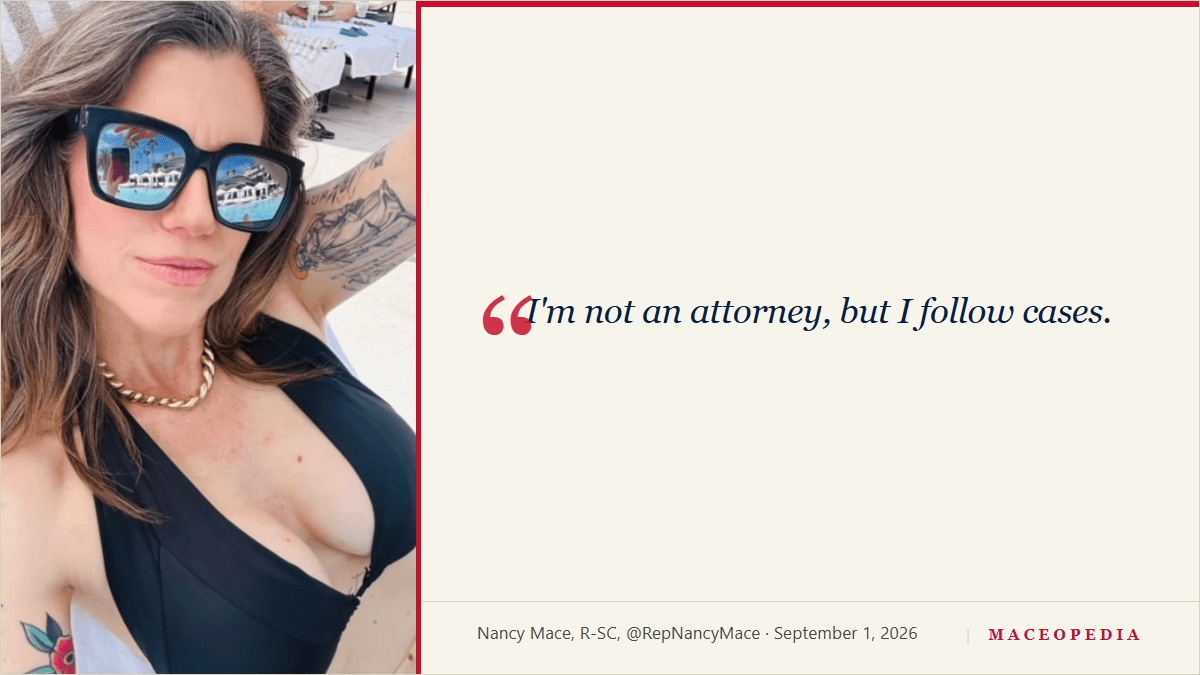
Nancy Mace is not a lawyer. She says so herself, on camera, in the same breath as the words this dispatch is about: "I'm not an attorney, but I follow cases."
Seconds later, in an interview she promoted on her official congressional account on September 1, 2026, the sitting congresswoman took a federal child-pornography case and floated the idea that the defendant, former Charleston County magistrate James B. Gosnell Jr., may have done something he was never charged with: "raping a baby." The federal record contains no such charge against him. And she did not assert it. She asked it.
That combination, a reputation-ending accusation delivered as a question, by a public official, about a public figure, is close to the textbook description of how to damage someone's name and very likely never answer for it in court. This is not a defense of Gosnell. He pleaded guilty in federal court to possessing and distributing child sexual abuse material, and he faces up to 40 years in prison. This is about method: the difference between what the record says and what a member of Congress can insinuate around it.
What she said
The clip is audio over Mace's own official photo, posted to her account. The two passages that matter are verbatim below.
Audio: Rep. Nancy Mace, posted to @RepNancyMace, September 1, 2026. The full clip is hosted here.
On the plea and her own standing to read it:
"I'm not an attorney, but I follow cases, especially cases of child predators, because I want every child rapist to be executed. I don't care how it happens, firing squad, guillotine, I don't care."
And then, asked how Gosnell's plea deal came about, the line at the center of this piece:
"There is no explanation. Did he plead guilty so they couldn't find other evidence of other potential criminal wrongdoing, like raping a baby? I just, I don't know, because that information isn't available to the public."
She had already told the audience, moments earlier, "there was a baby involved here."
We don't recognize the country we grew up in. A Charleston judge who served more than 20 years on the bench was caught with thousands of images of child sexual abuse material. James Gosnell Jr. pleaded guilty to one count of possession and one count of distribution of child sexual abuse material...
Rep. Nancy Mace (@RepNancyMace) September 1, 2026
What the record actually shows
The record is public, and it is narrower than the insinuation.
James Gosnell Jr., 69, a Charleston County magistrate for more than twenty years, pleaded guilty on July 2, 2026, in the U.S. District Court for the District of South Carolina to two federal counts: possession of child sexual abuse material and distribution of child sexual abuse material. Per the U.S. Attorney's Office, he faces a five-year mandatory minimum, up to 40 years total, a fine of up to $250,000, lifetime supervised release, and lifetime sex-offender registration.
He was not charged with, indicted on, or convicted of any hands-on or contact offense against a child. His guilty plea is to images, not to touching anyone. In court, Gosnell and his attorney stated that he "never touched a child" and never intended to.
There is a source for the darker material, and it is important to be precise about what that source is. In a detention motion filed September 22, 2025, federal prosecutors alleged, quoting Gosnell's own Telegram chat messages, that he described abusing infants and a toddler. Those are allegations in a pretrial filing, drawn from his claimed statements. They are not charges he was indicted on, they are not part of the crimes he pleaded guilty to, and Gosnell denies ever touching a child. "Was the baby abused," as the interview put it, is a question the public record does not answer against Gosnell as a matter of proven fact.
That gap, between "the prosecution once alleged, from his chats, that he described abusing infants" and Mace's "did he plead guilty so they couldn't find evidence of, like, raping a baby," is exactly the space where defamation lives.
How a South Carolina defamation lawyer reads it
What follows is a general legal explainer, written for readers, of how South Carolina defamation law would apply to these statements. It is not legal advice, and it is not a statement from any lawyer representing any party. Every case below was pulled and confirmed from the court's own opinion text; the links are in Sources.
Start with the elements. To win a defamation case in South Carolina, a plaintiff generally must prove a false and defamatory statement of fact about him, published to others, with the required fault, causing harm. The state's leading modern case is Erickson v. Jones Street Publishers, LLC, 368 S.C. 444, 629 S.E.2d 653 (2006), where the South Carolina Supreme Court worked through a libel claim and the "constitutional actual malice" a public plaintiff must prove.
Now apply it to Mace's Gosnell line, and two shields appear. They are the two reasons a good defamation lawyer would tell Gosnell his case is hard, and they are the same two reasons the statement is built the way it is built.
Pillar one: she asked a question. Falsely stating that a man raped an infant is defamation per se: it imputes a serious crime and needs no proof of special damages. But Mace did not state it. She asked, "Did he plead guilty so they couldn't find evidence of, like, raping a baby?" A question is harder to pin down as a "false statement of fact," because on its face it asserts nothing. That is the loophole, and it is a real one. But it is not magic. In Milkovich v. Lorain Journal Co., 497 U.S. 1 (1990), the Supreme Court refused to create a blanket exemption for anything phrased as opinion or hedged language. As the Court put it, "If a speaker says, 'In my opinion John Jones is a liar,' he implies a knowledge of facts which lead to the conclusion that Jones told an untruth." The protection runs to statements that a listener "cannot reasonably interpret as stating actual facts," what the Court called "rhetorical hyperbole." A statement "of opinion relating to matters of public concern which does not contain a provably false factual connotation will receive full constitutional protection."
So the question is whether a reasonable listener hears Mace's rhetorical question as pure speculation, or as her implying she knows a hidden fact: that Gosnell raped a baby and cut a deal to bury it. If it is the former, it is protected. If it is the latter, the question form does not save it. That is genuinely a close call, and "close call" is a defense lawyer's friend, because the burden is on Gosnell.
Pillar two: he is a public figure. This is the bigger shield. Gosnell is a public official turned public figure: a sitting judge for two decades, and now the subject of national coverage. Under New York Times Co. v. Sullivan, 376 U.S. 254 (1964), a public official cannot recover for a defamatory falsehood about his official conduct "unless he proves that the statement was made with 'actual malice,' that is, with knowledge that it was false or with reckless disregard of whether it was false or not." The Court extended that same demanding standard to public figures who are not officials in Curtis Publishing Co. v. Butts, 388 U.S. 130 (1967), and reaffirmed the framework in Gertz v. Robert Welch, Inc., 418 U.S. 323 (1974). South Carolina applies it too (Erickson).
To win, Gosnell would have to prove not just that the "raped a baby" implication is false, but that Mace either knew it was false or recklessly disregarded whether it was true. That is a high wall. And notice how the clip is pre-built to clear it: "I'm not an attorney," "I don't know," "that information isn't available to the public." Every one of those lines is a brick against a finding of actual malice. They cast the accusation as the honest wondering of a layperson who lacks the facts, which is close to the opposite of "knowing falsity."
So: is it defamation? In the everyday sense, a false and reputation-destroying imputation of one of the worst crimes imaginable, aimed at a specific, named man, yes, the statement has the shape of defamation, and but for the two shields it would be a strong per se claim. In the courtroom sense, it is very hard to prove, precisely because she framed it as a question (pillar one) about a public figure (pillar two). That is not an accident of phrasing. That is the craft.
And the office? This is where it stops being hypothetical. The headline says she uses her office to skirt the law, and that is not a figure of speech. Her federal position can open two separate doorways, and one of them has already shut a defamation case brought against her.
The first is the Constitution's Speech or Debate Clause, which shields a member of Congress for legislative acts: votes, floor speeches, committee work. It is why a suit over something Mace says on the House floor is very hard to bring. But it does not reach a podcast or a cable hit. The Gosnell clip is an interview, not a floor speech, so Speech or Debate does not cover it.
The second doorway is broader, and it does reach interviews: the Westfall Act. When a federal employee, a sitting member of Congress included, is sued for a tort like defamation, the Justice Department can certify that the employee was "acting within the scope of his or her office or employment." On that certification the United States is substituted as the defendant (28 U.S.C. § 2679(d)(1)), and because the Federal Tort Claims Act bars libel and slander claims against the United States (28 U.S.C. § 2680(h)), the case is dismissed, with no trial on whether the statement was true or false.
We do not have to imagine how that plays out for Mace, because it already happened, in the same federal courthouse, before the same judge who would later take Gosnell's plea.
In February 2025, Mace used a House floor speech to name Brian Musgrave and three other men, label them "predators" on a poster beside her, and accuse them of incapacitating and secretly recording women, accusations Musgrave denies. She reposted the speech on her official congressional account, placed the "PREDATORS" poster in the hallway outside her office, and in an April 2025 television interview said things Musgrave alleged falsely implied she had evidence he had committed crimes. He sued her for defamation, Musgrave v. Mace, No. 2:25-cv-01823-RMG (D.S.C.). On August 20, 2025, U.S. District Judge Richard Mark Gergel dismissed the libel claims with prejudice. The United States certified that Mace had acted within the scope of her congressional duties, substituted itself for her, and the FTCA's bar on libel claims ended the case. The court never ruled on whether her accusations were true. It did not have to. The office answered first.
Whether that same certification would cover this particular Gosnell interview is a separate fight, and a Westfall certification can be challenged in court. But the Musgrave order shows how readily it reached Mace's own words: the dismissal there swept in not only her floor speech but her reposts and a television interview. So the office is a third shield, stacked on the other two, and it is not theoretical.
Ten and a half months after he dismissed Musgrave's suit, on July 2, 2026, the same Judge Gergel accepted James Gosnell's guilty plea. That coincidence is the through-line of this dispatch. When Mace wonders on camera whether Gosnell "raped a baby," a claim the record does not support against him, a question (shield one) about a public figure (shield two) is already hard to sue over, and her federal office (shield three) has a proven record of making a defamation suit against her disappear before a jury weighs a single word. That is the art of it: say the most damaging thing available, in the safest possible form, from the one office built to absorb the blow.
She did it again, ninety seconds later
The Gosnell line was not a one-off. In the same clip, Mace pivoted to a second target using the same technique:
"I saw a headline about Governor Tim Walz in Minnesota pardoned a child sexual abuser. He was going to be deported. He pardoned a child predator, a child sexual predator."
Here the underlying facts are, unlike the Gosnell insinuation, largely true, which is why the defamation exposure is lower. On June 10, 2026, the Minnesota Board of Pardons, on which Governor Walz sits alongside the state attorney general and the chief justice, voted unanimously to pardon Tou Lue Vang, who was convicted in 2005 and 2006 of first-degree criminal sexual conduct for abusing a 10-year-old girl. Federal immigration authorities have used the "child rapist" and "predator" framing themselves. So "Walz pardoned a person with a child sexual-abuse conviction" is substantially accurate.
Two cautions a careful lawyer would flag. First, it was a three-member board acting unanimously, not Walz alone; "Walz pardoned" is shorthand. Second, and more important, any suggestion that the pardon protected Vang from deportation is false: he was deported to Laos anyway in July 2026, despite the pardon. Walz, of course, is also a public figure, so the same actual-malice wall applies. The point is not that the Walz claim is defamatory. It is that the method is identical: attach the most incendiary label available to a named official, keep it inside the zone where the facts (or the framing) give cover, and let the office carry it.
Why it matters
None of this is sympathy for James Gosnell, who admitted to crimes that deserve the contempt they draw, or a brief for anyone's pardon record. It is about a habit worth naming. Even the guiltiest defendant has an actual record: a set of charges, a plea, findings a court will stand behind. When a member of Congress reaches past that record to insinuate an uncharged, unproven, far worse crime, and does it as a question about a public figure so the law cannot easily touch her, that is not accountability journalism or oversight. It is the art of defamation: maximum reputational damage, minimum legal exposure, delivered from a federal office that makes every word louder.
Readers can listen to the clip above, read the record, and judge for themselves.
Sources and related coverage
- The clip: Rep. Nancy Mace, posted to @RepNancyMace, September 1, 2026. Audio hosted here.
- The plea (primary): U.S. Department of Justice, District of South Carolina, "Former Charleston County Magistrate Pleads Guilty..." (July 2, 2026).
- Coverage: The Post and Courier, "James Gosnell pleads guilty...".
- The detention-motion allegations (context for "the baby"): FITSNews, "Feds detail alleged child sex abuse by suspended S.C. judge" (Sept. 22, 2025).
- The Walz pardon: CBS News Minnesota, "DHS attacks Minnesota Gov. Tim Walz over criminal sexual conduct pardon" (July 1, 2026).
- The Westfall dismissal: Musgrave v. Mace, No. 2:25-cv-01823-RMG (D.S.C. Aug. 20, 2025) (order of U.S. District Judge Richard Mark Gergel dismissing the libel claims with prejudice after the United States was substituted under the Westfall Act). Coverage: The Post and Courier, "Federal judge dismisses defamation lawsuit against Nancy Mace".
Legal authorities cited (each confirmed against the court's own opinion text):
- New York Times Co. v. Sullivan, 376 U.S. 254 (1964), CourtListener.
- Curtis Publishing Co. v. Butts, 388 U.S. 130 (1967), CourtListener.
- Gertz v. Robert Welch, Inc., 418 U.S. 323 (1974), CourtListener.
- Milkovich v. Lorain Journal Co., 497 U.S. 1 (1990), CourtListener.
- Erickson v. Jones Street Publishers, LLC, 368 S.C. 444, 629 S.E.2d 653 (2006), CourtListener.
Read next
 October 15, 2026 · Dispatch
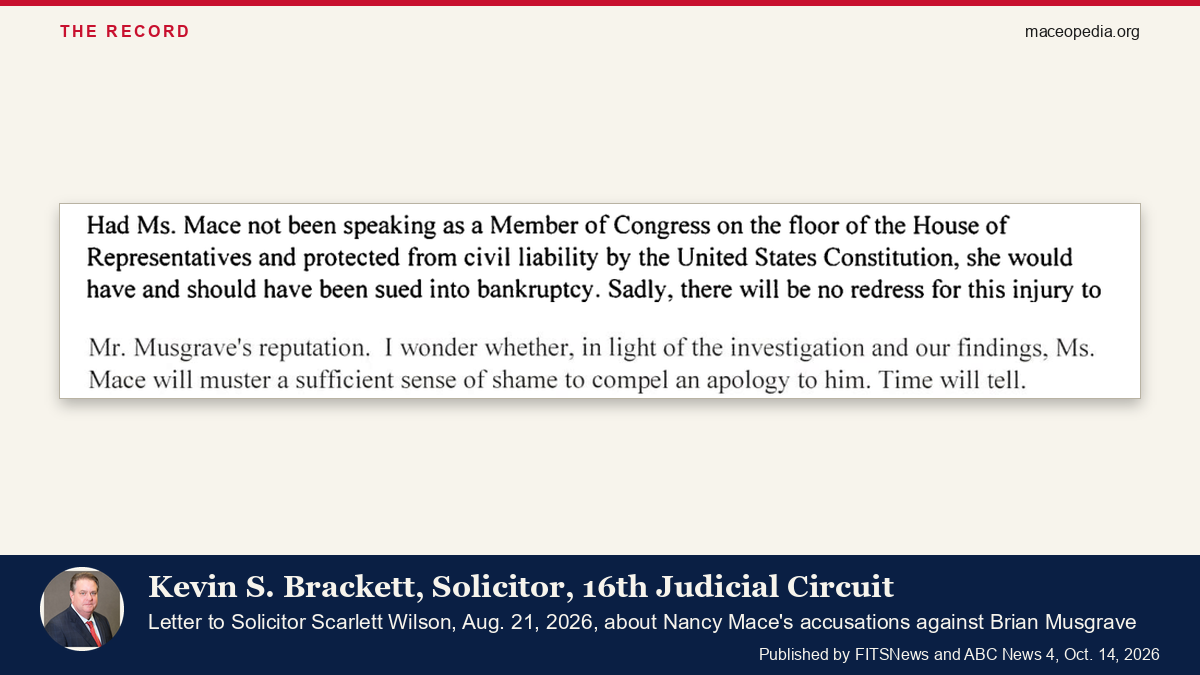
"She Would Have and Should Have Been Sued Into Bankruptcy": Three South Carolina Prosecutors on Nancy Mace's Accusations Against Brian Musgrave
Three of South Carolina's senior prosecutors reviewed the state investigation of Rep. Nancy Mace's accusations, and each wrote, in a letter now public, that her public accusations against Brian Musgrave lacked evidence. Ninth Circuit Solicitor Scarlett Wilson called them 'spurious claims' resting on 'the lack of even a scintilla of evidence' (Aug. 14, 2026). Fourteenth Circuit Solicitor Duffie Stone wrote that her statements 'branding Brian Musgrave a predator, a rapist, and a human trafficker are shocking' (Aug. 18). Sixteenth Circuit Solicitor Kevin Brackett wrote that 'there is not one speck of evidence' and that, had she not been protected by the Constitution, she 'would have and should have been sued into bankruptcy' (Aug. 21). FITSNews and ABC News 4 published the letters on Oct. 14, 2026. The letters are shown here. Musgrave has always denied the accusations. Mace has not retracted them.
 October 11, 2026 · Dispatch
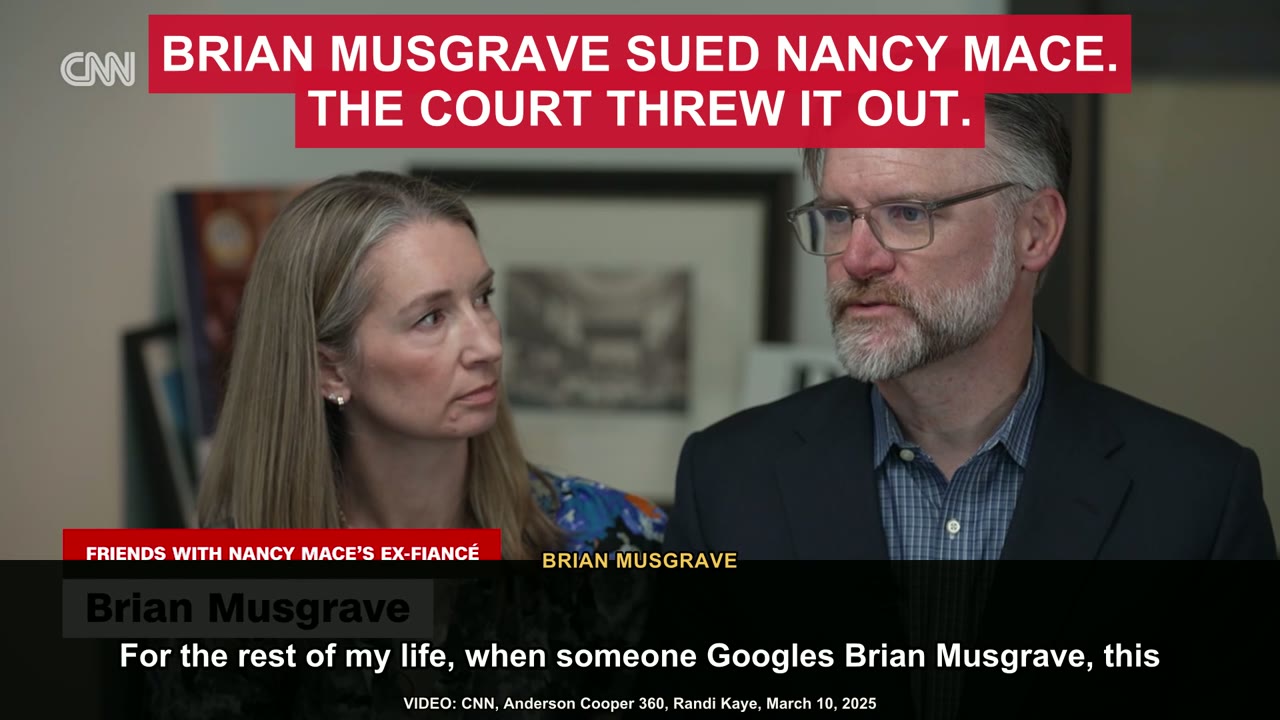
Brian Musgrave Sued Nancy Mace. The Court Threw It Out.
Brian Musgrave, one of the four men Nancy Mace named in her February 10, 2025 House floor speech, filed two defamation suits. The first, against Mace, was dismissed with prejudice on August 20, 2025 after the United States was substituted for her under the Westfall Act; the judge wrote that 'Plaintiff has no civil remedy to hold accountable persons he believes have defamed him' and that the court 'offers no opinion concerning the truthfulness or the lack of truthfulness' of her allegations. The second, against OAN's parent company and the Louder with Crowder podcast, produced a September 30, 2026 order: the parent company was dismissed without prejudice for lack of personal jurisdiction, and the podcast defendants won summary judgment because their statements were not susceptible to a defamatory meaning as to Musgrave. Neither court decided whether Mace's accusations are true. Musgrave denies them. Mace denies wrongdoing.
 October 7, 2026 · Dispatch
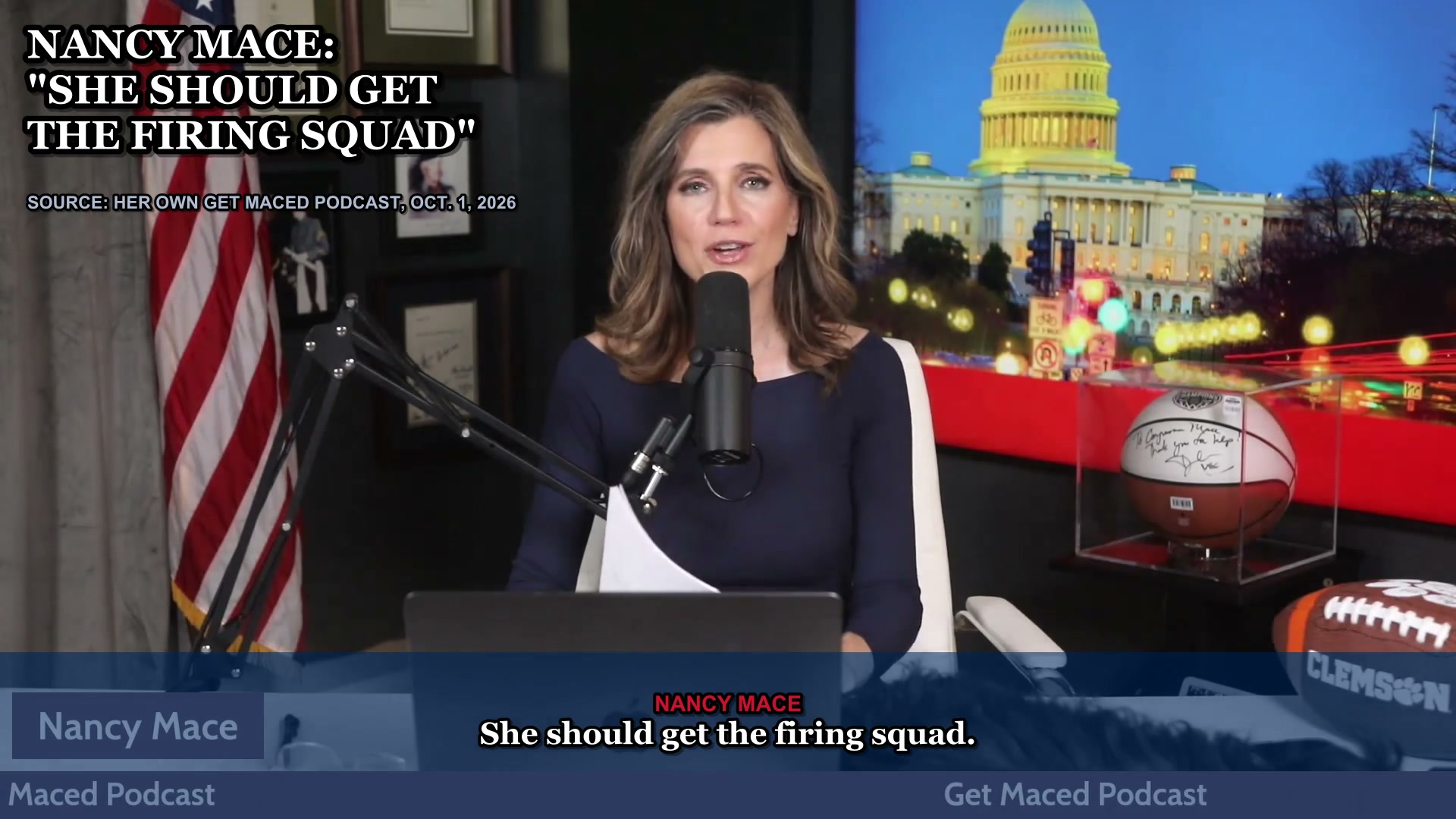
'She Should Get the Firing Squad': Nancy Mace Asks the South Carolina Legislature to Write a Death Penalty for One Untried Woman, Then Offers the Firing Squad to Lindsay Clancy
Two minutes into her October 1, 2026 Get Maced episode, Rep. Nancy Mace says she is 'begging the state legislature to make one exception' to South Carolina's death penalty for a Spartanburg County woman who has been charged with attempted murder and has not been tried: 'She should get the firing squad. We have that here.' She then offers the state's firing squad to Lindsay Clancy, a Massachusetts defendant whose trial is pending, and to an unnamed Tennessee defendant. The U.S. Constitution bars a state from passing a bill of attainder or an ex post facto law, so a death penalty written for one named person, after the alleged act, is not something any legislature can enact. Every quote here is verbatim from her own upload, checked against the audio. The woman she names is charged, not convicted. Her children are not named. Maceopedia reaches no conclusion about any defendant and assigns Mace no motive; the words are hers.
 October 1, 2026 · Dispatch
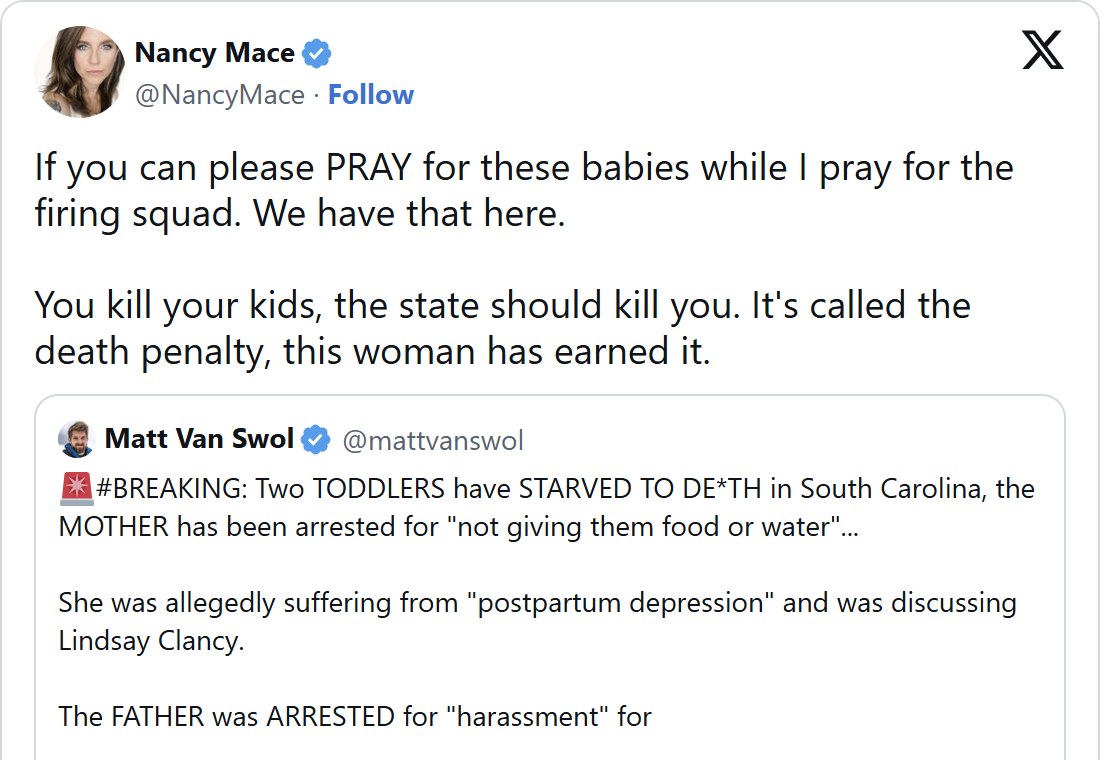
She Wants the Death Penalty for Women No Court Has Found Guilty: Nancy Mace Weighs In, Again, on a South Carolina Case She Has No Role In
On October 1, 2026, Rep. Nancy Mace posted on X that she is 'praying for the firing squad' for a South Carolina mother charged in the deaths of her two young daughters: 'You kill your kids, the state should kill you. It's called the death penalty, this woman has earned it.' The woman, Justine Marie May of Ladson, Charleston County, is charged, not convicted, has not been tried, and is presumed innocent. It was the second South Carolina child-death case in two days on which Mace publicly prejudged the defendant, after her September 30 House statement on a Spartanburg case ('This is not mental. This is criminal.') and one day after Lindsay Clancy's defense lawyer named her in a Massachusetts courtroom. Mace holds no charging, prosecuting, judging, or sentencing role in any of the three. Nothing here is a finding about any defendant's guilt or mental state, and nothing here assigns Mace a motive. The words are hers, in order. Readers can draw their own conclusions.
 September 25, 2026 · Dispatch
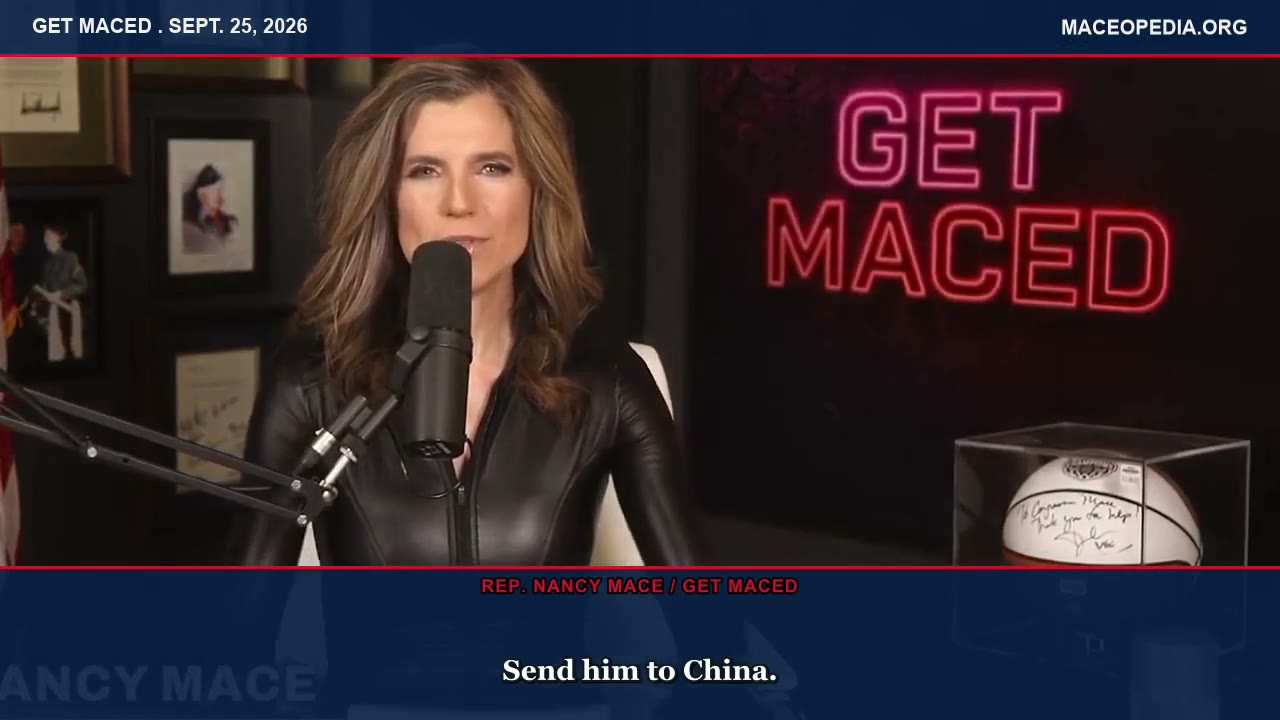
Mace Asks Why We 'Let In' a Guy Born in New Jersey
On the September 25, 2026 episode of her Get Maced podcast, Rep. Nancy Mace asked why the United States still 'lets in' the streamer Hasan Piker and said, 'Send him to China.' Piker was born in New Brunswick, New Jersey, in 1991. He is a natural-born US citizen. The member who built a national brand denouncing censorship as a First Amendment violation now wants a fellow American expelled over his politics.
 September 20, 2026 · Dispatch
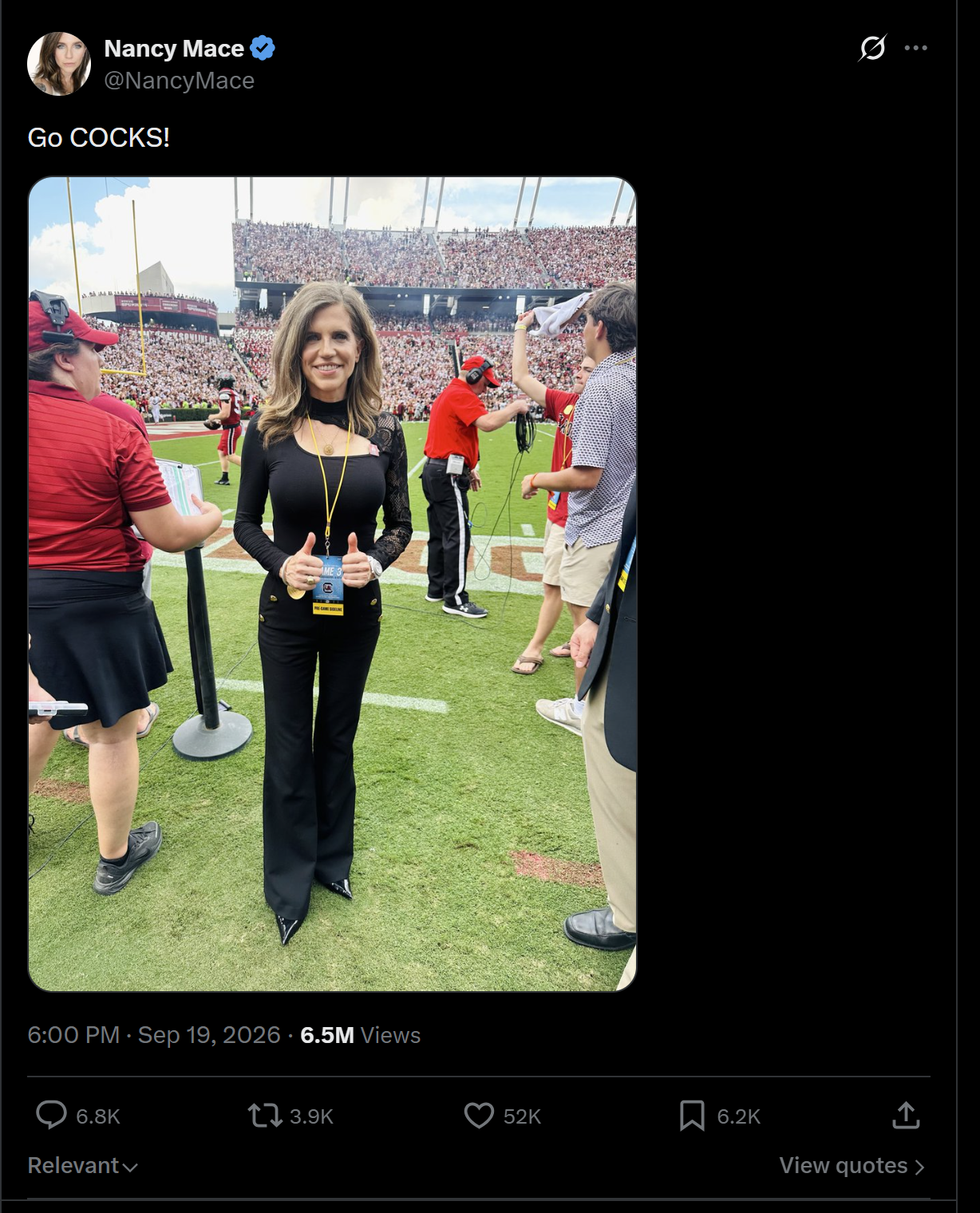
Nancy Mace's 'Go COCKS!' Post Buried Under Nearly 7,000 Replies, Overwhelmingly Mockery, After Black-Lace Gamecocks Cameo
Nancy Mace's 'Go COCKS!' post from the Gamecocks opener drew nearly 7,000 replies and more than 6.6 million views, the reaction overwhelmingly mockery of the black lace, the thumbs-up, and the timing, one day after she announced her DMs are closed. South Carolina lost 41-34 anyway.