Part of: Berg v. Bryant (and Bryant's Third-Party Complaint against Mace) · Assignment Desk Works, LLC v. Alexis Berg · Musgrave v. Mace (2:25-cv-01823-RMG) · Litigation Overview & Court-Filing Index
'To Simply Make Up a Legal Standard Is Inexcusable': Opposing Counsel Asks Court to Sanction Mace's Pro Se TRO Filing
In a March 5, 2026 response filed in ADW v. Berg, Assignment Desk Works' counsel Rene Dukes told a Charleston court that Rep. Nancy Mace's pro se emergency TRO motion cited a four-part legal standard that does not exist under South Carolina law, misrepresented a second case as supporting a doctrine it does not mention, and contradicted itself on whether an attorney-client relationship ever existed. Dukes asked the court to deny the motion and sanction Mace under Rule 11, the rule that requires any litigant, represented or not, to certify that a filing has good-faith legal and factual support.

When Assignment Desk Works, LLC filed its response to Rep. Nancy Mace's emergency motion for a Temporary Restraining Order, its counsel told the court in plain terms what she thought of the filing:
"to simply make up a legal standard is inexcusable."
That line, written by Rene Dukes of Saxton & Stump on March 5, 2026, targets the legal framework Mace cited in her pro se TRO motion, a four-part test she attributed to Scratch Golf Co. v. Dunes West Residential Props., Inc., a South Carolina Supreme Court case. According to Dukes, that case sets out a three-part standard; elements (3) and (4) in Mace's motion, that "the threatened injury to the movant outweighs the potential harm to the opposing party" and that "the injunction will not disserve the public interest", do not appear in Scratch Golf Co. or its progeny under South Carolina law.
Dukes devoted a separate section of the response to a second citation in Mace's motion. She wrote that Mace invoked In re Mt. Hawley Ins. Co. to support the argument that a "common legal interest" doctrine shielded the documents at issue, but, Dukes told the court, that case "does not even mention the common interest doctrine." A quick search of the South Carolina courts website, the response notes, would have shown as much in seconds. The response also identified a factual contradiction in Mace's own filing: Mace stated both that she "shared confidential information" with defense counsel in connection with seeking legal advice, and that defense counsel "improperly obtained" those very same materials, positions the response describes as mutually exclusive and unsupported by any detail.
Taken together, Dukes argued, the motion amounted to a violation of Rule 11 of the South Carolina Rules of Civil Procedure, which requires a pro se litigant's signature to certify that the filing rests on good ground and is not interposed merely to delay:
"Proposed Intervenor clearly filed her Motion to cause delay."
The response closes with a request that the court reject the TRO and impose sanctions:
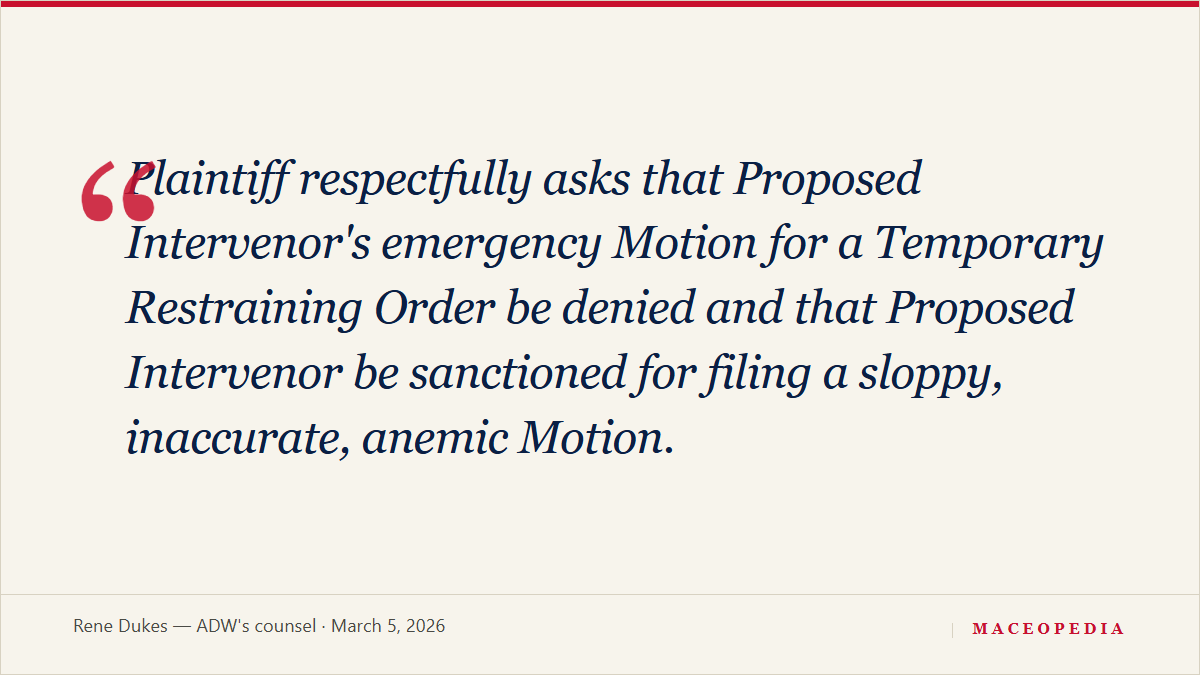
"Plaintiff respectfully asks that Proposed Intervenor's emergency Motion for a Temporary Restraining Order be denied and that Proposed Intervenor be sanctioned for filing a sloppy, inaccurate, anemic Motion."
The significance of the filing is this: Mace, a sitting member of Congress, filed a motion in her own name in a South Carolina state court, without an attorney, and opposing counsel told that court, on the record, that she invented a legal standard, misrepresented a case she cited, contradicted herself on a foundational privilege question, and filed the motion to obstruct the case rather than on the merits. That is the standard for Rule 11 sanctions, and ADW asked the court to apply it.
The filed response is reproduced in part below; the complete 11-page document is available here.
The response, as filed
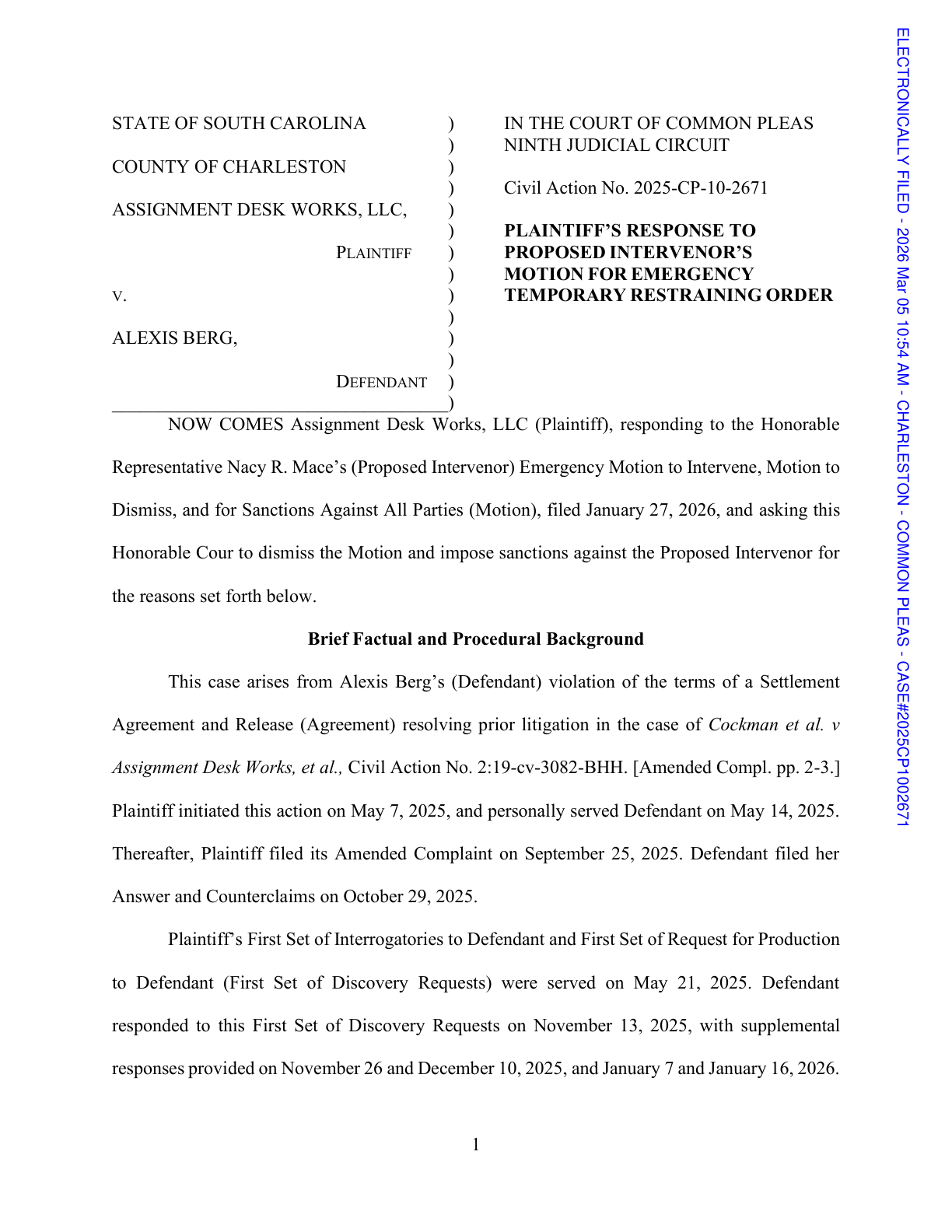 Page 1 of 11, the caption page: Assignment Desk Works, LLC v. Alexis Berg, Civil Action No. 2025-CP-10-2671, Court of Common Pleas, Ninth Judicial Circuit; electronically filed March 5, 2026.
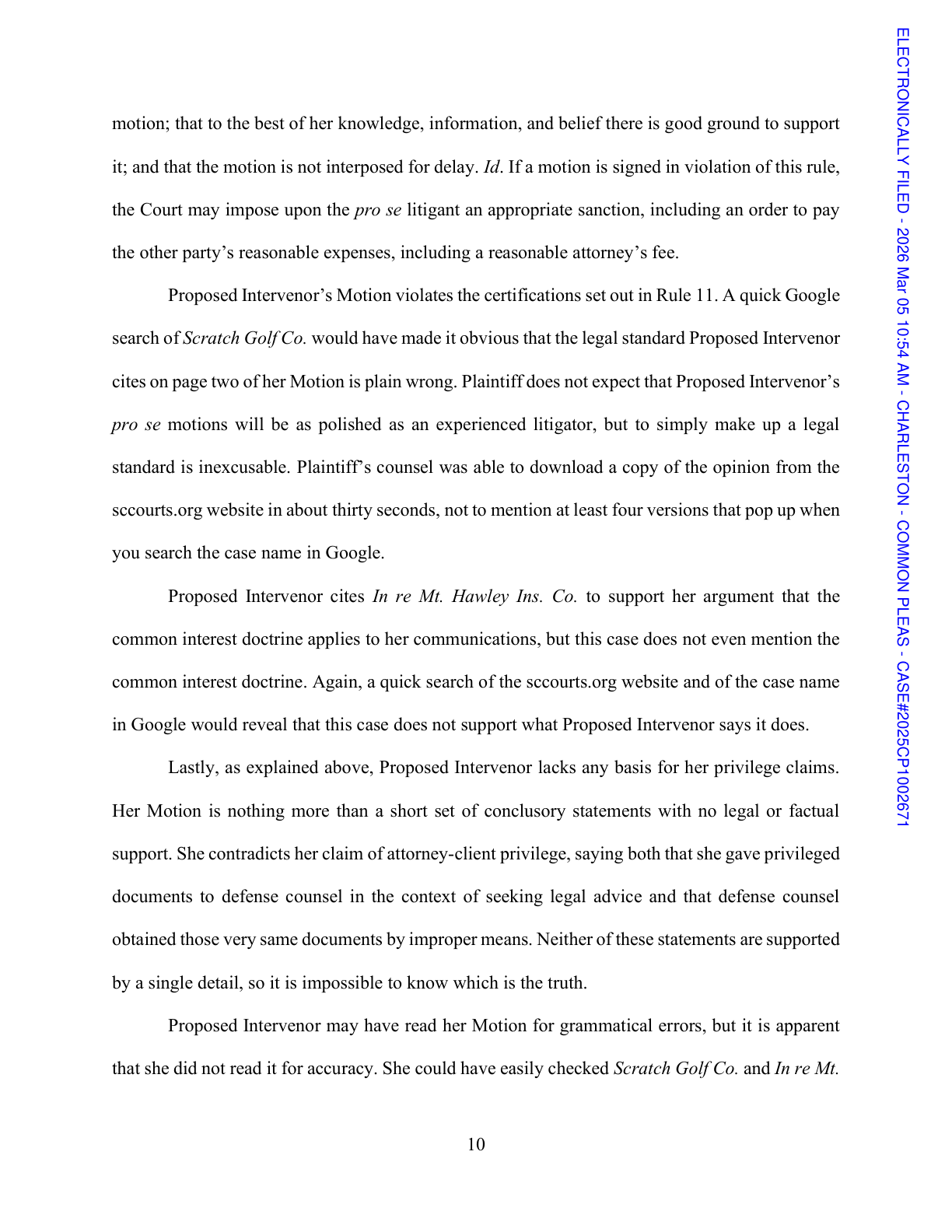 Page 10 of 11, the Rule 11 section: "Proposed Intervenor's Motion violates the certifications set out in Rule 11 … to simply make up a legal standard is inexcusable" and "this case does not even mention the common interest doctrine."
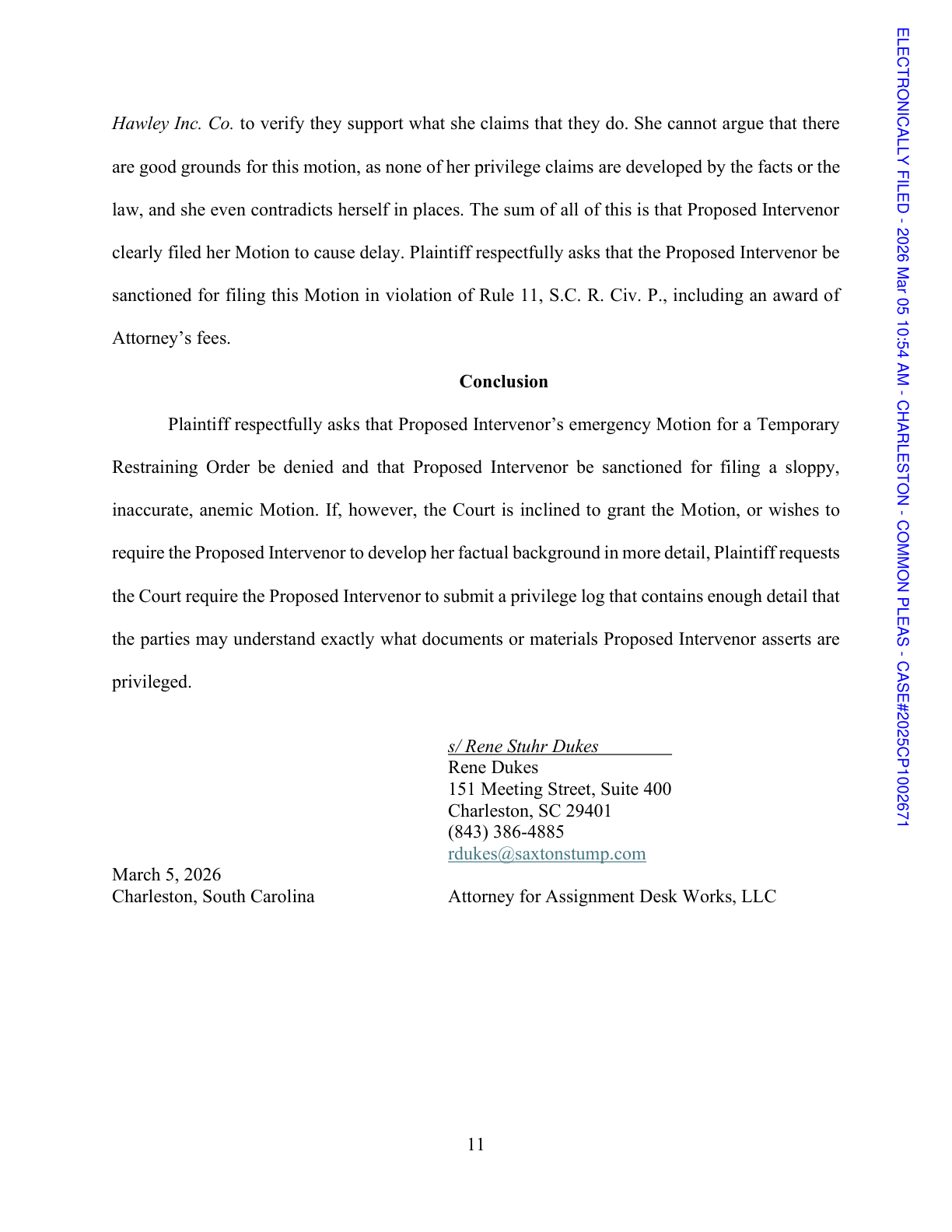 Page 11 of 11, conclusion and signature block: "Proposed Intervenor clearly filed her Motion to cause delay … sanctioned for filing a sloppy, inaccurate, anemic Motion"; signed by Rene Stuhr Dukes, Saxton & Stump, Attorney for Assignment Desk Works, LLC, March 5, 2026.
What the filing says
The dispatch summary above covers the substance. The filing is built around three related failures Dukes attributes to Mace's pro se TRO motion: a fabricated four-part legal standard (Mace cited a case that sets out only three parts), a misrepresented supporting case (Mace cited In re Mt. Hawley Ins. Co. for the common interest doctrine, a doctrine the case does not mention), and an internal factual contradiction on attorney-client privilege (Mace both voluntarily shared materials with counsel and claimed counsel improperly obtained them). Dukes argues the cumulative effect makes the motion a Rule 11 violation, and asks the court to impose sanctions including attorney's fees.
The arguments above are those of a party to the litigation, not findings of any court. The TRO motion, the sanctions request, and all underlying claims in ADW v. Berg remain contested; no court has adjudicated the merits. A South Carolina State Law Enforcement Division (SLED) investigation into related matters remains open. Rep. Mace and the other parties named in related litigation deny the allegations against them. For background on the parties, see People in the Public Record.
Sources & related coverage:
- The filing itself: Plaintiff's Response to Motion for Emergency Temporary Restraining Order (PDF, 11 pages), Rene Stuhr Dukes, Saxton & Stump, on behalf of Assignment Desk Works, LLC, Assignment Desk Works, LLC v. Alexis Berg, Charleston County Court of Common Pleas, Ninth Judicial Circuit, Civil Action No. 2025-CP-10-2671, electronically filed March 5, 2026.
- The state docket is verifiable on the SC Judicial Branch Public Index (Charleston County) under Case No. 2025-CP-10-2671.
- Case background: The Litigation
Read next
- February 2, 2026 · Dispatch
Opposing Counsel Tells Court Mace's Motion Is 'Intended to Delay This Litigation, Harass Plaintiff, Its Members, and Agents'
In a February 2026 court filing, ADW's counsel Rene Dukes argued that Rep. Nancy Mace had no legal standing to intervene in the ADW v. Berg breach-of-contract case and that her motion was frivolous, filed solely to harass and delay. Dukes also noted that Mace's filing invoked her own congressional floor speech, in which she had named private citizens who are members of the plaintiff.
 June 16, 2026 · Dispatch
Court appoints former Judge Kristi Harrington as third-party neutral to sort the 11,000+ disputed files in Mace's Google Drive
On June 16, 2026, Judge Donald B. Hocker appointed Kristi Harrington, a Charleston attorney and former South Carolina Circuit Court judge, to serve as a 'third-party neutral' in Assignment Desk Works, LLC v. Alexis Berg (Charleston County Court of Common Pleas, No. 2025-CP-10-2671), one of the cluster of cases tied to Rep. Nancy Mace and her former fiance, Patrick Bryant. Harrington's task is to review the more than 11,000 electronic files in what the court calls 'Mace's Google Drive,' files that both Mace and Bryant claim to own, and decide which, if any, must be turned over in discovery. The court split her fees between the two camps, warned the volume could make the process 'very cost-prohibitive,' and entered the order over Mace's objection. The order makes no finding on privilege, admissibility, ownership, or wrongdoing; the underlying allegations remain contested and unproven.
 June 8, 2026 · Dispatch
Gretchen Carlson, who helped write the Speak Out Act, files a sworn declaration backing Alexis Berg
On June 8, 2026, Alexis Berg's counsel filed a reply brief in Assignment Desk Works, LLC v. Alexis Berg (No. 2025-CP-10-2671) arguing that the federal Speak Out Act makes the non-disparagement clause ADW is suing on judicially unenforceable, because the dispute before the court involves sexual-assault allegations. Attached was a sworn declaration from Gretchen Carlson, the former Fox News anchor whose 2016 case helped inspire the Act, who states she has met with Berg and that 'this is exactly the situation we fought to address,' and offers to testify. ADW argues the Act does not apply. The motion is undecided; the underlying allegations are contested and denied.
 March 4, 2026 · Dispatch
For All the Accusations, 'Not One Woman Other Than Defendant Has Brought an Action Against Bryant, Including Mace'
In a two-page response filed March 4, 2026, ADW's counsel Rene Stuhr Dukes told a Charleston court that despite a coordinated effort by Ali Berg and Nancy Mace to level sexual-crime accusations against Patrick Bryant, no woman — including Mace herself — has filed a legal action against him. The filing is opposing counsel's argument, not a judicial finding; Bryant's denials and an open SLED investigation remain part of the record.
 February 10, 2026 · Dispatch
Bryant's Own Lawyer Alleges Mace 'Stole' His Phone and Hired a PI to Extract Its Data
In a public court filing, Patrick Bryant's attorney asserted in an email exhibit that Nancy Mace took Bryant's Samsung Galaxy S22 from his home and hired a private investigator to copy files off it. The allegations are unproven and contested; Berg's motion argues that Bryant's own pleadings directly contradict the account.
- January 27, 2026 · Dispatch
Mace Calls ADW's Breach-of-Contract Suit a 'Fishing Expedition,' Moves to Dismiss It, Despite Not Being a Party
On January 27, 2026, Rep. Nancy Mace, not a party to ADW v. Berg, a breach-of-contract case between her company and a former employee, filed an Emergency Motion to Intervene, seeking to dismiss the suit, impose sanctions on both sides' attorneys, and block all discovery. Mace signed the motion herself, as a pro se litigant, and certified that she had skipped the required meet-and-confer with opposing counsel because, in her judgment, it 'would not be productive.' ADW v. Berg is a civil case in Charleston County; no findings of fact have been made.